
6 minute read

Meet the Authors
Key Takeaways
What you need to know
As enterprises adopt AI, only 3% have established a unified, governed data layer, revealing a critical gap that must be addressed for successful AI integration.
Organizations must treat their data and AI strategies as one cohesive initiative to ensure that their AI deployments inherit a solid foundation of accurate and governed data.
Learning from proof of concepts is vital; successes are defined by insights gained rather than production outcomes, fostering a culture of continuous innovation and improvement in AI implementations.
Artificial Intelligence’s (AI’s) arrival in the enterprise came with the promise of a leap: a step-change moment where systems transform and decisions get faster almost overnight. Two years on, SAPinsider’s own benchmark research puts just 3% of organisations at a unified, governed data layer, the foundation most agentic AI work depends on. Seven accounts from SAP customers across insurance, retail, energy, food and beverage, fruit export and state government at the SAP NOW AI Tour described what closing that gap looks like in practice. It includes rebuilding process, data and accountability by hand, months before anyone lets AI near the result.
Prashant Shetty, Executive Manager – Digital Finance at IAG, put it plainly when explaining why the insurer did not simply move its finance function onto SAP S/4HANA when the opportunity arose. “If we are building an ERP system which is centered around finance, what does that actually look like?” he asked. The answer IAG reached was to stop and look at process and data first. It mapped more than 300 finance processes in SAP Signavio before touching the core system, then used what it found to cut 40% of its company codes, a decision that shrank the data migration before it started and cleared out legacy problems that had been compounding since the ECC days. “AI cannot drive value in itself,” Shetty said. “You need to have the right data and process in place to make sure that you’re getting the right toolsets.”
That sequencing, process and data before the platform, was not unique to IAG. It shows up across sectors as different as retail, energy, fruit export and state government, each arriving at a version of the same discipline from its own direction.
Explore related questions
Ask SAPi
The Unglamorous Half of The Ledger
Murtuza Imdadali, Head of SAP at Woolworths, drew the line between data work and AI work as tightly as Shetty. “Your AI strategy and data strategy should not be two separate initiatives,” he said. “The AI foundation is only as good as your data foundation.” Before any of that, Imdadali said, comes governance. “Understand the governance, the guardrails, and the security requirements. I think once you know the clear path to take, then it’s easy to go down there. Otherwise, you get roadblocked.”
Travis Smith, Principal SAP Enterprise Architect at SA Power Networks, described what earning trust in a retrieval system requires at the implementation level. Building a portal on a retrieval-augmented generation pattern grounded in the company’s own manuals meant getting the embeddings right and then going further. “We actually stored the page number where it found the embedding,” Smith said. “So not only when it goes to the source document, it actually highlights the text where it’s actually created that answer, which provides that trust and transparency to the business user.”
The same project also carried a lesson about failure. Smith counts several earlier proof of concepts that never reached production as successes rather than write-offs, because they built the tooling knowledge and developer confidence that let the eventual portal go from idea to live use inside a month. “As long as you’ve learned something from that, you’ve right-sized your investment,” he said, “the POC’s a success even if it didn’t go to production.”
At Zespri, the fruit exporter, Chief Digital Officer Dave Scullin has gone further than treating data as a supporting function. He has declined to build a standalone business case for it at all. “We don’t have a specific business case or case for change for our data platform,” Scullin said. “We couple this whole data strategy and the implementation of data products with our longer-term transformation program.” The return on that bundled investment is not hypothetical. Scullin credited real-time modelling on Zespri’s SAP IBP solution and SAP S/4HANA foundations with saving the business $15 million last year on a single decision, diverting two ships from China to Europe and understanding the impact on growers’ orchard gate returns before committing. He also expects the roles doing this work to keep changing. Traditional report writing is fading as a skill in demand, he said, while people who combine SAP application knowledge with data engineering, or who can trace a process end to end and find where it breaks, are becoming the valuable hires. “The good old days of business process reengineering are coming back,” Scullin said.
Where The Trust Actually Breaks
If foundations describe the plumbing, these businesses were equally focused on what happens once people start turning the taps.
Matt Dixon, Digital & IT Director at Suntory Oceania, holds his suppliers to the same scrutiny as internal efforts. Coming up for renewal with one of Suntory’s service providers, he has been pressing for a specific answer rather than a general one. “Where is your AI-led thinking around how this is going to evolve over the next three years?” he asked. So far, the answer has not satisfied him. “I’m still not seeing a positive story from some of the big service providers in that space yet about what is happening in terms of evolution around managed services and how AI is going to disrupt that,” Dixon said.
Simon Williams, General Manager B2B Digital Engagement at Metcash is applying the same scrutiny to his own vendors. Williams’ team pushed a search and personalisation partner to defend its work in P&L terms rather than engagement metrics alone. “It’s very good to talk to me about click ranking and relevancy,” he said. “But if we’re really serious here, let’s talk about how we demonstrate real P&L benefit through the investments that we make.” The metrics his team settled on, frequency of purchase and average order value, became the basis of the business case rather than a headline conversion number. “That was a very clear P&L decision,” Williams said. ” We’ve now created a way of working that supports that, so that it was never a set and forget.”
The anecdote that best captures how far governance paperwork has already been touched by the technology it is meant to constrain came from Paul Hesford, Deputy Chief Finance Officer – Digital Transformation at Transport and Main Roads in Queensland (TMR). TMR put its SAP AI deployment through the state’s ethical assessment process before going live with Copilot even writing the assessment.
He is also unconvinced by the phrase most of the industry has settled on for oversight. “The human in the loop phrase doesn’t sit very well with me,” he said, describing a conversation with a mentor that reframed his thinking toward what the University of Queensland calls human-controlled AI, language that puts the decision, and the accountability for it, back with the person rather than the system. TMR has since gone live with AI-assisted resume ranking on that basis. “If you’re in front of the Industrial Relations Commission, you won’t be blaming AI,” Hesford said. “You are the owner of that decision.” The department also ran its existing data through Syniti’s profiling tool ahead of its upgrade, surfacing more than 200 recommendations and giving Hesford, in his words, “a grounded truth” to work from rather than an assumption that AI would fix data problems on contact.
Where This Connects
The pattern these seven organisations describe lines up with what SAP itself measured in the Value of AI Report 2026, and with the findings in SAPinsider’s own benchmark research. Just 22% of Australian businesses consider themselves ready to govern AI, and SAPinsider’s data puts only 3% of organisations at a unified, governed data layer. The Value of AI Report 2026 also found nearly half of Australian organisations rolling out AI agents faster than they can standardise and govern them, and 43% with no human-in-the-loop process defined at all. The seven organisations in this story sit on the other side of that statistic. IAG’s process mapping, TMR’s data profiling and Smith’s page-number citations are what closing the gap looks like in practice, done ahead of a framework rather than waiting for one to arrive.
What This Means for SAPinsiders
Treat the data program and the AI program as one initiative, not two. Imdadali’s warning against separating AI strategy from data strategy and Scullin’s refusal to write a standalone business case for Zespri’s data platform both point the same way: fund and govern the work together or the AI layer inherits every gap in the data underneath it.
Treat proof of concepts foremost as learning experiences. Smith’s account of SA Power Networks reaching a month-long build only because of earlier projects that never shipped is a case for measuring a POC by what it teaches a team, not by whether it reaches production.
Set accuracy standards at the task level, because the first wrong number is the only chance a system gets. Williams built his business case on frequency of purchase and average order value rather than a headline conversion figure, and Dixon is pressing suppliers for the same specificity. Organisations that settle for one standard everywhere either block work that could tolerate more variance or ship errors that cannot. And whether trust is built through Smith’s cited page numbers, Hesford’s Syniti-driven data profile, or Shetty’s process mapping before migration, every account converges on the same point: confidence lost early is difficult to earn back.
More Resources
See All Related Content
The Mandatory Transformation Your Business Didn’t Choose Could Be Its Biggest OpportunityThe mandatory migration to S/4HANA, often viewed as a disruption, can be transformed into a strategic opportunity through Lemongrass's Brightfield approach, which integrates AI from the onset to streamline the process, reduce costs, and unlock business value before go-live.

From Data Warehouses to Data Fabric: What SAP Business Data Cloud Really Means for Your EnterpriseThe article discusses the modern challenges of enterprise data management in large organizations, emphasizing the transition from traditional data warehouses to a more integrated, AI-ready data fabric framework facilitated by SAP Business Data Cloud, while addressing common issues such as technical debt, data extraction strategies, and the necessity for alignment between IT and business perspectives.
6 minute read

Rethinking SAP Modernization: The Shift from AI Later to AI NowThe article discusses the urgent shift in SAP transformation strategies from a sequential modernize-migrate-innovate approach to an 'AI First, AI Now' paradigm that prioritizes immediate AI-driven value creation amidst complex legacy systems.
3 minute read
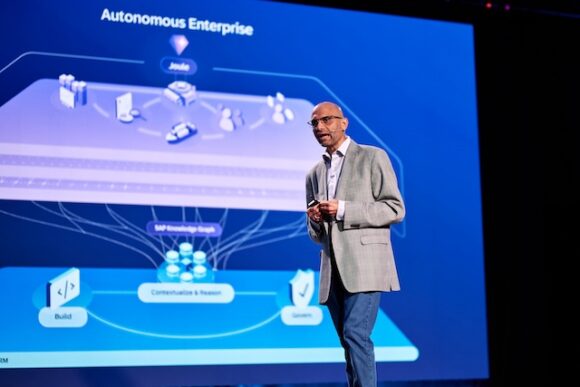
SAP Pushes the Autonomous Enterprise from Vision to Reality, But Customer Adoption Remains EarlyAt SAP Connect 2026, the company presented its Autonomous Enterprise vision, showcasing advancements in AI-driven business processes while acknowledging that widespread adoption remains limited and emphasizing the need for foundational data readiness and robust governance frameworks for successful implementation.
6 minute read