
1 minute read
Meet the Experts
Key Takeaways
What you need to know
SAP's Autonomous Enterprise vision is evolving into a production reality.
The emphasis on governance and compliance during SAP Connect highlights that successful enterprise AI adoption requires more than technology.
While SAP's Autonomous Suite promises advanced capabilities, broad-scale adoption remains limited primarily to mature organizations.
At SAP Connect 2026, SAP’s message was that the future of enterprise software is the Autonomous Enterprise. Five months after unveiling the Autonomous Enterprise vision at Sapphire 2026, SAP used its Las Vegas event to demonstrate that the concept has moved beyond vision and into production environments. However, beneath the demos and customer success stories was the reality that, while the technology appears increasingly capable, broad-scale adoption remains in its infancy. In addition, many organizations are still waiting for these capabilities to become available, practical, and proven within their own environments.
The Autonomous Enterprise Takes Center Stage
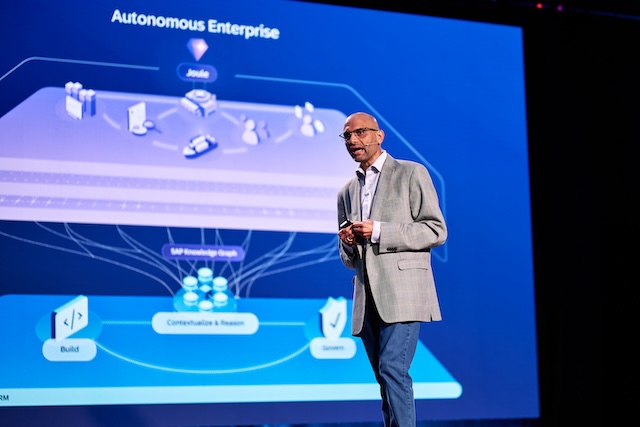
The keynote was built almost entirely around the concept that enterprise software is entering a new era in which AI assistants and agents will increasingly execute business processes on behalf of users. SAP executives repeatedly emphasized that Joule, which is now far more than a co-pilot or generative AI assistant, and the broader Autonomous Suite represent a fundamental shift from traditional applications to systems capable of reasoning, recommending, and eventually acting autonomously.
CEO Christian Klein framed the discussion around that of business context, what SAP sees as their core advantage in the AI era. While commonly used frontier models can produce answers, SAP argues that enterprise AI must understand processes, governance requirements, master data relationships, and industry-specific rules. Throughout the keynote, multiple speakers stressed SAP’s ability to leverage decades of ERP knowledge, an ontology built from millions of data fields and hundreds of thousands of tables, and deep process understanding across industries.
Explore related questions
Ask SAPi
SAP announced that more than 20 AI assistants and over 200 agents are now generally available, with plans to exceed 400 agents by year end. The company also highlighted Joule Work as a new interaction layer intended to replace traditional application-centric user experiences with conversational interfaces and agent-driven workflows.
SAP’s strategic message is clear. The Autonomous Suite is no longer an experimental capability. It is the future operating model for SAP customers.
Customer Stories Showcase Progress, But Also Reveal How Early the Market Remains
To demonstrate momentum, SAP brought several customers on stage, Novartis, Morgan Foods, and Nestlé.
These stories provided useful examples of how the company envisions the Autonomous Suite delivering value across sourcing, supply chain, finance, and workforce management. However, the examples also highlighted a broader truth: many of the showcased organizations are long-standing SAP customers that have already completed substantial ERP and cloud transformation efforts.
For example, Nestlé’s accounts receivable automation story was explicitly built atop a recently completed global SAP S/4HANA transformation spanning more than 140 countries. Morgan Foods emphasized that its AI ambitions are possible because years of foundational work created consistent data and connected business processes. Novartis described its sourcing assistant initiative as a pilot that is still in the early stages of deployment.
While these examples validate SAP’s direction, they also underscore how much work remains before autonomous operations become commonplace across SAP’s broader customer base.
The Availability Question Continues to Follow SAP
Several questions at a Q&A session that followed the event keynote focused on the gap between SAP’s ambitious messaging and the realities facing most customers. For example, question specifically noted that SAP’s autonomous enterprise narrative appears targeted toward leading-edge organizations and asked what the journey looks like for more traditional companies still operating on-premises or running older environments.
Klein acknowledged this challenge directly. He reiterated SAP’s commitment not to leave any customers behind, and referenced APIs and integration approaches designed to help those organizations accelerate their journeys. However, he also made clear that the most advanced capabilities are fundamentally tied to SAP’s cloud strategy and the platform services underpinning the autonomous architecture.
The exchange highlighted an issue SAP continues to face. While the company speaks confidently about autonomous workflows, ontology layers, and agent-driven business execution, many customers remain focused on the question of when these capabilities be broadly available and realistically deployable in their environments.
Governance Becomes a Core Part of the Message
Another major theme for the event was governance. Speakers across the event reinforced the message that enterprise AI success will be determined not only by model quality but by governance, compliance, and trust.
The discussion became even more prominent during the analyst Q&A, where participants questioned executives about security concerns and the implications of autonomous agents making decisions within enterprise systems. SAP leaders responded by outlining detailed governance frameworks, treating agents as managed identities and stressing continuous monitoring, auditability, and bounded permissions.
This emphasis reflects an important shift in SAP’s positioning. Earlier discussions around enterprise AI often focused on productivity gains and automation. At Connect, SAP spent nearly as much time discussing governance as it did discussing automation itself. The underlying message is that autonomy without governance is not enterprise-ready.
From Features to Agents
One of the more significant strategic announcements emerged during the Q&A when Klein described a broader change in SAP’s product development philosophy.
Rather than continuously adding application features, SAP increasingly intends to solve business problems through AI agents. Klein suggested that future innovation will move away from traditional UI enhancements and transactional features toward agent-based experiences built on SAP’s business processes and data models. This does not necessarily mean that SAP will stop innovating in its core solutions, but more of those innovations may be directly connected to new features being implemented in AI assistants and agents.
For customers, this could represent a profound change in how SAP applications evolve. It also reinforces the importance of SAP’s underlying platform and business context strategy. If agents become the primary interface for executing work, then ownership of process knowledge and transactional systems becomes significantly more valuable.
What This Means for SAPinsiders
SAP Connect 2026 demonstrated that SAP has fully aligned its AI strategy around the Autonomous Enterprise vision first outlined at Sapphire. The company now has customer references, generally available assistants and agents, and a comprehensive narrative built around business context, governance, and agent-driven execution.
At the same time, the event highlighted a gap between vision and widespread adoption. Most of the showcased success stories came from large, highly mature SAP customers that have already completed major cloud and transformation initiatives. While those organizations are proving what is possible, many customers are still determining when these capabilities will be generally available and what will be required from a technology and license standpoint to deploy and use them.
For SAPinsiders, the message is that the Autonomous Enterprise is no longer a future concept, but it is also not yet a mainstream reality. Organizations should focus less on chasing the latest AI announcements and more on building the foundational capabilities that will allow them to take advantage of autonomous processes as they mature.
- Focus on data and process readiness before AI readiness. A consistent theme throughout both the keynote and customer presentations was that successful autonomous initiatives depend on clean data, standardized processes, and modernized ERP environments. The organizations SAP highlighted were not successful because they deployed AI first. They were successful because they had already completed years of transformation work that created the foundation necessary for autonomy. This makes it crucial to prioritize data quality, process harmonization, governance, and ERP modernization initiatives. Organizations that are still struggling with fragmented processes or inconsistent data will find it difficult to realize meaningful value from autonomous agents, regardless of how sophisticated the technology becomes.
- Start experimenting with autonomous capabilities where that is possible. Although autonomous operations are still in the early stages, organizations should not wait for the technology to fully mature before beginning their evaluation efforts. The most successful adopters are already identifying targeted use cases in areas such as sourcing, finance, supply chain, and employee services where AI assistants and agents can augment existing workflows. Start by establishing structured pilot programs, identify low-risk business processes suitable for automation, and develop internal expertise in AI governance and agent management. Early experimentation will help organizations understand both the opportunities and limitations of autonomous processes before large-scale adoption becomes necessary.
- Build governance frameworks now. One of the strongest messages from SAP Connect was that governance, security, and trust are as important as the AI technology itself. As agents move from providing recommendations to executing actions, organizations will need clear policies governing oversight, accountability, permissions, compliance, and risk management. Every organization should begin developing governance frameworks today rather than waiting for large-scale autonomous deployments. Organizations that establish controls, monitoring capabilities, and clear operating models now will be far better positioned as autonomous capabilities become more widely available across the SAP portfolio.
The most important takeaway from SAP Connect is that SAP is demonstrating that autonomous business operations are becoming achievable for a growing number of customers, even if adoption today remains concentrated among large enterprises that have already invested heavily in transformation.
The next 12 to 24 months will determine whether the Autonomous Suite evolves from a compelling vision supported by a handful of showcase customers into a broadly adopted operating model across the SAP ecosystem. Until then, SAPinsiders should view autonomy as both a strategic destination and a readiness challenge, focusing on the foundational investments that will allow them to capitalize on the technology when it reaches their organization.
More Resources
See All Related Content
ERPs as Enablers Not EndpointsMany organizations treat ERP implementations as the finish line, only to discover that technology alone does not deliver transformation. This paper explores how leading organizations turn ERP investments into lasting business value through governance, process change, organizational alignment, and a relentless focus on outcomes.

From Data Warehouses to Data Fabric: What SAP Business Data Cloud Really Means for Your EnterpriseThe article discusses the modern challenges of enterprise data management in large organizations, emphasizing the transition from traditional data warehouses to a more integrated, AI-ready data fabric framework facilitated by SAP Business Data Cloud, while addressing common issues such as technical debt, data extraction strategies, and the necessity for alignment between IT and business perspectives.
6 minute read

How CTOs Can Choose the Right GenAI Partners at the Right TimeOrganizations aiming to succeed in GenAI must develop a strong partner network, as evidenced by BCG and AWS's survey indicating that 75% see partners as key to ROI, with distinct partner strengths needed at various phases of the GenAI journey to achieve operational efficiency and revenue growth.
1 minute read

Qorelo and AdEx Partners Team Up to Bring AI-Native Consulting to SAP Transformation ProgramsAdEx Partners and Qorelo are redefining SAP transformations by integrating AI into consulting workflows, which reduces manual tasks, accelerates projects, and enhances client outcomes, as discussed in a conversation between their CEOs.
1 minute read