8 minute read

Meet the Authors
Key Takeaways
What you need to know
SAP ERP 6.0 keeps running after 2027, but SAP's support obligations narrow in two stages.
Customer-specific maintenance continues the contract while dropping legal changes and new support packages.
SAP's July 2026 commitments let companies set support choices for each commercial installation.
SAP ERP 6.0 doesn’t stop working when mainstream maintenance ends in 2027. What changes is how much SAP does to keep it current. Under SAP’s maintenance strategy, Business Suite 7 customers can choose extended maintenance from the start of 2028 through the end of 2030. Customers that don’t choose it, or whose extended maintenance has ended, move to customer-specific maintenance. Each stage moves more of the work of keeping the system compliant, secure, and technically current onto the customer.
Extended Maintenance Continues Support Without New Development Through 2030
Extended maintenance is the smaller of the two changes. SAP’s Release and Maintenance Strategy describes its scope as similar to mainstream maintenance, at an additional fee. SAP’s training material states that it does not add new features, functions, or enhancement packages.
In practice, SAP keeps supporting ECC without developing it further. The functionality SAP offers for ECC at the end of 2027 is what companies will work with until they move.
Explore related questions
Ask SAPi
Customer-Specific Maintenance Continues the Contract With a Narrower Service
The bigger change comes when a system enters customer-specific maintenance. SAP says the move happens automatically and that support continues with restrictions: no new support packages, no updates for legal changes, and limited technology updates. Problem resolution also becomes customer specific, which SAP says means customers are charged for solving problems not yet known to SAP.
Security and technology coverage narrow as well. SAP’s commitment to fix new high-severity security vulnerabilities applies to releases in mainstream and extended maintenance. SAP defines technology updates as those that keep software compatible with new database, operating system, and browser versions, so limits there affect the stack beneath the ERP.
Compliance, Security, and Stack Work Shifts to the Customer
Regulatory change continues on its own schedule. In Germany, mandatory B2B e-invoice issuance extends to all businesses in January 2028, after larger businesses begin in January 2027. Once a system is on customer-specific maintenance, SAP no longer delivers legal changes to that release. Meeting rules like these then becomes the customer’s job, whether through internal development, a partner, or a separate solution.
Security and infrastructure follow the same pattern. Companies need their own monitoring and controls, with documentation that auditors can review, and someone tracking database and operating system lifecycles against the ERP release.
SAP’s contract terms changed in July 2026, and the change affects how companies can divide this work. Under maintenance and support commitments effective July 10, 2026, customers can choose a different SAP support model, a different provider, or no support for each commercial installation. SAP has also waived its reinstatement fee and capped back-maintenance payments. Within those published terms, end of support no longer has to be handled the same way across an entire landscape.
What This Means for SAPinsiders
Mapping support stages early creates planning time. Customer-specific maintenance begins automatically for systems without extended maintenance and covers less than current support. Knowing which installations will enter it, and when, gives teams room to arrange coverage for what SAP stops delivering.
Clear ownership keeps legal and security updates on track. Once SAP stops delivering these updates, an internal team or a provider can take them on. Settling that responsibility early helps regulatory deadlines arrive as planned work instead of emergency projects.
Contract-specific terms give compliance teams a firm footing. SAP’s published security-fix commitment covers mainstream and extended maintenance, and the formal scope of customer-specific maintenance sits in an SAP Note. Confirming the terms for each installation gives security, audit, and compliance teams a reliable basis for planning.
More Resources
See All Related Content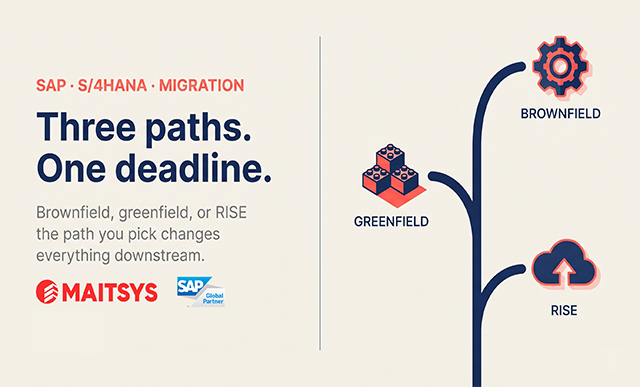
ECC to S/4HANA: Brownfield, Greenfield, or Selective Data Transition?To effectively transition from SAP ECC to S/4HANA, organizations must separately decide on their system transformation approach—whether through system conversion, new implementation, or selective data transition—and their operational model, with RISE with SAP primarily addressing the latter.