6 minute read
Key Takeaways
What you need to know
AI-driven SAP Custom ABAP Object Analysis helps enterprises identify which custom ABAP objects are still used, which add upgrade and security risk, and which can be retired, making SAP Clean Core decisions faster and more accurate.
Manual ABAP code reviews, spreadsheets, and SME interviews no longer scale in mature SAP ECC and S/4HANA systems because they cannot reliably prove business value, usage frequency, dependencies, or redundancy across thousands of custom objects.
For SAP teams, modernization, and S/4HANA migration projects, the real shift is from deleting all custom code to categorizing it as retain, refactor, or retire so technical debt becomes measurable and Clean Core planning becomes business-driven.
Every mature SAP system tells a story that’s written in custom ABAP !!!
Over years of enhancements, regulatory changes, integrations, and urgent business requests, custom code quietly becomes the backbone of daily operations. It also becomes the biggest obstacle to SAP Clean Core.
The problem is not customization itself. The problem is lack of clarity. Most organizations know they have custom code. Very few know which objects still matter, which ones quietly add risk, and which should no longer exist.
Explore related questions
Ask SAPi
This is why SAP Custom ABAP Object Analysis must evolve from developer-led assessment to AI-driven decision intelligence.
The Reality of Undocumented ABAP in Enterprise SAP Systems
In long-running ECC and early S/4HANA systems, undocumented custom ABAP is the norm, not the exception. Several structural reasons contribute to this:
- Enhancements were created to meet immediate business deadlines
- Original developers left, vendors changed, or teams were restructured
- Functional ownership shifted without technical realignment
- Custom code survived multiple upgrades without revalidation
Over time, SAP systems accumulate:
- Custom reports no longer actively used
- Z-programs embedded in critical processes with unclear logic
- Enhancements overlapping standard SAP functionality were introduced later
- Interfaces supporting integrations that no longer exist
Static code repositories can list objects, but they do not explain intent, usage, or business dependency.
Why Clean Core Fails When Decisions Are Manual
Clean Core initiatives often stall because organizations approach them as technical cleanup exercises. Traditional methods rely on workshops, spreadsheets, and SME interviews to decide the fate of custom code.
This approach breaks down at scale.
Manual analysis struggles with:
- Large object volumes across modules
- Cross-functional dependencies
- Inconsistent usage patterns
- Subjective assessments of business value
As a result, teams default to safe choices:
- Let’s keep it for now
- We might need this later
- Removing this feels risky
Ironically, this caution preserves the very technical debt Clean Core is meant to eliminate.
Business Value is Contextual, and Hard to Prove Manually
Determining business value is not about code quality. It is about impact.
A technically clean ABAP object may be irrelevant today. A poorly written enhancement may still support a revenue-critical process. Manual reviews rarely capture this nuance because they lack access to correlated data points such as:
- Execution frequency
- User behavior
- Process touchpoints
- Functional overlap with standard SAP
Without this context, decisions are opinion-driven rather than evidence-based.
How AI Reframes SAP Custom ABAP Object Analysis
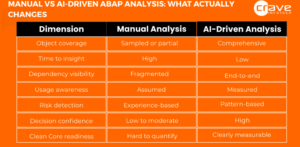
AI introduces a fundamentally different approach to ABAP analysis. Instead of reviewing code in isolation, AI evaluates custom objects as part of a living system.
AI-driven analysis can combine:
- Static code characteristics
- Runtime usage patterns
- Dependency networks
- Redundancy detection
- Risk indicators for upgrades and compliance
This allows AI to surface insights humans cannot realistically assemble at scale.
Rather than asking “Is this code well written?”, AI helps answer:
- Is this code still used?
- Does it deliver unique business value?
- Does it increase upgrade or security risk?
Is it replaceable by standard SAP or BTP services?
Clean Core Requires Categorization, Not Elimination
Clean Core does not mean “remove all custom code.” It means intentional customization.
Effective Clean Core strategies classify custom objects into clear categories:
- Retain: High business value, low risk
- Refactor: Valuable but technically misaligned
- Retire: Obsolete, unused, or redundant
AI enables this classification objectively. It removes emotion, bias, and fear from the process.
CoreAssess.AI: Turning Analysis into Modernization Strategy
CoreAssess.AI is built to support Clean Core decision-making, not just ABAP inspection. It translates technical complexity into executive-ready insights.
With CoreAssess AI, organizations can:
- Discover and classify all custom ABAP objects
- Identify hidden technical debt
- Quantify Clean Core readiness
- Prioritize remediation efforts
- Align modernization plans with business impact
Instead of reacting during upgrades or migrations, teams gain a forward-looking roadmap.
Technical Debt Becomes a Measurable Risk
Technical debt in SAP is often invisible until it Blocks progress—during S/4HANA conversion, cloud adoption, or integration expansion.
AI-driven SAP Custom ABAP Object Analysis makes technical debt measurable. It allows organizations to:
- Track debt reduction over time
- Justify modernization investments
- Reduce upgrade effort and downtime
- Improve compliance and security posture
Most importantly, it transforms Clean Core from a theoretical goal into an executable plan.
Conclusion
SAP Clean Core is not achieved by deleting code. It is achieved by making informed decisions at scale.
AI-powered ABAP analysis gives enterprises the clarity they have been missing—clarity about value, risk, and relevance. In a landscape where custom code defines both strength and fragility, that clarity is no longer optional.
Frequently Asked Questions
- What is SAP Custom ABAP Object Analysis?
SAP Custom ABAP Object Analysis is the process of evaluating custom ABAP programs, enhancements, and objects to understand their usage, dependencies, risk, and business relevance. It helps organizations decide which custom code should be retained, refactored, or retired as part of SAP Clean Core and modernization initiatives.
- Why is SAP Custom ABAP Object Analysis critical for Clean Core?
Clean Core requires minimizing unnecessary customizations without disrupting business operations. ABAP object analysis provides visibility into undocumented and legacy custom code, helping enterprises reduce technical debt while protecting business-critical functionality during S/4HANA migrations and upgrades.
- How does AI improve SAP Custom ABAP Object Analysis?
AI enhances ABAP analysis by combining static code review with usage data, dependency mapping, and pattern recognition. This allows organizations to identify redundant, unused, or high-risk custom objects and make data-driven decisions instead of relying on assumptions or manual assessments.
- Can AI-driven ABAP analysis replace manual code reviews?
AI does not eliminate the need for manual reviews but significantly reduces their scope. It prioritizes which ABAP objects require attention, enabling teams to focus manual effort on high-impact decisions rather than reviewing thousands of low-value or unused objects.
- How does SAP Custom ABAP Object Analysis help reduce technical debt?
By identifying obsolete, redundant, and risky custom code, ABAP object analysis enables organizations to systematically retire or refactor low-value customizations. This reduces technical debt, simplifies future upgrades, and improves overall SAP system stability and Clean Core readiness.
More Resources
See All Related Content
The Mandatory Transformation Your Business Didn’t Choose Could Be Its Biggest OpportunityThe mandatory migration to S/4HANA, often viewed as a disruption, can be transformed into a strategic opportunity through Lemongrass's Brightfield approach, which integrates AI from the onset to streamline the process, reduce costs, and unlock business value before go-live.

S/4HANA navigation path: Standard project support during and post go-liveMigrating to SAP S/4HANA is a complex, ongoing process that requires careful dual maintenance and robust support for both legacy and new systems, with variations in support models depending on whether a cloud or on-premises approach is taken.
7 minute read
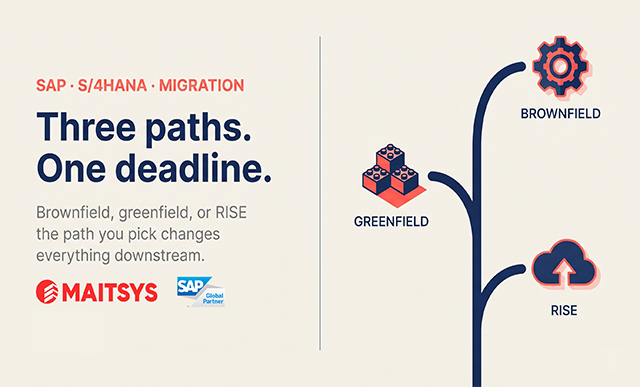
ECC to S/4HANA: Brownfield, Greenfield, or Selective Data Transition?To effectively transition from SAP ECC to S/4HANA, organizations must separately decide on their system transformation approach—whether through system conversion, new implementation, or selective data transition—and their operational model, with RISE with SAP primarily addressing the latter.
8 minute read