
1 minute read

Meet the Authors
Key Takeaways
What you need to know
A global protein producer extended Liquid UI screens into SAP S/4HANA, letting maintenance operations continue at go-live with zero mechanic retraining while adopting Fiori selectively.
Seattle Public Schools consolidated 18 SAP HR screens into one with Liquid UI, delivering 90% faster processing and 90% higher data accuracy.
SAPinsider's ERP Migration and Transformation 2026 benchmark found only 34% of organizations report a complete S/4HANA transition, making frontline cutover disruption a live risk for the majority.
The most remarkable thing about one recent SAP S/4HANA go-live was what did not happen. At a global protein producer running thousands of daily maintenance tasks through SAP Plant Maintenance, cutover day arrived, and the mechanics simply kept working. No new interface to learn. No retraining program. No dip in maintenance throughput while a frontline workforce relearned muscle memory built over years.
That non-event was the deliberate result of a decision made months earlier. Facing a migration that threatened operational downtime, costly re-specification of PM logic, and retraining mechanics on an unfamiliar interface, the company instead extended its existing Liquid UI screens into SAP S/4HANA. Proven PM workflows stayed in place, Fiori was adopted where it fit, and Liquid UI carried the complex, high-volume maintenance work through the cutover.
The story comes from Synactive, the company behind the SAP-certified Liquid UI platform, which spent May and June 2026 publishing a run of customer cases arguing a contrarian point: SAP modernization does not have to mean rebuilding SAP, or retraining everyone who touches it.
Explore related questions
Ask SAPi
The Pattern Repeats Far From the Plant Floor
The same shape appears in Synactive’s other recent cases, in settings about as different from a protein plant as possible. At Canada Post, parcel clerks navigated multiple complex SAP Warehouse Management transactions per shipment; Liquid UI consolidated the steps into single, role-based screens with prefilled location and equipment details, resulting in faster parcel handling and fewer input errors, even during peak season. At Seattle Public Schools, updating one employee’s information meant retyping data across multiple SAP HR screens; consolidating 18 screens into one delivered 90% faster processing and 90% higher data accuracy.
Warehouse, school district, protein plant. The common thread is not an industry but a persona: the frontline user who touches SAP hundreds of times a day and was never the audience SAP GUI was designed for. Synactive’s platform positioning is built for that persona: screens redesigned with a drag-and-drop designer and delivered to desktop, mobile, and web with zero SAP downtime, no middleware, no backend changes, and no SAP license changes, a model the company says now serves more than 500 enterprises across 50-plus countries.
Why the Boring Go-Live Is A Strategic One
SAPinsider’s ERP Migration and Transformation 2026 benchmark found that while 55% of organizations have deployed SAP S/4HANA or SAP S/4HANA Cloud, only 34% report a complete transition. For the majority still mid-journey, frontline disruption at cutover is a genuine go-live risk, and retraining is among its highest hidden costs. A UX layer that decouples what users see from what the backend runs converts that risk into a controlled variable.
The efficiency case compounds the argument. SAPinsider’s Technology Leader’s Strategic Agenda for 2026 found 70% of technology leaders prioritizing operational efficiency and cost reduction. Screen consolidation delivers that arithmetic without a single line of ABAP.
What This Means for SAPinsiders
Make frontline UX continuity an explicit cutover deliverable, not a hope. ERP program managers should inventory their highest-volume frontline transactions in warehousing, maintenance, and HR administration, then deliberately decide which to move to Fiori and which need a continuity layer such as Liquid UI, before go-live forces the answer.
Hunt for repeated data entry; it is the cheapest error-reduction lever available. Seattle Public Schools’ 90% accuracy gain came from entering data once instead of across 18 screens. SAP application owners should mine their most error-prone processes for multi-screen re-keying and weigh consolidation, via Liquid UI, Fiori apps, or Screen Personas, against yet another training cycle.
Clean core friendly does not mean governance-free. Experience-layer customization avoids ABAP and backend changes, but enterprise architects should still register UX scripts and screens in the architecture inventory, assign owners, and regression-test them each upgrade cycle, so the experience layer never becomes the new undocumented customization estate.
More Resources
See All Related Content
Shelf-Awareness: Stabilizing and Unlocking ERP Transformation in Grocery RetailIn the white-paper-shelf-awareness-stabilizing-and-unlocking-erp-transformation-in-grocery-retail, Boston Consulting Group outlines a three-phase framework of Stabilize, Simplify, and Scale with AI to help grocery retailers recover from ERP implementation disruptions and unlock long-term business value. The paper demonstrates how disciplined improvements in processes, data governance, architecture, and operating models can create the foundation for AI-driven inventory management, pricing optimization, and operational excellence

The Mandatory Transformation Your Business Didn’t Choose Could Be Its Biggest OpportunityThe mandatory migration to S/4HANA, often viewed as a disruption, can be transformed into a strategic opportunity through Lemongrass's Brightfield approach, which integrates AI from the onset to streamline the process, reduce costs, and unlock business value before go-live.
6 minute read
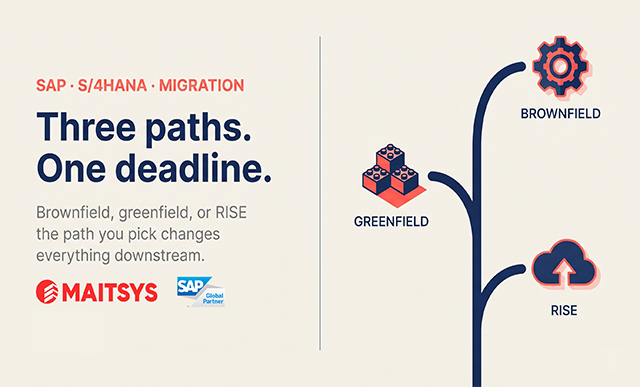
ECC to S/4HANA: Brownfield, Greenfield, or Selective Data Transition?To effectively transition from SAP ECC to S/4HANA, organizations must separately decide on their system transformation approach—whether through system conversion, new implementation, or selective data transition—and their operational model, with RISE with SAP primarily addressing the latter.
8 minute read