3 minute read

Meet the Authors
Key Takeaways
What you need to know
SAP extended its current Chief People Officer, Gina Vargiu-Breuer’s contract through January 2030.
The move reinforces leadership continuity as SAP reshapes its workforce for the AI era.
The announcement also reflects a focus toward making talent strategy central to enterprise transformation.
SAP said it has extended the contract of its current Chief People Officer, Gina Vargiu-Breuer, through January 2030, signaling continued focus on workforce transformation as the company accelerates its AI strategy.
The extension, announced April 10, reinforces leadership continuity at a time when SAP is focusing on how it attracts, develops, and manages talent to support its transition into an AI-driven enterprise.
Pekka Ala-Pietilä, chairman of the supervisory board of SAP, said, “In her role as Chief People Officer, Gina Vargiu-Breuer optimized our processes in the areas of recruitment, development, and management, thus setting an important course for SAP’s long-term success.” He added, “We value her drive and commitment and are convinced that she will further advance SAP on its path into the age of AI.”
Explore related questions
Ask SAPi
Rethinking Value Delivery Amid AI Transformation
Vargiu-Breuer, who joined SAP’s Executive Board in 2024, was senior vice president of human resources at Siemens Energy.
The renewal comes as SAP, and the broader enterprise software market, faces increasing pressure to adapt workforce models to support AI-led innovation, new delivery models, and changing customer expectations.
In her statement, Vargiu-Breuer highlighted that SAP’s transformation is not just technological but organizational, focused on how the company operates, makes decisions, and delivers value to customers.
“I am grateful for the trust the Supervisory Board has placed in me and look forward to shaping SAP’s transformation in the age of AI,” she said. “It’s about changing how we operate – how we work, make decisions, and deliver value to our customers. My People & Culture team and I will continue what we started two years ago and achieve significant value creation with this transformation.”
This aligns with SAP’s broader push toward embedding AI across its portfolio, requiring new skills, governance structures, and operating models across the enterprise.
People and Regional Leadership Moves Anchor SAP’s AI Operating Model
The extension of Gina Vargiu‑Breuer’s mandate as Chief People Officer comes as SAP retools its operating model for AI‑led growth. SAP has consolidated its customer‑facing functions into a new Customer Value Group under Chief Customer Officer Thomas Saueressig. He now steers the full customer lifecycle – from initial engagement through delivery, support, and renewal of cloud and AI solutions.
At the same time, SAP is deepening regional AI and cloud execution capacity through leadership moves in Southeast Asia and new SAP Labs investments. This includes appointing Saket Ranjan as Managing Director for SAP Southeast Asia and Sianto Wongjoyo as Managing Director for SAP Indonesia, sharpening accountability for cloud adoption and partner‑led growth across high‑potential Southeast Asian markets.
Manik Saha’s appointment as Managing Director of SAP Labs East Asia earlier this year in Singapore also shows SAP’s focus on advancing Business AI. The regional R&D unit brings together engineering teams in Singapore, Vietnam, Japan, and Korea to strengthen AI‑driven product engineering capacity in Asia.
Separately, SAP Labs East Asia Singapore is partnering with Singapore’s Infocomm Media Development Authority (IMDA) through the TechSkills Accelerator program to hire and train 50 AI scientists and machine learning engineers over three years, building enterprise AI skills in areas such as generative AI, model orchestration, and AI agents.
By locking in leadership continuity for Vargiu‑Breuer while reshaping customer, regional, and engineering accountability around Business AI, SAP is signaling to customers and employees that workforce strategy, operating model design, and local execution capacity will directly shape how its AI roadmap shows up in real projects and outcomes.
Why Workforce Strategy Is Becoming Central to ERP Transformation
While SAP’s public narrative often focuses on cloud ERP, AI, and data platforms, this move underscores a less visible but critical layer: workforce readiness.
According to a 2025 IDC research, 94% of enterprises say AI skills are critical for their plans for the year, but only about one‑third feel their workforce is ready, highlighting a widening AI skills gap inside large organizations.
McKinsey’s 2025 ‘AI in the workplace’ report states that 46 percent of surveyed leaders identify skill gaps in their workforces as a significant barrier to AI adoption, reinforcing why reskilling and talent strategy are moving to the center of digital and ERP transformation agendas.
As enterprises modernize to solutions such as SAP Cloud ERP and AI-powered applications, success increasingly depends on reskilling employees for AI-assisted workflows, redesigning decision-making processes, and aligning organizational structures with digital operating models.
What This Means for SAPinsiders
Workforce transformation is now a core ERP priority. AI-led ERP programs require new skills, governance, and operating models. Organizations must treat people strategy as integral to transformation, not as a downstream HR initiative.
Leadership continuity supports long-term transformation programs. Extending executive roles tied to transformation ensures consistency in strategy execution. This is critical as ERP modernization and AI adoption span multiple years and organizational layers.
AI adoption will reshape how enterprises operate, not just what they deploy. SAP’s emphasis on rethinking work and decision-making highlights a broader shift: transformation success depends as much on organizational change as on technology implementation.
More Resources
See All Related Content
Anthropic Adds Invisible Watermarking to Claude as AI Labeling Rules Take HoldAnthropic has added invisible watermarking to Claude-generated text, embedding a detectable signal without visibly changing the output. The feature gives enterprises another tool for tracking AI content as provenance and labeling requirements become more important.
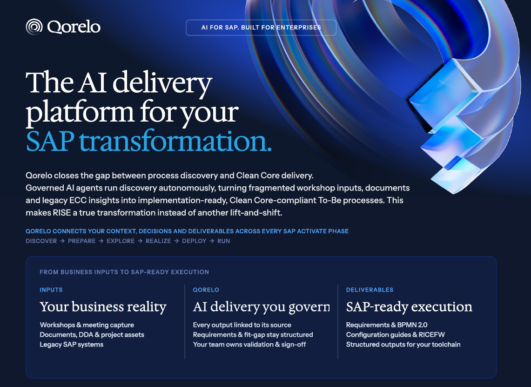
Qorelo: AI-Powered SAP Transformation Delivery, From Discovery to DeploymentQorelo is an enterprise AI platform that enhances SAP transformations by converting business inputs and legacy data into SAP-compliant deliverables, enabling faster delivery and reduced rework through improved governance and traceability.
1 minute read
IBM Expands Granite 4.1 Model Family, Ties It Directly to the Watsonx PlatformIBM's Granite 4.1 model family, now natively integrated into watsonx.ai, signals a push towards auditable, production-ready AI for enterprise data. This update provides open, transparent foundation models designed for secure on-premises deployment and efficient performance.
3 minute read