

2 minute read

Meet the Authors
Key Takeaways
What you need to know
OpenLegacy Hub offers pre-built connectors and low-code tools, promising to replace months-long middleware projects with days-long setup for SAP integration.
The platform leverages existing SAP interface points like BAPIs and IDocs, providing a bridge between SAP and modern applications without requiring a full middleware rebuild.
Native connectivity, subscription pricing, and low-code capabilities position OpenLegacy as an alternative for SAP teams navigating the PI/PO sunset and developer shortages.
OpenLegacy is marketing its Hub platform as an all-in-one integration layer for SAP environments, claiming organizations can “accelerate SAP integration to the outside world in minutes without complex installations or development.” The company frames the offering around the SAP PI/PO sunset, a deadline it positions as a threat to digital transformation plans already underway. OpenLegacy positions Hub as a way to extend SAP, CRM, and industry-specific systems with a few clicks rather than a multi-month development cycle, using pre-built connectors and low-code tools to get organizations connected, in the company’s words, “in days, not months.”
Bridging SAP to Modern Systems Without Replacing Core Architecture
Hub’s mechanism for connecting SAP to outside systems runs through several established SAP interface points rather than a rebuilt middleware layer. The platform supports bi-directional communication using standard and customized BAPIs, and it extends that same bi-directional model to SAP IDocs. A separate capability, SAP Triggers, lets data leave SAP for another system and return, which OpenLegacy applies to scenarios like syncing real-time inventory data with an e-commerce platform or automating order fulfillment between SAP and a CRM system.
BAPIs and IDocs are not new technology. Both have served as the backbone of point-to-point SAP integrations for years, and many organizations are now working to modernize or replace them as they shift toward cloud-based integration models. OpenLegacy’s approach keeps these interfaces in place and wraps connector logic around them, describing the result as “a bridge between SAP and modern applications.”
Explore related questions
Ask SAPi
The inventory and order-fulfillment examples reflect a priority found across SAP customer bases: connecting ERP systems to commerce and CRM platforms in near real time to support supply chain visibility. OpenLegacy’s framing suggests these use cases can run without a parallel integration project sitting alongside SAP’s core transaction processing.
Why Native Connectivity and Speed Matter for Legacy Integration Decisions
OpenLegacy describes its platform as connecting natively with core and legacy systems, stating that it works “via the system’s logic or database layers” rather than through an intermediary translation layer. The company ties this native connection to a broader value proposition, calling it “legacy integration that enables innovation with faster time to market, reduced risks, and decreased costs.”
That cost and speed framing carries into the SAP-specific product as well. OpenLegacy pairs the native connectivity claim with an affordable subscription model that it says avoids major upfront investment, alongside pre-built connectors and low-code tools meant to compress integration timelines. Together, these claims describe a setup where an SAP team configures connections rather than commissioning a custom-built interface for each new system.
Low-code and no-code integration tools have become a broader pattern across ERP ecosystems as IT organizations contend with a shortage of specialized integration developers. The shift many SAP customers face, moving off PI/PO and toward SAP Integration Suite, adds a second pressure point that shapes how integration vendors are evaluated on timeline and cost. OpenLegacy’s native-connectivity claim sits inside that pattern as one option an SAP team might weigh during that evaluation.
What This Means for SAPinsiders
- Faster SAP connectivity without a middleware rebuild. Teams facing the PI/PO sunset can evaluate connector-based approaches that claim to reuse existing BAPIs, IDocs, and triggers rather than rebuilding integration logic from scratch. This approach changes the scope of a migration project before a vendor decision is even made.
- Subscription pricing changes the procurement math. An affordable subscription model without major upfront investment shifts how IT and finance teams compare integration vendors during annual or multi-year budget cycles. Total cost of ownership discussions may start earlier in the vendor evaluation process.
- Low-code tools shift who owns SAP integration work. If connections can be built in days through low-code tools, integration tasks may move from specialized SAP developers to broader IT staff. That shift raises governance questions about who reviews and approves connector configurations before they touch production SAP data.
More Resources
See All Related Content
Which Software Projects AI Makes Cheaper to BuildCoding agents are lowering the cost of writing software, but review, testing, and requirement definition now carry a larger share of build effort. The largest savings go to SAP projects with clear requirements, testable outputs, and documented interfaces.
SAP EPPM-Plus Turns Capital Governance Into an Operating ProcessData center programs force projects to compete for the same capital, engineering talent, and delivery capacity. Platinum DB Consulting's SAP EPPM-Plus turns capital governance into a repeatable process that links project intake, stage-gate approvals, FP&A planning, and SAP Project System execution.
3 minute read

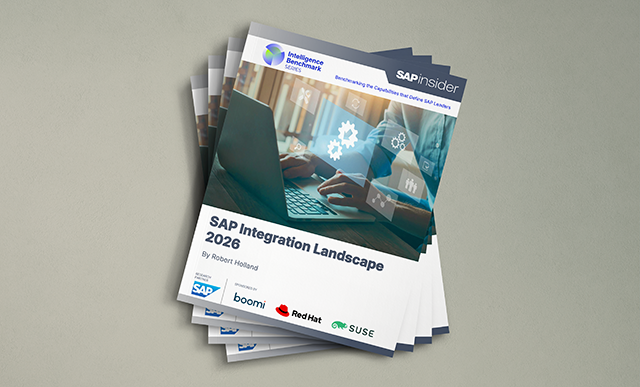
Enterprise Integration for SAP 2026 SAPinsider Benchmark Research ReportEnterprise integration is becoming a strategic platform capability for SAP organizations. As application landscapes expand across SAP and non-SAP systems, businesses increasingly depend on integration to support cloud transformation, operational visibility, analytics, partner connectivity, and artificial intelligence. The question is no longer whether organizations need an integration strategy. It is whether they can translate that strategy into a modern, governed, and scalable architecture.
SAP integration has become strategic, but it is not yet uniformly modern. Organizations are defining enterprise strategies and increasing investment as real-time visibility, cloud growth, SAP transformation, and AI create new connectivity demands. At the same time, legacy middleware, point-to-point integrations, skills shortages, and technical debt continue to limit execution.
This year’s integration research reveals substantial progress at the strategic level. Half of respondents describe their integration strategy as either enterprise-wide or platform-driven and AI-enabled, while only 4% have no formal strategy. Integration is also closely connected to transformation: 46% say it is strategically aligned with, or fully embedded in, broader cloud and digital transformation programs.
Download this benchmark research report to read a deeper analysis and receive insight on your own plans.
- Understand the integration strategies and architectures that organizations are using.
- Explore how organizations are transitioning to real-time and AI-ready integration.
- Learn about the integration challenges that are being created by AI.
- See what SAPinsiders are doing to implement the capacity to execute on integration.
1 minute read