

3 minute read

Meet the Authors
Key Takeaways
What you need to know
SAP ECC users face a 2027 deadline; early readiness assessments are crucial to avoid rushed planning across people, process, systems, and data.
Successful migrations hinge on data quality; profiling and cleansing should be a mandatory pre-cutover step to ensure user trust and system reliability.
Cross-functional planning workshops require clear internal ownership and governance to effectively reconcile departmental priorities before making system decisions.
COSOL recently completed a SAP migration spanning 20 legacy systems, 80 million records, and 350 data sources, an engagement the company says restored data confidence and produced a system its client could trust from day one. The project sits inside a broader SAP practice that COSOL, a certified SAP Partner since 2000, has built around enterprise asset management for sectors including mining and defence. Its core offering centers on SAP ERP’s Enterprise Asset Management module, which tracks and optimizes assets across their lifecycle alongside core functions such as finance, procurement, and human resources, with S/4HANA available in both Public Cloud and Private Cloud configurations.
Assessing the Path Before Migration
SAP ECC support and maintenance ends in 2027, a deadline that has pushed many organizations still running the older platform to formalize their S/4HANA plans. COSOL’s S/4HANA Readiness Assessment addresses that planning gap across four program streams: people, process, systems, and data. The assessment covers three deliverables that matter most: a solution assessment, simplification recommendations, and a documented data migration plan. It also includes guidance on module selection and legacy data handling, giving an organization a documented basis for the transformation decisions that follow.
A separate COSOL offering, the EAM/ERP Market Assessment, addresses a different point in that same planning sequence. Workshops bring together stakeholders from finance, maintenance, and human resources teams, among others, to establish an organization’s priorities before any system is selected. That requirement-gathering exercise feeds a fit-gap analysis, delivered as a consulting report, which shortlists best-of-breed EAM or ERP systems and gives the organization the data needed to build an investment business case. Fit-gap analysis of this kind is a standard technique used across ERP and EAM selection projects industry-wide.
Explore related questions
Ask SAPi
Executing Migration Without Losing Data Integrity
Once an organization moves from assessment into execution, COSOL’s Data Migration solution relies on a proprietary tool, RPConnect, to automate the extract, transform, and load work that migrating legacy asset data typically requires. RPConnect carries out data validation and cleansing as part of that automation, aiming to ensure migrated data is accurate, complete, and consistent. The tool operates across three phases: pre-migration data profiling and remediation, in-migration data standardization and loading, and post-migration data reconciling and archiving, a sequence designed to improve data quality ahead of a project while building an organization’s ongoing capability to sustain it.
The scale of COSOL’s recent migration, 20 legacy systems, 80 million records, and 350 data sources, illustrates the kind of data-integrity discipline this phased approach is built to support. Asset-intensive organizations in sectors such as mining and utilities commonly run several EAM or ERP systems in parallel, which raises the burden of reconciling data before it converges into one platform. Migrations at this volume and source count are generally associated with multi-phase ETL governance across enterprise SAP transformations, and the result, a system trusted from go-live, underscores data reconciliation as the practical measure of success.
What This Means for SAPinsiders
- ECC’s 2027 deadline compresses planning windows. Organizations still running SAP ECC have a fixed date after which mainstream support ends, making a readiness assessment an early, time-boxed purchase rather than a deferrable one. Teams that wait risk squeezing the people, process, systems, and data planning work into a shorter runway.
- Data quality determines whether a migration is trusted. A system that is technically live but built on unreconciled data can undermine user confidence long after go-live. SAP teams should treat data profiling and cleansing as a gating step before cutover, not a cleanup task for afterward.
- Cross-functional workshops require named internal owners. Market and readiness assessments pull stakeholders from finance, maintenance, human resources, and workplace health and safety into the same planning process. Organizations running these assessments need a governance structure that can reconcile competing departmental priorities before a system decision is made.
More Resources
See All Related Content

CSCorp Anchors Its SAP Portfolio With a Purpose-Built HCM Payroll Migration ToolCSCorp, a 25-year SAP partner, introduces a proprietary tool to streamline SAP HCM Payroll to SuccessFactors Employee Central Payroll migrations. This accelerator is part of their broader SAP consulting practice, which includes S/4HANA migrations and comprehensive AMS.
3 minute read
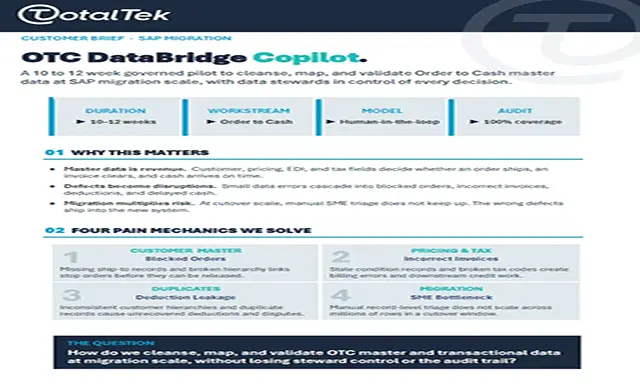
OTC DataBridge Copilot: Governed AI for Cleaner SAP Migration DataTotalTek's OTC DataBridge Copilot is an AI-driven tool that enhances data quality in SAP migrations by profiling, cleansing, and validating Order-to-Cash records, thus mitigating issues like duplicate customers and invoice errors, while streamlining the review process for data stewards.
1 minute read

Why One SAP Customer Paused Its SAP S/4HANA Transition Before Moving ForwardA consumer products company paused its SAP S/4HANA migration after early work showed the original brownfield plan no longer fit the business. Working with cbs Corporate Business Solutions, the company moved toward Selective Data Transition, showing how disciplined reassessment can reduce legacy complexity and support stronger outcomes.
4 minute read