

3 minute read
Meet the Authors
Key Takeaways
What you need to know
A BAPI-based tool allows SAP procurement teams to efficiently manage and validate material and vendor data changes directly within Excel, eliminating manual re-entry into SAP.
By shifting data validation to an earlier stage, organizations can reduce rework cycles and correct errors before they propagate through the SAP system, improving data quality and saving time.
The availability of zero-license, BAPI-based tools for mass data maintenance provides a cost-effective alternative to custom development or third-party software, especially for high-volume data changes.
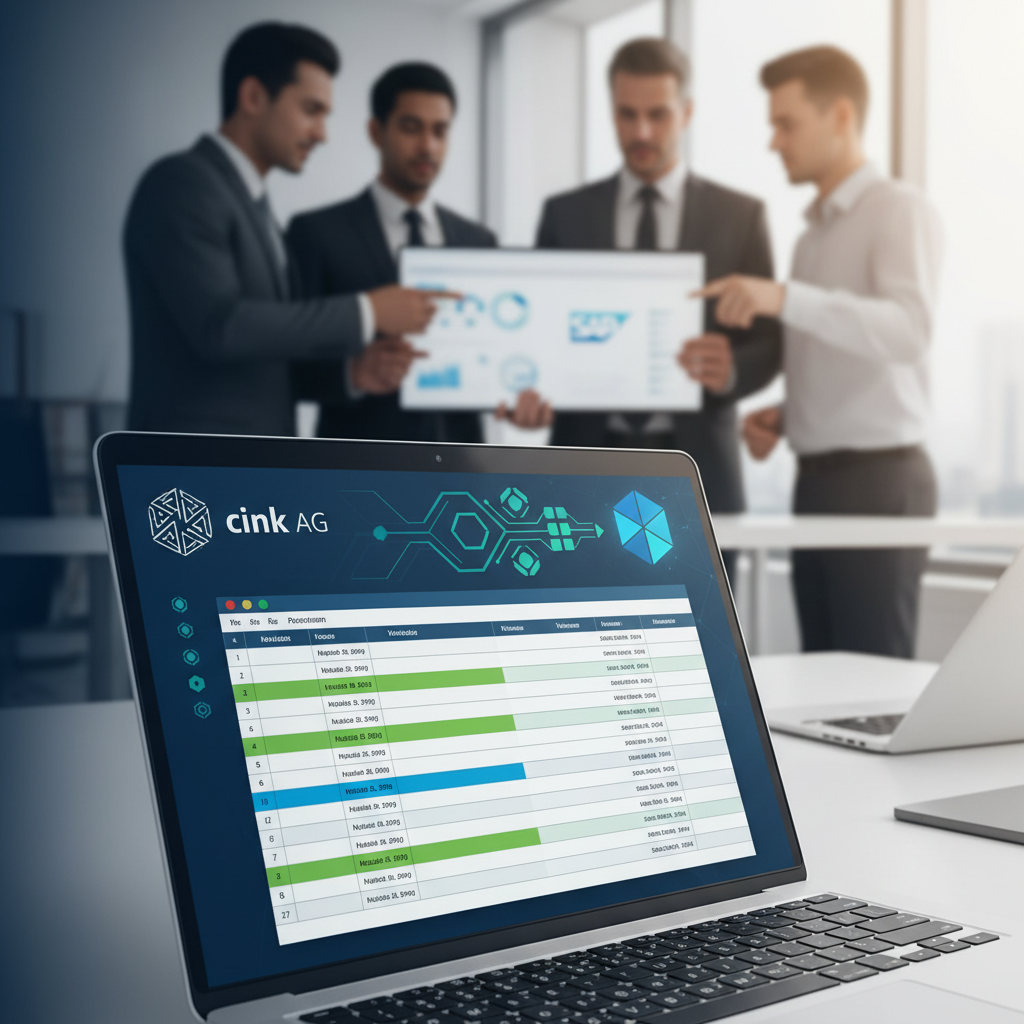
cink AG, an SAP consultancy focused on procurement and logistics, has built an Excel-based tool for mass maintenance of SAP purchasing and master data. The tool lets buyers keep preparing changes in spreadsheets while the underlying updates move into SAP through an automated, validated process instead of manual re-entry. It sits alongside the firm’s broader SAP S/4HANA work across procurement, sales, and warehouse management, among other logistics modules, and it targets a specific friction point: teams that already draft data changes in Excel but must then key those changes into SAP by hand.
Closing the Excel-to-SAP Gap in Procurement Data Maintenance
The Excel-based tool for mass maintenance of SAP purchasing data follows a four-step sequence. Data is first exported selectively from SAP into Excel, where relevant fields for material master records, purchasing info records, and vendor purchasing data are marked as editable. Buyers then make changes in the spreadsheet using formats they already know instead of navigating SAP transaction screens field by field.
Before writing anything back to SAP, the tool checks the proposed changes for plausibility and technical feasibility. Errors and warnings are surfaced before the update runs, and once changes are transferred, the tool flags successful and failed records so failed entries can be exported back to Excel for correction and resubmission.
Explore related questions
Ask SAPi
The mechanism relies on SAP-standard BAPIs, the programmatic interfaces SAP provides for structured data changes, which is why cink AG describes the tool as S/4HANA-ready. BAPIs are a standard SAP interface used across the industry for building custom data-update tools, not a method unique to this one. cink AG states that the tool carries no license costs beyond a one-time implementation effort and that it can be used immediately without additional training, since the working environment remains Excel.
Extending Efficiency Across the Broader SAP Logistics Stack
The mass-maintenance tool is one piece of a wider set of SAP logistics services cink AG provides. The firm implements and optimizes S/4HANA across procurement, sales, and production, among other logistics modules, treating these processes as core drivers of operational performance for a manufacturing or distribution business.
On the procurement side, cink AG offers a Web Shop solution that automates the requisition-to-fulfillment cycle, covering requirement notification, digital approval routing, and supply. The firm also activates the SAP Fiori Launchpad for clients, giving procurement and logistics staff access to mobile, responsive applications. Many SAP customers already hold Fiori app entitlements under their existing licenses, and activation work like this is a common efficiency step among SAP partners.
Beyond transaction processing, cink AG builds dashboards intended to give procurement teams real-time visibility into purchasing metrics for data-driven decisions. The firm describes its approach as collaborative: it analyzes a client’s existing processes with client teams and identifies optimization potential before developing tailored solutions. Jonas Tautz is named on the firm’s site as its SAP logistics expert, and Christoph Gnirck, an SAP consultant at the firm, is credited as the author of the post describing the Excel mass-maintenance tool.
What This Means for SAPinsiders
Validation before write-back reduces rework cycles. Procurement teams that currently discover data errors only after changes hit SAP can shift error-catching earlier, cutting the time spent tracing and correcting bad records after the fact. Flagging failures at the point of transfer, rather than downstream, shortens the loop between mistake and fix.
Zero-license tools change the build-versus-buy calculus. Teams evaluating mass-data maintenance options can weigh a BAPI-based, no-license tool with a one-time implementation cost against custom in-house development or third-party software purchases. That comparison matters most for organizations with recurring, high-volume master data changes but limited appetite for new recurring software spend.
Tactical tools and full S/4HANA scope can run in parallel. SAP program leads can sequence a narrow, fast-to-deploy fix like Excel-based mass maintenance alongside a longer S/4HANA logistics rollout so both efforts move forward together. Doing so lets operational teams see near-term relief while structural project work continues on its own timeline.
More Resources
See All Related Content
CeleriTech Extends SAP Gold Partner Status Into Consumption-Based S/4HANA HostingCeleriTech extends its SAP Gold Partner status by offering consumption-based S/4HANA hosting, integrating consulting, implementation, and cloud infrastructure. This new service provides flexible pricing, robust compliance, and simplified hybrid integration for SAP customers migrating to S/4HANA.

ConvergentIS Brings AI-Powered Procurement Intake Orchestration to SAP MarketplaceConvergentIS has listed its AI-powered Rio product on SAP's spend management marketplace. Rio unifies fragmented procurement requests from ERP, email, and chat into a single workflow, offering SAP customers a documented path to streamline intake processes and improve efficiency.
2 minute read

CONTAX Lets SAP Customers Test S/4HANA Conversions Before Committing to a Full MigrationCONTAX introduces a sandbox conversion service, offering a low-risk pathway for organizations with stalled S/4HANA migration plans. It helps test scope, cost, and addresses custom code and interface challenges before full commitment.
3 minute read

Carlson Cash Presses Its Case for SAP Treasury Specialists With a Bank Statement Automation WalkthroughCarlson Cash champions SAP treasury specialists, showcasing deep technical expertise with a detailed walkthrough of the 'Manage Processing Rules' Fiori app. They argue their narrow focus and in-house delivery model outperform generalist approaches for bank statement automation and other treasury functions.
3 minute read