
5 minute read

Meet the Authors
Key Takeaways
What you need to know
Integrating SAP implementation with ongoing service and maintenance under one partner can significantly reduce the risk of post-deployment support issues, fostering long-term system viability.
For stalled SAP initiatives, beginning with IT consultancy and training offers a low-commitment entry point to realign stakeholders and redefine scope before a full-scale project restart.
Formal Service Level Agreements (SLAs) for SAP maintenance compel enterprises to establish clear internal ownership and escalation processes, ensuring defined standards for support.
Blue Solutions Public Company Limited, established in 2009 as a system integrator and solution provider, organizes its offering around three connected service lines: Project Implementation, Service and Maintenance, and IT Consultancy and Training. The company states a commitment to delivering end-to-end solutions with current technology, and it applies that same structure to its SAP implementation work.
From Deployment to Long-Term Support: A Lifecycle Model
Project Implementation at Blue Solutions covers the full rollout sequence, including site survey, planning, and installation, along with related design, procurement, and coordination work, carried out by personnel the company describes as skilled, qualified, and certified. The scope places the implementation team inside the physical and organizational setup of a project, extending beyond software configuration alone.
Once a system goes live, Service and Maintenance takes over. The offering includes preventive maintenance and emergency troubleshooting, structured to keep systems and equipment running as intended. Blue Solutions ties this support to Service Level Agreements, giving customers a defined standard for measuring response and resolution times.
Explore related questions
Ask SAPi
Pairing implementation with SLA-bound maintenance reflects a pattern seen across the SAP partner ecosystem. Enterprises that pause or reverse SAP S/4HANA initiatives often cite uncertainty about post-go-live support as a factor, since a system left without a clear maintenance path becomes harder to justify operating. Integrators that build ongoing support into the same relationship as deployment reduce that hesitation, regardless of the vendor or delivery partner involved.
Consultancy as a Re-Entry Point for Stalled Initiatives
The third line, IT Consultancy and Training, sits apart from the deployment and maintenance work. Blue Solutions describes this service as professional consulting on information technology infrastructure, systems, and strategy, delivered alongside project design, project management, and annual maintenance contracts.
A consultancy engagement asks for a narrower commitment. It skips the procurement, installation, and coordination effort that Project Implementation involves, and it does not commit a customer to an SLA before scope is defined. The lower-commitment structure matters for organizations reconsidering a SAP initiative that stalled internally, whether from budget review, leadership turnover, or shifting priorities.
Across the SAP market, standalone consultancy and training engagements commonly help rebuild internal agreement among finance, IT, and operational stakeholders before a paused ERP project resumes with a defined scope. Positioning consultancy as a distinct, lower-commitment service line gives a customer a path back into a project without immediately reopening the larger implementation decision.
What This Means for SAPinsiders
Bundled support reduces re-engagement risk. SAP teams weighing whether to restart a paused initiative may favor partners who combine deployment with SLA-backed maintenance in one relationship. The combined structure limits the risk of a system going live without a defined path for ongoing support.
Consultancy lowers the barrier to resuming stalled work. Starting with IT consultancy or training lets a previously paused SAP effort restart with minimal impact on daily operations. Teams can rebuild internal alignment before committing to installation and rollout.
SLA terms push clearer internal ownership. Formal SLA-bound maintenance arrangements require an SAP customer to define who owns escalation and response internally. Defining that ownership often gets skipped when support is treated as informal or ad hoc after go-live.
More Resources
See All Related Content
What Happens After the S/4HANA Transformation? From Go-Live to Continuous OptimizationThe article emphasizes that go-live in SAP S/4HANA transformations should be seen as the start of continuous optimization rather than the end, advocating for a structured approach to capturing knowledge and decision-making during the transformation process to facilitate ongoing improvement and effective integration of AI technologies.

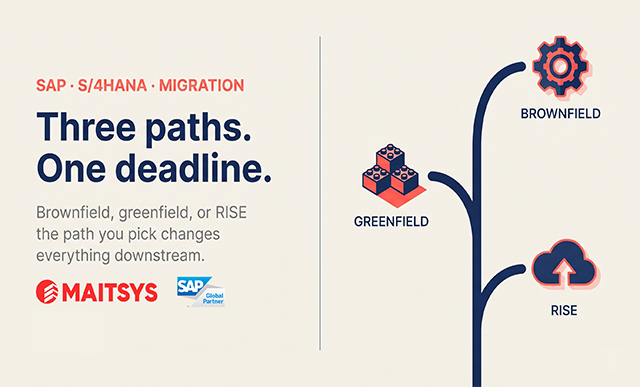
ECC to S/4HANA: Brownfield, Greenfield, or Selective Data Transition?To effectively transition from SAP ECC to S/4HANA, organizations must separately decide on their system transformation approach—whether through system conversion, new implementation, or selective data transition—and their operational model, with RISE with SAP primarily addressing the latter.
8 minute read