

1 minute read

Meet the Authors
Key Takeaways
What you need to know
Enterprise IT staffing firm ALKU supports the entire SAP lifecycle, from initial S/4HANA implementation to ongoing production support and strategic upgrades, minimizing vendor handoffs.
Post-go-live is a critical juncture where organizations often re-evaluate staffing, as support and maintenance needs differ significantly from initial implementation, requiring specialized skill sets.
Access to ALKU's specialized SAP consultants allows internal teams to flexibly address skill gaps for tasks like ticketing or upgrades without increasing permanent headcount, ensuring continuity and expertise.
ALKU, a nationally ranked staffing firm operating through niche-focused divisions, runs its SAP consulting practice under ALKU Technologies, a unit that also covers Salesforce, Workday, and cybersecurity ERP implementations. The firm describes its role as connecting organizations to an exclusive network of highly skilled consultants who meet clients’ most critical business needs. Within SAP specifically, ALKU’s stated scope runs from initial implementation through the ongoing support work that follows go-live, a range that positions the firm as a resource SAP teams can call on well after their original project team has disbanded.
From Implementation to Optimization: Staffing the Full SAP Lifecycle
ALKU’s SAP consultants support two distinct entry points into a program: greenfield S/4HANA implementations built from the ground up, and brownfield migrations that move an organization from ECC to S/4. The firm positions its consultants’ project experience as the mechanism for smoothing these transitions, recognizing greenfield and brownfield work as distinct staffing needs. Once a program is underway, the ALKU SAP team also works to identify resources for company-wide project management, covering the full arc from forecasting and planning through accounting and closure.
A separate strand of the practice addresses what happens after a system is live but before it is current. ALKU states that a firm grasp of client requirements allows it to help design strategic upgrade plans aligned to business objectives, and that its consultants can help organizations get onto the latest released SAP version. This upgrade-focused staffing sits apart from net-new implementation work, reflecting the reality that most SAP customers spend far more of their program lifecycle maintaining and advancing an existing system than building a new one.
Explore related questions
Ask SAPi
The timing of this positioning tracks a broader pattern across the SAP customer base. Many organizations are staffing up for S/4HANA migrations as ECC end-of-maintenance timelines approach, which has widened demand for consultants who can handle both the initial build and the less glamorous work of moving a mature system forward. Firms with experience across both types of work are better positioned to be engaged repeatedly across a multi-year migration effort.
The Re-Engagement Point: Why Support Staffing Gets a Second Look
A distinct phase begins once an SAP system has actually been implemented. ALKU frames this as support and management work, and its consultants are positioned to fill both short-term and long-term roles resolving ticketing issues and other day-to-day SAP business needs. Support roles tend to be ongoing, less predictable in scope, and more dependent on institutional knowledge of a specific system’s configuration than a discrete project engagement.
That difference is often exactly when organizations reconsider who is staffing their SAP work. Post-go-live is a common juncture at which the original implementation vendor or systems integrator rolls off, leaving a gap that internal teams must fill quickly. The broader shift toward RISE with SAP and cloud-based ERP has also changed the skill sets required for ongoing support, since maintaining a cloud-hosted S/4HANA environment draws on different technical knowledge than administering an on-premise ECC landscape. Organizations that shelved a staffing relationship during implementation may find themselves revisiting it once support needs shift.
ALKU’s positioning around specialized technical and functional consultants speaks directly to that gap. Its scope across SAP alongside Salesforce, Workday, and cybersecurity also means the same staffing relationship can extend beyond a single ERP platform, which matters for organizations running parallel enterprise technology initiatives beyond a single SAP program. A team that already works with ALKU for one platform has a lower-friction path to sourcing support staff for another.
What This Means for SAPinsiders
Full-lifecycle staffing reduces partner handoffs. Teams that use one staffing partner across implementation, upgrades, and support avoid re-onboarding a new vendor at each phase. That continuity can shorten ramp time when support needs shift unexpectedly after go-live.
Post-go-live is a natural re-evaluation point. As support requirements change once a system stabilizes, organizations often reassess staffing relationships that were set during implementation. Firms previously considered too narrow or too broad for the build phase may fit the support phase better.
Specialized consultants offset internal skill gaps without added headcount. Access to niche SAP technical and functional talent lets teams fill short-term gaps, such as ticketing backlogs or upgrade planning, without expanding permanent staff. This keeps governance of the SAP environment with internal teams while the workload flexes.
More Resources
See All Related Content

SAP S/4HANA Migration Timelines: The Average, the Range, and the Factors Behind BothBenchmark research from SAPinsider, ASUG, and Panorama Consulting puts the typical SAP S/4HANA migration at 15 to 20 months, with scope deciding where a project falls. An average project starting now finishes after mainstream maintenance ends in 2027.
3 minute read

S/4HANA navigation path: Standard project support during and post go-liveMigrating to SAP S/4HANA is a complex, ongoing process that requires careful dual maintenance and robust support for both legacy and new systems, with variations in support models depending on whether a cloud or on-premises approach is taken.
7 minute read
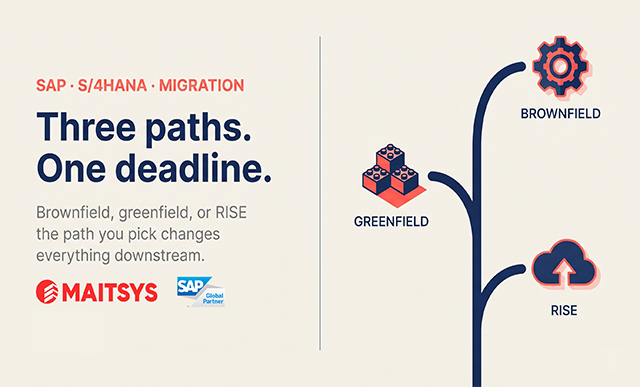
ECC to S/4HANA: Brownfield, Greenfield, or Selective Data Transition?To effectively transition from SAP ECC to S/4HANA, organizations must separately decide on their system transformation approach—whether through system conversion, new implementation, or selective data transition—and their operational model, with RISE with SAP primarily addressing the latter.
8 minute read