2 minute read
Meet the Experts
Key Takeaways
What you need to know
Generative AI is changing enterprise application development from manual coding and traditional build-versus-buy decisions to intent-based development, where teams can generate, test, and deploy applications more quickly.
AI-generated code alone is not enterprise-ready: without context on SAP S/4HANA, ERP systems, data lakes, APIs, business processes, and governance, vibe coding can create applications quickly but make integration, scalability, and maintenance much harder.
Joule Studio creates a detailed Product Requirements Document from natural language, helping teams build compliant, landscape-aware applications.
The advent of generative AI has had an enormous impact on application development. Platforms like Claude Code have accelerated code generation, improved testing efficiency, and allowed developers to become significantly more productive. The vibe coding trend has even allowed teams to create and deploy applications in just minutes or hours. This complete shift in the Software Development Lifecycle (SWDC) has driven many organizations to reconsider the build versus buy discussion.
For decades, when organizations identified a problem or a need, they would source and purchase a solution that provided that capability. AI has changed that thinking when it comes to purchasing solutions. The possibility of building an application with the assistance of AI instead of having to purchase a software license and pay ongoing maintenance can be very attractive to organizations that want to minimize costs or the number of vendors in their landscape. However, while it’s now possible to prototype an application in hours that would previously have taken months, there is a difference between having a capability and being able to scale it.
Beyond the governance and scalability factors involved in vibe coding an application, code that is built using AI tools has no insight into the enterprise landscape. It doesn’t have insight into ERP systems or data lakes, how these applications are connected, or the role they play in business processes. This makes what is sometimes called vibe coding for the enterprise significantly less valuable because the work required to integrate and connect applications developed using AI can far exceed the time it takes to develop them.
Explore related questions
Ask SAPi
Intent Based Development
One methodology for addressing this need is to use specification-based development. Under this method, a detailed specification is created and then used by AI to create a solution. However, the drawback with specification-based development is that generating that specification can be complex and time intensive, potentially eliminating a portion of the savings that AI-assisted development offers. It also requires team members that have the right system access and business process knowledge to create the specification, which may not always be the case.
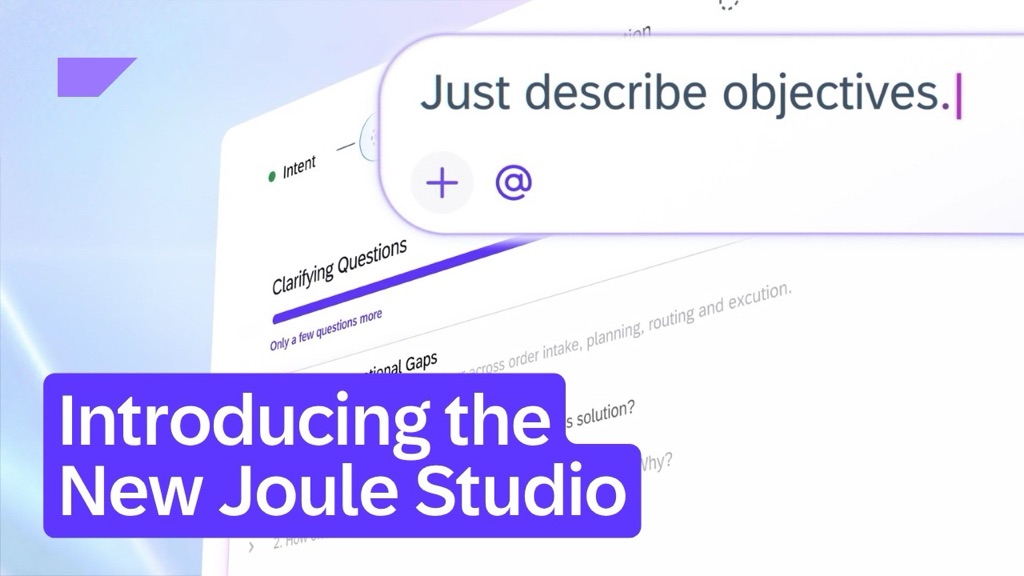
The approach that the updated Joule Studio takes in addressing these challenges is that of Intent-Based Development (IBD). IBD is a cycle that starts with an intent and continues to code development, deployment, and ensuring that the software that is created is enterprise ready. In Joule Studio, a user can describe a problem in natural language. and a Product Requirements Document (PRD) will be created from that problem. Once the PRD is created, the developer can take the solution and create an agent, application, or whatever is required to address the specified intent.
The big difference is that Joule Studio uses tools within the SAP landscape to create a highly polished PRD and specification, which can be iterated over to ensure that it exactly aligns with the stated intent. This ensures that there is a lot of thought and knowledge going into the development process. It also ensures that the vibe coding and specification-based development approaches are combined into a single, streamlined process that has detailed insight on the architecture, processes, and agents residing in an organization’s landscape. For example, the PRD will include whether an SAP S/4HANA system exists, the cloud provider in use, and agents that may be running in the environment. This type of detail ensures that the solution can be built and tested quickly as it will have access to necessary data, environmental variables, and API access.
Precision Through Context
The sources of context that Joule Studio uses to build the PRD makes it most useful. Built on a knowledge set that includes SAP’s architectures and guidelines, including the SAP Business Technology Platform (BTP) reference architecture, these form the static starting point just like any Large Language Model (LLM). However, Joule Studio then uses the SAP Knowledge Graph to gain insight into a graph of the data sources in applications, how they connect to APIs, and the data models in use in the enterprise. This goes beyond static information to understand what makes up each customer’s unique environment.
Joule Studio then accesses SAP LeanIX to gain insight into the applications that exist in the landscape, as well as any agents that are in use whether or not those are from SAP. This information is then combined with information on business processes from SAP Signavio. This allows Joule Studio to understand exactly where the described intent fits with all the business processes across the enterprise. Lastly, SAP domain models are used to understand each landscape in detail allowing for a PRD that is landscape specific.
This detailed and specific PRD can then be iterated, for example, to make updates or changes, to ensure that it exactly fits the intent described. Other users can also be invited to review and update the PRD if desired. Instead of creating an application or agent based on a prompt, the solution is now based on a comprehensive document that maps each part of the landscape — something that can be created in minutes or hours instead of weeks no matter the user’s technical background.
The Final Step: Iteration
For developers who prefer to use a specific environment, for example Visual Studio Code or Claude Code, they can use that tool to work on the project and continue development. Users can even switch back and forth between development environments, or Joule Studio and their environment of choice, if it makes sense to do so. In the end, the project is generated using Joule Studio and exists with a full knowledge of the environment, the applications in it, and including enterprise guardrails to ensure that it will be effectively governed.
However, the project is not necessarily complete at this point. Because a polished PRD was created that captured the intent of the user, as new and updated models are created, whether those are frontier models, open weight models, or domain specific models, the development step can be redone using these new and updated models to leverage the new features or capabilities in them. So, as underlying technology improves, that can be used to make the best solution created using the most thorough PRD even better.
What This Means for SAPinsiders
Joule Studio allows users of any level of development experience to create applications that will integrate seamlessly into the enterprise. Users do not have to be professional coders to leverage its capabilities because Joule Studio uses multiple tools and specifications to build a detailed Product Requirements Document that forms the source of the solution being developed. Those that have more significant experience can use the development environments they are most familiar with ensuring a more seamless development process without the need to learn new tools or interfaces to be successful.
The PRD allows for a solution that can be smoothly integrated into any SAP environment. The solution developed from a PRD has all the information needed to function immediately. This is because the PRD that is created contains detailed information on landscape, business processes, systems, agents, and leverages SAP specifications and references architectures. Solutions created without the benefit of this insight are likely to need significant work to interface with existing systems or even to access SAP environments.
Iterating over time allows for a solution that continues to be valuable even as AI models and capabilities improve. The solution created by Joule Studio is based on a highly detailed PRD. Therefore, it can continue to be quickly updated when new AI models are released. Even if the landscape or intent changes slightly over time, the PRD can simply be updated to reflect the new landscape and an updated solution developed. This streamlines the SWDC and significantly reduces the amount of work required to ensure solutions remain current with both enterprise landscapes and model capabilities.
More Resources
See All Related Content

From SAP BTP to EIC: Where SUSE Can Help Define Agentic AI GovernanceSAP teams retiring PI/PO before 2027 are quietly deciding where sensitive data meets AI. In hybrid architectures, that decision lands on the Kubernetes runtime beneath SAP BTP, and Edge Integration Cell becomes the residency line where SUSE AI belongs in the conversation.
4 minute read

SAPinsider Summit Chicago 2026Join SAPinsider Summit Chicago on November 11–12 for practical SAP ERP transformation insights, clean core strategies, cloud ERP planning, and AI-focused learning for SAP end users. The event brings together SAP leaders, architects, program teams, and practitioners for expert sessions, peer networking, and real-world guidance across every stage of the SAP journey.
1 minute read

SAP’s June 2026 Patch Day Stacks Critical NetWeaver and ABAP Fixes: A Basis Team Action ListAn authentication bypass and a kernel memory-corruption flaw in the same month, is the kind of pairing that should pull a patch schedule forward. SAP's June 2026 Patch Day shipped 15 notes, with a CVSS 9.9 SAML bypass at the top. Here is a prioritized action list for Basis and security teams.
4 minute read