Modern SAP managed services are shifting work from reactive firefighting to continuous optimization, data quality and business-led change adoption. For SAP technology leaders, that means the operating model is becoming the biggest driver of transformation outcomes.
Transformation Becoming a Continuous Evolution
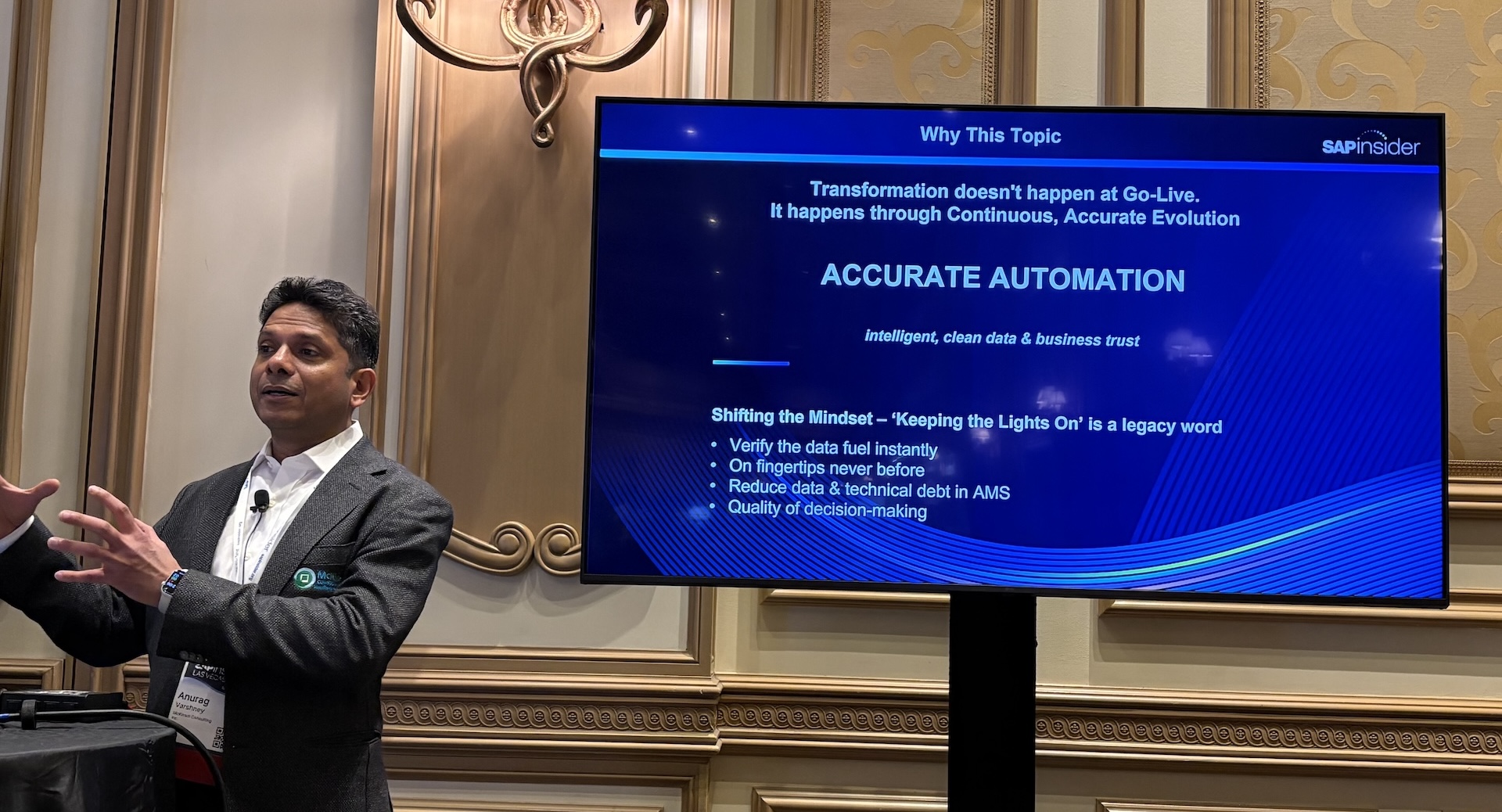
Speakers from McKinsol framed transformation as a continuous, data-driven evolution rather than an event at go live during their presentation “How Modern SAP Managed Services Drive Continuous Business Transformation” at SAPinsider Las Vegas.
Anurag Varshney, Chief ERP & Ai Transformation Strategist & CIO Advisor, said about transformation, “What matters now is the speed and continuity. It used to happen every few years, but now it’s continuous.”
This is a shift many SAP customers are now codifying in their operating models. Instead of measuring success by incident closure rates, outcome-driven managed services emphasize accurate automation, healthy data and the ability to adopt business change at speed.
This manifests as proactive monitoring and AIOps that identify anomalies and capacity risks before they hit critical business processes, freeing staff from routine log checks and manual root-cause analysis. In practice, AI-assisted monitoring on SAP BTP and core landscapes is enabling IT teams to reduce unplanned downtime and redeploy effort into performance tuning and innovation backlogs.
For application owners, the focus shifts from chasing tickets to managing outcome dashboards: cycle times for order-to-cash, forecast accuracy, or maintenance-related downtime become the unit of work.
AI-enabled predictive maintenance in SAP-centric manufacturing environments has reduced unplanned equipment failures by scheduling interventions during planned downtime, directly improving asset uptime and protecting revenue. In supply chain operations, AI-driven forecasting layered onto SAP data has reduced both excess stock and stock-outs, improving cash flow and service levels. For leaders, these examples point to a future where managed services success is defined by business KPIs tied to SAP, not just SLA adherence.
Data Serves as the Foundation of Managed Services Value
Roopal Chaturvedi, data partner at McKinsol, said, “Most SAP transformation fails because of bad data.” She added that modern managed services are moving upstream from one-off cleansing projects toward ongoing data health practices that keep master and transactional data fit for automation and AI.
By embedding approval workflows, domain-specific validations, and mass data operations into SAP master data processes, organizations reduce duplication and aging data while aligning ownership between business and IT. For data stewards and process owners, that means day-to-day work becomes more about governing standardized workflows and policies that ensure trustworthy inputs for automation and analytics.
Evaluation criteria are evolving as a result. SAP leaders are increasingly prioritizing providers that can demonstrate:
- Continuous data quality monitoring tightly integrated with SAP master data domains.
- Predictive and preventive approaches to data errors instead of batch cleanups.
- Clear roles for business users in data workflows, with IT providing enablement rather than manual fixes.
More SAP change is now business-driven than IT-driven, but business teams still rely on IT-led platforms and guardrails. That tension is pushing managed services toward models where business users own escalation paths and prioritization, while IT and partners provide the underlying automation, observability, and governance.
Common adoption challenges remain. Andy Varshney, AI Product Manager, McKinsol, said, “One of the biggest technical challenges a lot of the custom codes are not being utilized. When planning the transformation, it’s important to know what you have. That helps with the migration.”
Modern assessment services and code analytics are helping leaders rationalize that footprint, reducing technical debt and simplifying future operations.
At the same time, culture change is required. Teams must stop treating “keeping the lights on” as the end goal and start treating operational data, monitoring and automation as levers for continuous business innovation.
What This Means for SAPinsiders
Operational models are becoming strategic. Managed services that prioritize continuous value, data health, and AIOps will influence SAP product roadmaps, favor outcome-based contracts, and demand tighter integration between cloud ALM, BTP and core ERP platforms.
Data health will dictate AI success. Vendors and integrators that embed ongoing data quality workflows into SAP operations will be better positioned to deliver credible AI, analytics and automation outcomes across complex, heterogeneous ERP estates.
Business-led change will reshape partnerships. As more SAP transformation demand originates in the business, SIs and managed service providers must align around co-owned KPIs, clean-core principles and modular architectures that support rapid, low-risk innovation.