
1 minute read

Meet the Experts
Key Takeaways
What you need to know
SAP is shifting to an outcome-led, adoption-first model, which means customers need verified ROI, defined adoption milestones, and consumption value before signing cloud contracts.
Implementation-led services are being replaced by presales advisory, architecture planning, and guided adoption plans that help enterprises achieve faster time-to-value.
Agentic AI and the Autonomous Enterprise are evolving enterprise change management, making it essential for SAP customers to plan for human-AI workflow adoption and process automation across the transformation.
A decade ago, the uncomfortable reality about enterprise software was that a significant portion of what vendors like SAP sold became shelfware. Organizations either paid for the technology, deployed it, and ignored it, or they never even realized that they owned it. Today, the consumption economics of the cloud and the arrival of agentic AI mean that those sorts of situations are no longer tenable.
Sitting down at Sapphire 2026 in Orlando, Thomas Pfiester, Head of Customer Engagement and Adoption and a member of SAP’s Extended Board, detailed how the company is responding. The shift is not a subtle pivot. It is a structural overhaul of how SAP goes to market, and enterprise decision-makers must recalibrate their strategies in response.
Redefining the Sales Sequence
Pfiester argues the legacy enterprise software sequence of buy, deploy, and adopt no longer reflects modern purchasing behavior. Customers now require a verified value proposition before they invest in a platform. This change is driven by contractual realities, since consumption-based cloud renewals do not tolerate shelfware, and by a shift in executive expectations.
Explore related questions
Ask SAPi
The buying conversation itself has changed shape. In the past, a customer would arrive with a known process framework and ask whether SAP software was a functional fit. Today, customers arrive with strict budgetary constraints and return on investment (ROI) targets.
“A customer comes to me saying they have a business challenge,” Pfiester stated. “They have to reduce cost of sales by five percent in the next two years. That is what their competitors are doing, and that is how they are evaluated in the market. If they cannot reduce that number, their valuation goes down. They want to know how we can help.”
That re-framing pushes adoption to the front of the engagement. SAP now commits advisory and architecture resources before the contract is signed. The company co-designs the outcome and the technology over a three- to six-month window, adjusting the proposed platform to ensure delivery. The unspoken truth behind this model is that the old approach no longer works. Cloud renewals fail when software goes unused, and customers monitoring consumption meters will not pay for idle capacity.
Shifting Services from Implementation to Adoption
SAP embeds adoption plans into the presales phase of the customer value journey and pairs them with the refreshed customer success plans launched in February 2026. Pfiester noted his teams build these plans before the customer even embarks on the implementation. This model began under RISE with SAP and now extends to the broader platform strategy driving field sales.
The Advanced and Max success plan tiers are gaining traction faster than SAP projected. Pfiester said penetration is three months ahead of expectations because customers recognize they need structured support to achieve faster time-to-value. Customers are choosing to pay for guided adoption instead of buying technology and hoping for organic uptake.
This transition relies on a significant redeployment of assets. SAP possesses a larger services organization than many other software vendors, a scale advantage at a moment when AI-native competitors are rushing to build their own services arms. Pfiester noted SAP does not need to build these competencies from scratch. The company is redirecting veteran architects and platform experts away from traditional implementation work and focusing them on customer adoption. The implementation-led services model is becoming an outcome-led engine.
The Autonomous Enterprise Raises the Stakes
The push toward the Autonomous Enterprise and operational AI across the SAP portfolio makes adoption discipline critical. It also raises the change management requirements in ways customers often underestimate.
Pfiester used a procure-to-pay workflow to illustrate the difference. In a legacy environment, a user moved from transaction to transaction. In an agentic environment, after a human executes the first step, an AI agent handles the following steps. The human returns to review the output.
That shift demands a new adoption model. SAP is repurposing WalkMe as a digital adoption platform for agentic workflows to help users learn to interact with AI agents. Change management for agentic processes is not the same exercise as training staff on a new transaction code. It requires onboarding a non-human colleague.
Pfiester also highlighted agent-led migration as the next frontier for his team. Customers no longer question whether the technology is ready. Their primary concern is the massive transformation effort required to reach the Autonomous Enterprise. To compress timelines and reduce costs, SAP is pulling levers like test script automation and AI-assisted process mapping with SAP Signavio.
AI as a Day-One Activity
A common challenge for new cloud adopters is the data gap. A GROW with SAP customer mid-implementation lacks the historical data in their ERP system required to feed an AI model because they are starting from scratch. Pfiester rejected the idea that AI must wait for the core implementation to conclude, provided customers utilize SAP Business Data Cloud (BDC).
“You don’t have to wait until your entire system landscape is on SAP,” he said. SAP BDC brings SAP and non-SAP data together in zero-copy form. This gives customers a working data foundation for analytics and agents while the underlying ERP transformation remains in flight. AI becomes a day-one activity when organizations sequence SAP BDC as part of the initial architecture.
Harmonizing the Customer Experience
When asked where SAP must improve, Pfiester gave a candid assessment. Customers want to know who is responsible for specific outcomes, and they expect internal SAP teams to be connected. In the past, customers sometimes had to speak with five different SAP representatives to get a definitive answer. SAP is restructuring customer engagement around the value journey rather than internal product silos. The work is ongoing, but the commitment to a unified customer experience is clear.
What This Means for SAPinsiders
The era of buying enterprise software on a promise and hoping the business uses it is over. SAP has recognized that cloud renewals rely entirely on realized business value, and the company is restructuring its sales, services, and architecture resources to guarantee that value. To capitalize on this shift, business technology decision-makers should adapt their engagement strategies.
- Negotiate adoption commitments into the contract. SAP is willing to invest advisory, architecture, and success plan resources during the presales phase. Customers should formalize specific outcome metrics, name required SAP resources, and define adoption milestones within the contract itself. Tie these milestones to consumption ramp commitments to ensure accountability.
- Plan on using SAP Business Data Cloud as a foundational component. If artificial intelligence is part of the business case, the data foundation cannot wait for the ERP transformation to finish. Architect SAP BDC, now part of the SAP Business AI Platform, into the initial landscape to make SAP and non-SAP data available for agents from the start. This allows analytics and AI use cases to demonstrate return on investment while the core transformation is underway.
- Budget for agentic change management as a distinct workstream. Human-agent process choreography requires more than a standard interface tutorial. Allocate dedicated change management capacity and evaluate digital adoption platforms to support agentic workflows. Rewrite role descriptions and standard operating procedures to define exact boundaries between human oversight and agent execution. Traditional training programs will fail to capture the productivity gains AI promises.
More Resources
See All Related Content
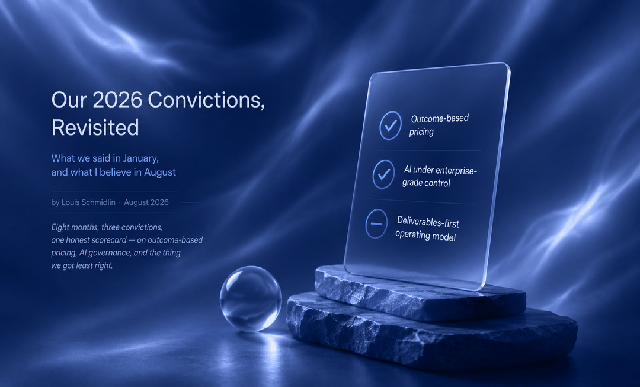
Our 2026 Convictions, RevisitedIn a mid-year review of three convictions regarding ERP transformation, one prediction about pricing moving to outcome-based models is accelerating, another remains valid for unexpected reasons relating to financial predictability in AI governance, while the third belief about deliverable-focused operating models was reassessed to emphasize the importance of connected, traceable decisions rather than merely increasing artifact volume.
8 minute read

Google Opens AI Search Opt-Out to Publishers Worldwide Under UK OrderGoogle is giving publishers worldwide new control over how their content appears in AI Search. The change arrives as falling referrals, zero-click searches, and AI-generated answers force B2B content teams to rethink how they measure visibility.
2 minute read
Case study: ENGIE As ENGIE advances its SAP Cloud ERP transformation, it chose Basware to manage supplier invoices outside the ERP core. This enables a scalable, compliant and automated AP model across nearly 900 entities while keeping SAP standardized. Within two years, automatic matching increased from 20% to 82%, supporting high-volume processing at global scale.
1 minute read