
10 minute read

Meet the Authors
Key Takeaways
What you need to know
Limited digital maturity risks excluding African SMEs from increasingly integrated global supply chains.
SAP says African SMEs can close digital capability gaps through cloud, AI, and ERP adoption.
The message aligns with SAP’s broader Africa positioning around cloud ERP and embedded AI as the foundation for more resilient, integrated operations.
African small and midsize enterprises (SMEs) are entering a critical phase where digital capabilities will increasingly determine competitiveness, resilience, and scalability, according to Dumisani Moyo, Marketing Director at SAP Africa, in a blog post.
SMEs represent a significant share of Africa’s economy, accounting for nearly 95% of registered businesses and contributing roughly half of regional GDP, according to SAP. Moyo outlines the key technology trends shaping SMEs across the continent in 2026, with cloud, embedded AI, and modern ERP systems emerging as foundational pillars of growth.
Digitization Is Uneven
Africa’s SME technology landscape is expanding, but adoption remains uneven at the operational level. Mobile technologies and services generated $220 billion in economic value across Africa in 2024, equal to 7.7% of GDP, according to a GSMA report, underscoring the scale of the region’s digital economy.
Explore related questions
Ask SAPi
Yet many SMEs are still early in translating that momentum into day-to-day business execution. SAP cites World Bank findings showing that fewer than one in three African firms that have adopted digital technologies make intensive use of them for business purposes, reinforcing the gap between access to digital tools and effective use of them.
Connectivity constraints add another layer: Brookings reports that mobile internet penetration in Sub-Saharan Africa was 27% in 2023, helping explain why SME modernization strategies still need to be mobile-first, cost-sensitive, and practical to deploy.
Cloud Becomes the Default Operating Model
To close this gap between access and execution, cloud infrastructure is emerging as the first critical step. Cloud adoption is reaching a tipping point among African SMEs, shifting from a modernization option to a baseline requirement for doing business.
“Cloud replaces large upfront capital costs with predictable subscriptions, supports hybrid and mobile work, and allows businesses to scale systems as they grow. Just as importantly, it reduces the operational burden of maintaining infrastructure, patching systems and managing uptime,” Moyo said.
This shift aligns with broader SAP strategy, where bundled offerings such as GROW with SAP and RISE with SAP are designed to simplify cloud adoption through preconfigured best practices and integrated infrastructure.
The positioning also reflects SAP’s broader messaging in Africa, where company leaders have increasingly framed cloud ERP and embedded AI as the operational foundation for resilience, real-time decision-making, and more integrated enterprise execution.
Business AI Moves From Experimentation to Everyday Use
Once cloud infrastructure is in place, the next shift is how SMEs use that data – driving the move toward embedded AI. The role of AI is also evolving rapidly, transitioning from isolated use cases to embedded functionality within core business processes.
That shift reflects a broader push toward applied AI. SAP has framed measurable AI ROI as a function of embedding intelligence directly into core business processes across finance, HR, procurement, supply chain, and customer operations, where use cases such as automation, forecasting, anomaly detection, and guided decision-making can be tied more directly to business outcomes.
In that model, the value proposition is not only smarter tools, but faster deployment, fewer integration barriers, and a clearer path from experimentation to operational impact. However, skills shortages remain a key barrier, with limited AI expertise slowing adoption and increasing the risk of failed implementations.
ERP Emerges As the Digital Core for SMEs
As AI becomes embedded in operations, SMEs need a system to orchestrate these processes by bringing ERP to the center of transformation. Modern ERP systems are becoming central to SME transformation strategies, acting as the backbone that connects data, processes, and ecosystems.
Viewed through that lens, ERP becomes the core platform that unifies processes and creates the foundation for automation, visibility, and future AI-driven decision-making.
Cloud-based ERP platforms now integrate finance, operations, workforce, and partner networks into a single system of record. This unified approach enables real-time visibility, supports compliance, and provides the foundation for AI-driven insights.
For African SMEs, ERP is no longer just a back-office system but a strategic enabler of growth, innovation, and participation in digital supply chains. Organizations that continue to rely on fragmented, legacy systems risk falling behind on cost efficiency, agility, and trust.
Cybersecurity Becomes a Board-Level Priority
With SMEs digitizing core operations through cloud, AI, and ERP, their risk exposure also increases, bringing cybersecurity into sharper focus.
Rising cyber threats, including ransomware and business email compromise, are increasing both in frequency and impact. Check Point data shows Africa remains the most targeted region globally for cyberattacks, with organizations facing an average of 3,286 attacks per week in Q1 2025
“Cloud platforms can help reduce overall risk by consolidating security, patching and monitoring into professionally managed environments,” Moyo explained.
The overarching message from SAP is clear: African SMEs that invest in cloud, AI, and ERP capabilities now will be better positioned to compete with larger enterprises, while those that delay risk exclusion from increasingly digital ecosystems.
As global and regional supply chains digitize, the ability to integrate, analyze, and act on data in real time will become a prerequisite for participation.
What This Means for SAPinsiders
Cloud economics are reshaping SME IT decisions. Subscription models reduce upfront costs but shift focus to ongoing cost governance and ROI. SAP customers must align cloud adoption with measurable operational outcomes, not just migration milestones.
ERP is becoming the foundation for AI value. Embedded AI depends on clean, unified data within ERP systems. Organizations investing in modern ERP architectures will unlock automation and insights faster than those with fragmented landscapes.
Digital maturity now determines market access. SMEs lacking integrated cloud and ERP capabilities risk exclusion from digital supply chains. For SAP customers, this raises urgency around interoperability, compliance, and ecosystem participation.
More Resources
See All Related Content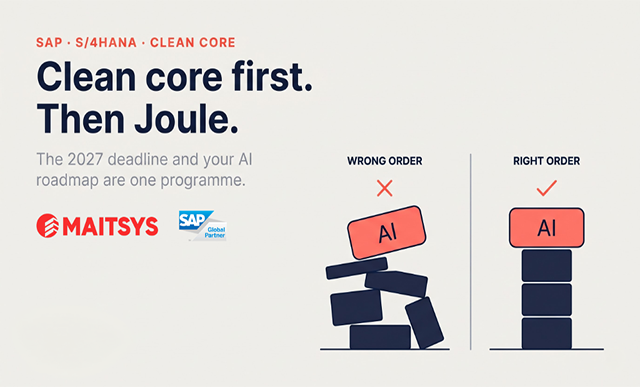
Protecting twenty years of SAP expertise – and building faster than ever before.Minol-ZENNER-Group leverages a two-decade-old custom SAP landscape enhanced with the AI platform Conduct to optimize IT operations, enabling rapid knowledge sharing, streamlined development processes, and improved incident resolution, ultimately turning their complexity into a competitive advantage.
3 minute read

From AI Pilots to ProductionTo capitalize on SAP's AI agents, enterprises must transition from supervised operations to granting these agents autonomy by building trust through a measured track record, clear mandates, rehearsal spaces, and reversibility, starting now to meet future regulatory requirements and unlock productivity.
7 minute read