



Mar 16-19, 2026Las Vegas, Nevada, NV
SAP APO
Featured Insiders
Upcoming Events
SAPinsider Las Vegas 2026
Related Vendors


Supply Chain Management: SAP APO
We are encountering endless advancements in technology and increasing levels of globalization. Businesses are now competing in an unpredictable world. Consumer shopping habits are changing, making sales and operational planning both highly important and challenging. It is important to keep modernizing to get ahead of your competition.
What is SAP APO?
SAP APO stands for Advanced Planner and Optimizer. It is a component complementing the SAP ERP Central Component (ECC) logistics and supply chain processes, like procurement, production, and sales. SAP APO is designed to improve the availability of products, putting customers at the center of the process.
SAP APO has four key capabilities:
- Demand Planning (DP). Analyze sales, consumer trends, historical patterns, and seasonality data to optimize your ability to meet your consumer demand most efficiently.
- Supply Network Planning (SNP). Focused on reducing inventory, safety stock management, and having a realistic supply plan. It supports hierarchical data structures with capabilities to consolidate data into families, versus combing extensive data for individual SKU’s, plants, or warehouses.
- Production Planning and Detail Scheduling (PPDS). Used for creating procurement proposals for in-house production or external procurement to cover product requirements. PPDS covers demand, excess inventory, resource planning, production monitoring, and modifications to the plan.
- Global Available to Promise (GATP). A module that searches to determine if product is available at specific times, and for quantities that satisfy the customer demand. The module works to optimize your customer demand fill rates.
Benefits of an SAP APO implementation are:
- Improvement in profit margins
- Reduced purchasing costs
- Reduced production and logistics costs
- Improved inventory management
- Improved management.
Technical resource partners for consideration might be – SAP, Gib, or Reveal.
Key considerations for SAPinsiders are:
Supply Chain Management: SAP APO
We are encountering endless advancements in technology and increasing levels of globalization. Businesses are now competing in an unpredictable world. Consumer shopping habits are changing, making sales and operational planning both highly important and challenging. It is important to keep modernizing to get ahead of your competition.
What is SAP APO?
SAP APO stands for Advanced Planner and Optimizer. It is a component complementing the SAP ERP Central Component (ECC) logistics and supply chain processes, like procurement, production, and sales. SAP APO is designed to improve the availability of products, putting customers at the center of the process.
SAP APO has four key capabilities:
- Demand Planning (DP). Analyze sales, consumer trends, historical patterns, and seasonality data to optimize your ability to meet your consumer demand most efficiently.
- Supply Network Planning (SNP). Focused on reducing inventory, safety stock management, and having a realistic supply plan. It supports hierarchical data structures with capabilities to consolidate data into families, versus combing extensive data for individual SKU’s, plants, or warehouses.
- Production Planning and Detail Scheduling (PPDS). Used for creating procurement proposals for in-house production or external procurement to cover product requirements. PPDS covers demand, excess inventory, resource planning, production monitoring, and modifications to the plan.
- Global Available to Promise (GATP). A module that searches to determine if product is available at specific times, and for quantities that satisfy the customer demand. The module works to optimize your customer demand fill rates.
Benefits of an SAP APO implementation are:
- Improvement in profit margins
- Reduced purchasing costs
- Reduced production and logistics costs
- Improved inventory management
- Improved management.
Technical resource partners for consideration might be – SAP, Gib, or Reveal.
Key considerations for SAPinsiders are:
- Leverage collaborative demand planning with APO. Anjali Butley is a business analyst with over 18 years of SAP experience in design and development of integrated supply chain solutions. Read her article on the benefits of developing an accurate demand plan with better communication, transparency, and quick decision-making.
- Address planning and scheduling challenges with APO industry extensions. Rajesh Raycurrently leads the SAP SCM product area at IBM Global Business Services. Read his insights to address the planning and scheduling challenges faced by the auto and retail industries.
- Manage promotions planning in SAP APO. Alok Jaiswal, is a consultant at Infosys Limited and has more than six years of experience in IT and ERP in supply chain. See his example of how promotional planning can be configured into SAP APO, which helps you improve forecast accuracy.
25 results

Enterprise-Class Demand Planning at Agilent TechnologiesJul 30, 2021 — For Agilent Technologies, a manufacturer of analytical instruments for the life science and laboratories sector, growth has been dramatic over recent years, including a number of acquisitions. Such growth has caused the company’s pathology division to experience a rapid expansion of sales, but also revealed that the division had outgrown its demand planning practices, which were largely manual and based on desktop productivity software, instead of a true enterprise solution.
Driven by a need to better support its expanding demand pipeline, Agilent's pathology division determined it needed to implement a solution with greater ability to scale and more flexible statistical modeling. By increasing the efficiency and sophistication of its demand planning and, therefore forecasting, Agilent targeted optimizing inventories, supply readiness, and capacity planning.
Distinguishing between one-time events versus long-term trends was identified as a key forecasting capability that needed improvement. By enhancing the statistical methods to generate forecasts, Agilent planned to tune its production and distribution pipelines to be as proactive and efficient as possible.
Read this article and learn:
- How demand planners can fine-tune their forecasts through their knowledge of products and markets;
- How Agilent leveraged its existing GIB investment to make a strong technology and business case for adopting GIB Forecast for demand planning;
- The outcome of implementing GIB Forecasting into Agilent's pathology division and what it achieved;
- How the GIB implementation enabled a self-service modality and greater process control by Agilent's users.
6 minute read
Leverage SAP S/4HANA – PPDS Block Planning Functionality to Optimize Production Schedule Considering High Priority Customer Anticipated DemandApr 5, 2021 — As supply chains evolve in complexity, manufacturing processes are becoming more complex as well. Evolving customer demands, proliferating SKU portfolios, increasing product design complexities, and the need to reduce manufacturing cycle time, are all adding to the complexities in the manufacturing world. A typical plant today manufactures a wide gamut of products, sometimes leveraging the same production line, for a large portfolio of customers. The manufacturing planning hence becomes an optimizing act that incorporates both operational planning (like manufacturing capacity planning) as well as tactical planning (like setup time optimization, route flows etc.). So inherently, the complexities of manufacturing end up spilling into complexities of manufacturing planning as well. And with that comes the need to leverage tools and functionalities that can help manage these complexities better.
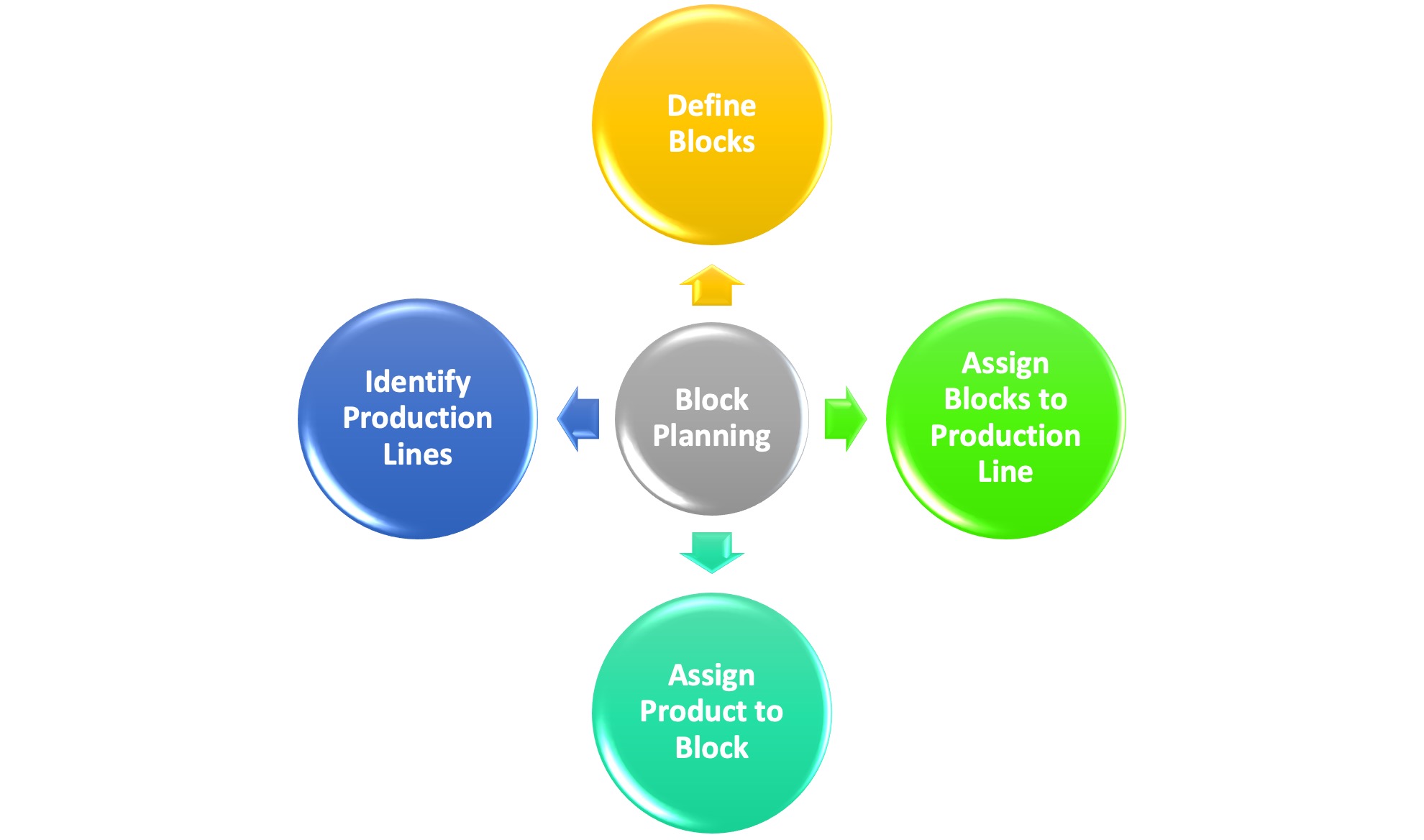
Block planning is one such feature in SAP production Planning and Detailed Scheduling (PPDS), that can help manage manufacturing planning complexity better. While SAP S/4HANA PPDS can help build an optimized schedule based on setup optimization, lead time, and other factors like alternate work center consideration, tool availability, planned machine shutdowns, etc., Block Planning functionality helps in the pre-assignment of resource capacity to produce a group of products with similar characteristics. Block Planning functionality can thus help businesses serve their customers better by prioritizing high-priority customer demand and can improve production yield and efficiencies by reducing changeover time.
Read this article to be able to:
- Understand the building blocks to enable block planning functionality
- Know how to define the blocks and transfer the data to PPDS
- Learn to update PPDS – Optimizer profile to enable block planning functionality
6 minute read
A Comparison of Production Planning and Scheduling functionality on SAP S/4HANA vs. SAP APOJan 21, 2021 — This session provides key criteria to differentiate between production planning and scheduling functionality delivered in SAP S/4HANA and SAP APO. Discuss the key changes, similarities, and differences between SAP S/4HANA and SAP APO and how these changes affect your supply chain. Explore different landscape options for customers who want PPDS functionality. Attend this session to:
- Gain an overview of the planning/scheduling functionality delivered in SAP APO and SAP S/4HANA
- Review key differences and similarities between them and how their functionality is applied to specific supply chain challenges, including real-life project lessons to get results quickly from SAP S/4HANA or SAP APO
- Align the various SAP S/4HANA and SAP APO planning tools to your organization's production scheduling requirements to determine which tool or combination of tools best fits your needs
1 minute read
How to Setup Demand Planning in SAP Advanced Planning and OptimizationMay 21, 2020 — SAP Advanced Planning and Optimization, demand planning allows a business to perform forecasting of their materials while considering all the factors that affect the demand. Demand planning is periodic and contains multi-step processes such as data gathering, statistical analysis, reviewing market intelligence reports, and performing adjustments against budgeted forecast to drive material requirements planning. SAP Advanced Planning and Optimization, demand planning is designed as a platform so it must be tailored to an organization’s product types and nature of their business with various key figures, characteristics, data aggregations or disaggregation factors, planning object structures, planning areas, planning books, macros and data views to execute the process.
This article will provide steps for implementing the solution, along with reasoning behind the configurations, prerequisites, navigation with transactions codes, relevant SAP notes, and tips and tricks for troubleshooting issues during implementation.
In this article you will learn:
- The essential steps of SAP demand planning configurations including time series, planning books, statistical forecasting, background job set up, and demand plan release to ECC;
- Explanation of each configuration step involved with navigation path, transaction codes, and tables; and
- Tips and tricks on configurations, performance optimization, and error resolutions.
21 minute read

Demand Sensing Improves Short-Term Demand Forecasting at Arla FoodsNov 19, 2019 —
Most organizations today are somewhere along the journey toward becoming a digital business, with meeting high expectations for the customer experience a central driver. One of the keys to creating an exceptional experience is the ability to access data in back-end systems in real time, which means that robust integration is critical. This article introduces a new, standardized approach to integration that can help you accelerate your digital transformation and ensure a seamless customer experience.
A holistic integration approach is a key prerequisite for organizations pursuing a digital path for their business. This article introduces SAP’s Integration Solution Advisory Methodology (ISA-M), which helps organizations shape their integration strategy — using predefined integration patterns for processes-, data-, user-, and Internet of Things-centric integration scenarios — and become an Intelligent Enterprise.
Secure connections between applications is critical in modern, hyperconnected landscapes. The SAP Cloud Platform Credential Store service enables highly secure connections between applications in cloud-based landscapes by storing the required credentials and making them available to applications via a REST API. This article provides an overview of the key concepts and configuration tasks that are required to use this service in SAP Cloud Platform landscapes.
Organizations and citizens worldwide have seen the results of the global plastic crisis. In response, policymakers, society, and leading companies, such as SAP, are coming together to work on solutions — by avoiding single-use plastics, better managing and recycling the plastic waste stream, and creating what’s called a “circular economy.” SAP specifically is helping its customers redesign global value networks toward more circular business models through efforts such as the Circular Economy 2030 and SAP Leonardo Plastics challenges and a number of circular uses cases – around secondary materials marketplace, extended producer responsibility, waste insights, and citizen engagement – that are already at work across various industries. Learn about these and other ways that SAP customers can adopt more sustainable business practices, which could unlock $4.5 trillion in growth by turning waste into wealth.
Organizations and citizens worldwide have seen the results of the global plastic crisis. In response, policymakers, society, and leading companies, such as SAP, are coming together to work on solutions — by avoiding single-use plastics, better managing and recycling the plastic waste stream, and creating what’s called a “circular economy.” SAP specifically is helping its customers redesign global value networks toward more circular business models through efforts such as the Circular Economy 2030 and SAP Leonardo Plastics challenges and a number of circular uses cases – around secondary materials marketplace, extended producer responsibility, waste insights, and citizen engagement – that are already at work across various industries. Learn about these and other ways that SAP customers can adopt more sustainable business practices, which could unlock $4.5 trillion in growth by turning waste into wealth.
Discover how SAP customers can improve short-term forecast and delivery accuracy using SAP Integrated Business Planning demand sensing, which uses machine learning and pattern recognition to match and balance forecasts to patterns in demand with inputs from historical and future sales orders, historical shipments, promotions, weather forecasts, and social media sentiment. With this functionality, companies can achieve higher order fulfillment rates and reduced inventory costs with more inventory turns. Learn how the Arla Foods, the world’s fourth largest dairy company, deployed the demand sensing functionality of SAP Integrated Business Planning and improved its forecast accuracy by 5.5% in Denmark and 2.4% in the UK.
5 minute read

Logistics and SCM: Case study: Building a stable supply plan — See how Hollister reengineered a capacity planning solution without an engine and still managed to drive successMar 5, 2019 — Learn how the Hollister expanded the standard capacity-leveling algorithm to include additional parameter checks in its system. SCM2017_Syed_Grace_Casestudybuildingastable Azeemullah Syed If you have comments about this article or publication, or would like to submit an article idea, please contact the editor. Steve Grace If you have comments about this article or publication, or would like […]
1 minute read
Not Your Same Old Advanced Planning System Implementation!Sep 1, 2018 — Panelists: Robert Birdsall and Ryan Rickard, SCMO2 Date: September 6 Sponsor: IBP Bootcamp and SCM 2018 Gone are the days of engaging a System Integrator and waiting nine to twelve months for the first in a series of rollouts. With today’s cloud platform, and specifically SAP Integrated Business Planning (SAP IBP), the platform is upgraded […]
18 minute read
Carry Out Planning for Production Replenishment Using the Supply-to-Production ProcessSep 28, 2017 — Learn the configuration, master data setup, and process flow for the supply-to-production process to replenish the components from a warehouse to production supply areas. Key Concept The supply-to-production process is used to organize the physical replenishment of components for production. It is generally used in the short-term horizon and uses a control cycle and supply […]
14 minute read

Leverage Control and Lower Procurement Costs by Exploiting the Subcontracting Process in PP/DS with Third-Party Provision of ComponentsAug 21, 2017 — Learn the process flow, master data setup, and the subcontracting process with third-party provision of components in SAP Advanced Planning and Optimization (SAP APO) Production Planning and Detailed Scheduling (PP/DS) with integration to SAP ERP Central Component (ECC). Key Concept In a normal subcontracting process, a manufacturing plant has a contractual agreement with a subcontractor […]
11 minute read

Manage a Distribution Plan in a Supply Chain Model in SAP APO When Demand Exceeds SupplyMay 24, 2017 — Learn the process flow and understand the various strategies you can use to deploy supply elements (receipts) in SAP Advanced Planning and Optimization (SAP APO) when the total demand is greater than the available supply. Key Concept Deployment determines which distribution requirements can be met by the supply (receipt elements). Deployment strategies to be used […]
9 minute read