



Mar 16-19, 2026Las Vegas, Nevada, NV
SAP Cloud Providers
Featured Insiders
Upcoming Events
SAPinsider Las Vegas 2026
Related Vendors

SAP Cloud Providers: An Overview and Key Considerations
What are SAP Cloud Providers?
For those moving SAP workloads to the cloud, there are multiple choices available in terms of where those solutions and their associated data repositories are located. For years organizations have been using hosting partners or managed service providers for infrastructure, though these are now referred to as private cloud environments.
At the other end of the spectrum are the SAP Hyperscalers (link to landing page) or what are called public cloud providers. These large organizations often have software or data from multiple customers running on the same hardware or systems in different virtual environments, called multi-tenant public cloud. These public cloud providers can also offer single-tenant public cloud environments where they ensure that software and data from only one organization is present on any given infrastructure.
SAP Cloud Providers: An Overview and Key Considerations
What are SAP Cloud Providers?
For those moving SAP workloads to the cloud, there are multiple choices available in terms of where those solutions and their associated data repositories are located. For years organizations have been using hosting partners or managed service providers for infrastructure, though these are now referred to as private cloud environments.
At the other end of the spectrum are the SAP Hyperscalers (link to landing page) or what are called public cloud providers. These large organizations often have software or data from multiple customers running on the same hardware or systems in different virtual environments, called multi-tenant public cloud. These public cloud providers can also offer single-tenant public cloud environments where they ensure that software and data from only one organization is present on any given infrastructure.
Other environments considered to be SAP Cloud Providers include larger managed service providers that offer their own hosting services in combination with infrastructure from larger public cloud providers. Some examples of these providers working in the SAP space include, but are not limited to:
The last type of SAP Cloud Provider is the managed environment on-premise offered by large technology companies. In these environments, organizations pay based on usage as they would with a public cloud or hyperscaler, but the hardware is physically located in their own data centers. Organizations offering these solutions for SAP are:
Key Considerations for SAPinsiders
- Ensure that you understand as much about your cloud service provider as you can before moving workloads. Every organization will want to understand how much it will cost them to start running workloads in the cloud, and how security can be assured on the data that they have located there. But there are other questions that you should also get answered before selecting a cloud service provider. This blog covers six basic questions that you should ask your cloud service provider before you start moving your SAP workloads and provides a starting point for making sure you know everything you need to know before making a commitment.
- Understand what sort of cloud environment you need and what best suits your requirements.There are many choices when it comes to cloud environments, including private cloud and public cloud, and a combination of these environments referred to as a hybrid landscape. Not every environment is suited for every deployment or every organization, and understanding the pros and cons of each choice is one of the most crucial parts of moving to the cloud. This article interviews multiple executives who made different choices when it came to cloud deployments in their own organizations, and why those made sense to them. Understanding these options is important to ensuring your own cloud success.
18 results

SAP S/4HANA and Microsoft AzureNov 15, 2019 — On October 21, 2019, SAP announced Microsoft Azure as the key cloud platform for SAP S/4HANA. Building on the “Embrace” project SAP announced at SAPPHIRE NOW in May 2019, this new cloud partnership between SAP and Microsoft focuses on creating industry-specific bundles to simplify migration to SAP S/4HANA on Azure, creating a joint sales and […]
5 minute read

SAP Announces Microsoft Azure as Key Cloud Platform for SAP S/4HANAOct 21, 2019 —
Today’s SAP Q3 2019 earnings call went way beyond announcing double-digit year over year revenue growth and a 37% boost in cloud revenue, as it also unveiled a new strategic partnership with Microsoft that emphasizes Microsoft Azure as the key cloud platform to support SAP S/4HANA, SAP’s flagship ERP release.
6 minute read

The Rockport Group Walks Tall in the CloudJan 10, 2017 —
The Rockport Group has long been focused on helping its customers find the right fit – and when the business was sold and subsequently set up as an independent company, it needed to find a good fit for itself. The organization began looking for a way to stand up its own IT infrastructure without pulling its resources away from the primary focus of producing great shoes. To do so, it elected to simplify its ERP processes with SAP Fashion Management while investing in a cloud solution to host its SAP and non-SAP applications. Discover how The Rockport Group stood up its new infrastructure in IBM Cloud and instituted an IT organization focused primarily on business support.
8 minute read

PeroxyChem Starts a Cloud ReactionDec 12, 2016 —
When PeroxyChem was divested from its parent company, it had only one year before it had to get off its parent company’s IT systems and stand up its own. This meant the opportunity to create a systems landscape poised for growth – if the newly divested business could meet all the challenges of building an IT department from scratch. Discover how PeroxyChem partnered with IBM Cloud to deploy an agile, cloud-based IT landscape on time and without business disruption.
8 minute read

Celanese Finds a Perfect Fit in the IBM CloudJul 20, 2016 —
With 40 SAP systems, 213 interfaces, and 30TB of data across development, test, and production environments, Celanese — a specialty materials company based in Texas — knew it needed a way to decrease its annual SAP operational costs. By partnering with IBM and leveraging IBM Cloud Managed Services for SAP, the company was able to migrate its SAP data center and transition away from a capital expense model. Learn how Celanese reduced operational costs by over 50%, increased flexibility for delivery of the SAP platform and operations, and improved service levels for its managed infrastructure.
8 minute read

Wolfgang Knobloch of IBM on Innovations in the CloudMay 31, 2016 — In this video, Wolfgang Knobloch, SAP Offering Manager for IBM Cloud, explores the new features coming to IBM Cloud, including integrated managed service offerings for SAP applications, on-demand SAP HANA appliances, and more. Katie Farrer, THINK Leaders Producer: I’m Katie Farrer here with Wolfgang Knobloch. He is the SAP Offering Manager for IBM Cloud. Thank […]
3 minute read
Accelerating the Adoption of SAP Solutions in the CloudApr 26, 2016 —
The rate of cloud adoption continues to rise among SAP customers, and for good reason: The flexibility afforded by cloud computing has become a major business enabler. Yet choosing the right cloud option can be a challenge, especially when selecting between the customization of a private cloud and the support of a public cloud. To enable easier cloud adoption and simplify this choice, SAP has introduced the partner managed cloud program, a route that enables organizations to use the expertise and support of SAP’s partner ecosystem while deploying their public cloud solution. Learn what benefits the partner managed cloud brings to organizations and how you can capitalize on them.
2 minute read
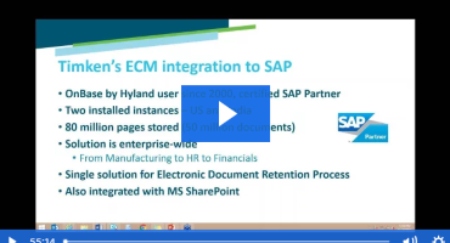
How Timken Company Extends SAP Information Access For Shared ServicesJan 14, 2016 — This webinar is hosted by SAPinsider and sponsored by OnBase by Hyland. Information needed to make decisions and support business isn’t always stored in SAP. While many organizations still struggle with information stored on paper, in file shares, or on Microsoft SharePoint sites, to name just a few, the Timken Company has transformed information access […]
1 minute read