1 minute read

Key Takeaways
What you need to know
Organizations are shifting to SAP Cloud ERP, necessitating a strategic partner selection process that goes beyond basic criteria, impacting those with limited cloud experience. This transition is crucial for operational efficiency and future growth.
The move emphasizes the importance of Clean Core governance and the use of SAP's integrated toolchain, including SAP Cloud ALM and SAP Signavio. Adhering to these practices is essential to prevent technical debt and ensure successful project outcomes.
Selecting a partner should also focus on their ability to drive long-term innovation through SAP Business AI capabilities and post-go-live support strategies. This ensures continuous improvement and maximizes the value derived from the ERP implementation.
Moving to the cloud represents a significant shift for many organizations, particularly those with limited internal experience in cloud environments or cloud-based ERP. As a result, selecting the right implementation partner has become one of the most critical decisions for organizations embarking on SAP Cloud ERP transformations.
To help customers navigate this decision, SAP has developed the partner selection guide, designed to highlight the key questions organizations should ask and the most important end-to-end criteria to consider when selecting an implementation partner for SAP Cloud ERP Private. By providing greater transparency into partner delivery capabilities, the partner selection guide helps organizations make more informed decisions when planning their transformation journey.
1. The Pre-Qualification Phase
The initial search for an SAP Cloud ERP Private implementation partner requires moving beyond generic criteria. A good starting point is the SAP Partner Finder, where customers can identify active partners with a valid SAP partnership and filter for those specializing in SAP Cloud ERP Private consulting and implementation services. Customers can further refine their search by enabling relevant SAP competencies and using the Best Match Sorting functionality, which highlights partners based on their experience, delivery capacity, and project track record. For organizations planning large or multi-country transformations, it may also be valuable to filter for companies recognized as RISE with SAP Validated Partners, whose global delivery methodologies have been validated by SAP. The validated partner methodology emphasizes deep industry expertise to ensure global compliance without sacrificing standardized business processes.
Explore related questions
Ask SAPi
2. The Shortlist and the Clean Core Mandate
Once a list of potential partners has been identified, the next step is to create a shortlist based on the capabilities required. Customers should assess whether the partner’s implementation methodology aligns with SAP Activate for SAP Cloud ERP Private, ensuring the project approach goes beyond a technical migration to support broader business transformation and innovation objectives. At this stage, it is also important to validate whether the partner plans to leverage the SAP integrated toolchain, including solutions such as SAP Cloud ALM, SAP Signavio, SAP LeanIX, and SAP Build, which together enable structured project governance, process optimization, and architectural transparency throughout the transformation journey.
Successful transformations typically require close cooperation between the customer, the partner, and SAP advisory teams. Customers should therefore confirm that the partner is willing to work in close alignment with SAP experts and incorporate SAP’s recommendations into the transformation roadmap. In addition, organizations should review the project team composition and certifications, ensuring critical roles are included and that consultants hold relevant credentials and experience. This helps ensure the shortlisted partners have both the technical expertise and the delivery structure required to support a successful implementation.
The Clean Core philosophy is now an operational mandate, and the RISE with SAP Methodology includes mandatory Clean Core Quality Gates at the end of each project phase to strictly monitor deviations. Hence, securing partner commitment to follow and leverage Clean Core guidelines ensures alignment with SAP’s best practices.
3. Final Selection: Choosing the Finalists
After narrowing the list to a few finalists, organizations should evaluate partners based on their ability to drive long-term innovation and deliver proven results. This includes assessing how the partner supports SAP Business AI adoption, including the use of capabilities such as Joule for Consultants and Joule for Developers, and how they incorporate these innovations into the implementation approach.
Equally important is understanding how the partner will support the organization beyond go-live. During this final stage, it is also valuable to clarify key elements such:
- Whether the partner establishes a clear RACI (Responsible, Accountable, Consulted, Informed) chart to define accountabilities before kick-off.
- How they handle change management and business friction
- Whether the partner utilizes SAP Business AI, specifically Joule for Consultants and Developers, to accelerate implementation
- Post-go-live, the partner must offer continuous improvement services, ensuring the system leverages the latest release updates
Finally, real success is determined by how a partner manages unforeseen risks and whether they are prepared to expand the SAP footprint over time. Addressing these considerations helps ensure the selected partner can not only deliver the implementation successfully but also support the organization’s ongoing transformation journey.
What This Means for SAPInsiders?
Mandate clean core governance from day one. Organizations must ensure that their partner has a tangible success plan based on SAP’s clean core strategy, is committed to conducting Clean Core Quality Gates at the end of every project phase, and manages tasks directly via SAP Cloud ALM. This discipline prevents the technical debt that often derails future cloud upgrades.
Utilize the full SAP integrated toolchain. Customers with SAP Cloud ERP licenses have access to SAP’s integrated toolchain for innovation. This includes SAP Signavio for process optimization, SAP LeanIX for target IT architecture, and SAP Cloud ALM as the digital backbone. Effectively using these tools helps ensure transparency, agile transformation, and provides a strong foundation for future innovation. Understanding and effectively using the tools available is a crucial part of overall project success.
Prioritize AI readiness and continuous innovation. Partners must demonstrate capabilities in SAP AI Adoption, specifically leveraging Joule for Consultants and Joule for Developers to accelerate the build. Moreover, they need a prescriptive strategy for post-go-live support to keep systems on the latest releases and continuously driving business value to help organizations succeed.
More Resources
See All Related Content

Navigating SAP cloud hosting options: is it time to worry?Navigating SAP cloud hosting options offers various strategies, particularly through hybrid setups that preserve critical local workloads and optimize legacy hardware, allowing for a customized roadmap that addresses rising costs, evolving licensing models, and operational needs while minimizing migration efforts and expenses.
4 minute read
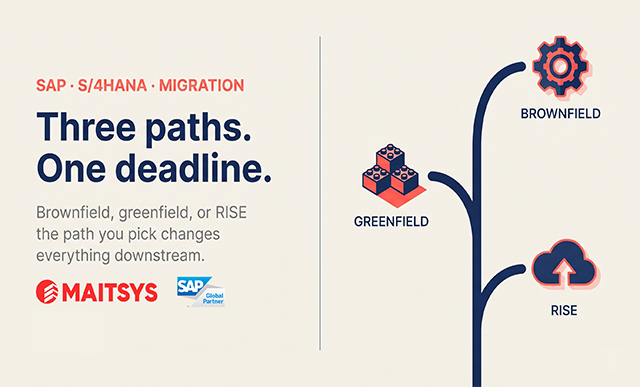
ECC to S/4HANA: Brownfield, Greenfield, or Selective Data Transition?To effectively transition from SAP ECC to S/4HANA, organizations must separately decide on their system transformation approach—whether through system conversion, new implementation, or selective data transition—and their operational model, with RISE with SAP primarily addressing the latter.
8 minute read