1 minute read

Meet the Authors
Key Takeaways
-
Organizations are shifting to SAP Integration Suite’s Edge Integration Cell (EIC) on Red Hat OpenShift to unify hybrid cloud environments, which enhances efficiency and reduces operational silos.
-
This change matters because it provides a consistent, secure platform for managing sensitive data across on-premise and cloud applications, ensuring a robust foundation for hybrid strategies.
-
This strategic shift impacts SAP insiders and IT teams by simplifying integration management, boosting security with a hardened supply chain, and offering flexible deployment options to future-proof their hybrid infrastructures.
SAP Integration Suite’s Edge Integration Cell (EIC) has emerged as the essential sovereign bridge for organizations needing to link on-premise sensitive data with the innovation of the SAP cloud. However, the business value of a hybrid model is only as strong as its underlying foundation.
In the final part of this series we explore why the focus is now shifting from deploying a cell to choosing an engine that can run it with enterprise-grade consistency across any environment. This is where the long-established partnership between SAP and Red Hat becomes mission-critical. Through joint engineering, the two giants have optimized the EIC to run on Red Hat OpenShift, creating a platform that extends cloud-native investments.
Consistency is the New Scalability
Fragmentation—using different tools for on-premise versus cloud operations—is the biggest challenge in hybrid cloud. However, running EIC on OpenShift eliminates this. It provides a trusted and consistent hybrid platform that supports the EIC whether it is deployed in a local data center or a public cloud environment. For teams already using OpenShift, this means adding SAP integration capabilities without adding a single layer of unnecessary IT complexity.
Explore related questions
A Solutions Brief by Red Hat indicates that since OpenShift is built on Red Hat Enterprise Linux (RHEL), it brings a hardened security foundation to the integration layer. This includes a trusted software supply chain and built-in security features that are vital when handling the sensitive workloads that necessitated a hybrid approach in the first place. For those looking for a hands-off experience, SAP also supports managed instances like Microsoft Azure Red Hat OpenShift (ARO).
The Strategic Shift for PI/PO Veterans
For veterans of SAP PI/PO, the SAP-Red Hat collaboration indicates a fundamental shift in how ground-to-ground integration is handled. By moving to an OpenShift-powered EIC, organizations aren’t just replacing a legacy server, but are moving to a container-based, scalable architecture that can run multiple integration cells simultaneously. This flexibility provides the rock-solid platform required to make the vision of the intelligent manufacturing thread a reality.
What This Means for SAPinsiders
Achieve architectural consistency across delivery environments. Standardizing the integration layer on Red Hat OpenShift across on-premise and cloud models reduces operational silos and simplifies management.
Secure the integration layer with a hardened supply chain. Running EIC on OpenShift provides a hardened environment with a trusted software supply chain, which is essential for protecting sensitive workloads at the edge.
Future-proof the hybrid strategy with managed service options. Organizations can balance control and reduced IT overhead by choosing between self-managed OpenShift or managed instances like Azure Red Hat OpenShift.
More Resources
See All Related Content
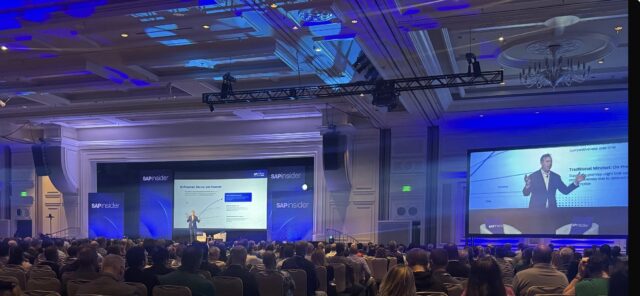
SAPinsider Las Vegas Opening Keynote: David Robinson Says SAP Customers Must Rethink IT Operating Models, Not Just Modernize ERPDavid Robinson, President of SAP North America, highlighted at SAPinsider Las Vegas that business transformation is no longer a linear process, as enterprises face an exponential convergence of AI, cloud, and automation.
4 minute read
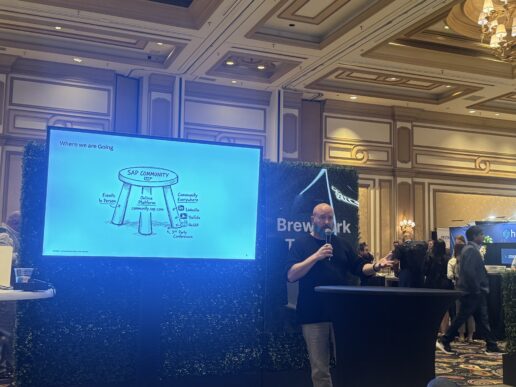
SAPinsider Las Vegas: AI Builds Confidence, but Community Still Defines CredibilityAt SAPinsider Las Vegas, Josh Bentley emphasized that while AI may boost user confidence in enterprise applications, true credibility still relies on human experience, as AI often provides shallow answers that lack depth and context, making community engagement essential for informed decision-making.
4 minute read