
1 minute read

Meet the Authors
Key Takeaways
What you need to know
In SAP Plant Maintenance environments, mobile forms are not a digitized checklist but a data-quality control point that validates field capture against SAP PM master data.
With 49% of EAM respondents citing fragmented asset data and only 7% having completed AI/ML deployments, the predictive maintenance gap is a data-capture problem, not an algorithm problem.
Offline-capable, master-data-validated capture aligned to ISO 14224 and ISO 8000, using no-code platforms like Sigga Empower Forms, is the prerequisite the analytics roadmap depends on.
Walk the floor of almost any manufacturing plant running SAP, and you will eventually find that clipboard, the grease-stained paper checklist, or the hastily updated spreadsheet serving as the unofficial system of record. For manufacturers pouring millions into predictive maintenance, artificial intelligence (AI), and supply-chain resilience, this analog disconnect is a critical architectural blind spot. This challenge can be alleviated with Mobile forms in SAP Plant Maintenance (PM).
However, these mobile forms must be viewed as a rigid data-quality control point. The central issue is whether the data created at the point of service is structured, complete, governed, and synchronized deeply enough to fuel reliability programs. This challenge is why purpose-built solutions like Empower Forms from Sigga Technologies are increasingly entering the enterprise architecture conversation.
The Manufacturing EAM Reality Gap
The SAP Enterprise Asset Management (EAM) backdrop is consistent across recent practitioner research. Manufacturers are aggressively chasing end-to-end visibility across enterprise assets, with 65% ranking it as a top EAM strategy, and nearly as many prioritize the uniformity and quality of their asset data.
Explore related questions
Ask SAPi
Yet, the operating reality is far less tidy. Nearly half (49%) of EAM respondents admit their asset data comes from multiple fragmented sources, making it inherently difficult to normalize and report. After a field inspection, a standalone spreadsheet often becomes the master record, forcing planners, reliability engineers, and data teams to manually reconcile information after the fact. This fragmentation undermines the predictive AI programs these organizations are actively funding.
The Empower Forms Data Layer
In SAP PM environments, a true forms layer does much more than digitize a checklist. Its business value hinges on validating entries natively against SAP PM master data and syncing without triggering another manual handoff.
Consider a routine scenario on the plant floor. A technician completes a centrifugal pump inspection. They capture vibration and temperature readings, note the replacement of a mechanical seal, and record the specific catalog part used from inventory. On paper, that critical event record may reach SAP PM days later, forcing a planner to reconcile equipment numbers and functional locations retroactively.
However, when deploying a governed digital workflow, such as Sigga’s Empower Forms, that same record is captured in a structured format with mandatory fields, conditional logic, and required photo evidence. By natively connecting field data to SAP Work Orders and Notifications, Empower Forms eliminates downstream interpretation. These granular details directly feed the metrics used to evaluate maintenance ROI. If the source data used to calculate Mean Time Between Failures (MTBF) and Overall Equipment Effectiveness (OEE) is inconsistent, the entire performance conversation loses credibility.
The AI Disconnect and Offline Architecture
This is where the AI and machine learning (ML) conversation often gets ahead of itself. SAPinsider research shows that currently, 71% of organizations want AI recommendations to improve uptime, and 70% want to ingest real-time sensor data from connected assets. Yet, a striking 7% have completed AI/ML deployments.
Thus, the familiar SAP PM problem is not that no one captured the maintenance data; it is that the data was captured inconsistently, and then a data scientist was asked to make it predictive.
Moreover, 59% of organizations using EAM require maintenance technicians to work remotely or in dead zones on the shop floor. This makes offline-capable, master-data-validated data capture an architectural necessity. When using a no-code platform like Empower Forms, standardized point-of-service capture becomes the reliable prerequisite upon which the entire analytics roadmap depends.
Governance and the Human Element
Technology alone cannot force discipline. Mobile forms only improve data quality if they are designed against a standard and adopted consistently by the humans using them. Therefore, using standard specifications, such as ISO 14224 and ISO 8000, is critical to enforcing asset data consistency.
However, some organizations cite organizational silos as a major obstacle to EAM adoption. The departmental boundaries that fragment maintenance data are often the same ones that prevent a common form library across different plants. A centralized forms platform makes standardization easier to operationalize, but true transformation remains a matter of enterprise architecture, stringent governance, and change management.
What This Means for SAPinsiders
Enterprise architects in manufacturing must enforce master data discipline. Assess point-of-service capture tools strictly by how well they validate against SAP PM master data and support global standards like ISO 14224. If a tool creates another data silo, reject it.
CIOs should tie AI investments to data capture. IT leaders must treat predictive maintenance and AI/ML investments as strictly dependent on measurable improvements in floor-level asset data completeness. This is because an algorithm cannot fix what the technician failed to record properly.
SI and GSI leaders must lead with governance. Approach mobile forms rollouts as data-governance and organizational-change engagements with a software component attached. Standardizing the human workflow across plants with tools like Empower Forms is what ultimately shapes the ROI of the application layer.
More Resources
See All Related Content
Every change validated, authorized, and on the recordEvery entry is checked against your master data before it is written, access is decided by roles down to the row, and every change is on the record in your own platform. Business data stays where it is. NextTables keeps configuration only.
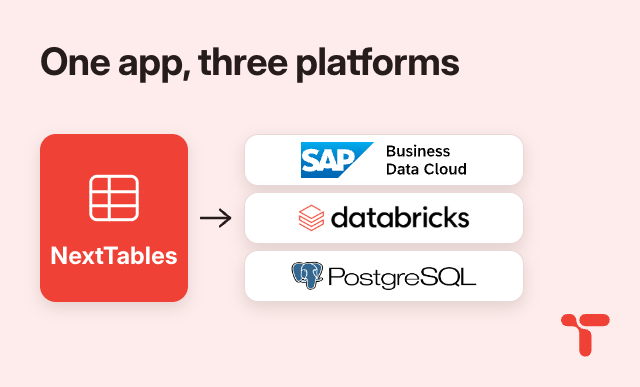
One data maintenance app, three enterprise data platformsBuild data maintenance apps, guided for business teams, trusted by IT. Business teams update their own data, with validation at entry, role-based authorization down to the row, and an audit log of every change stored inside your data platform.
1 minute read
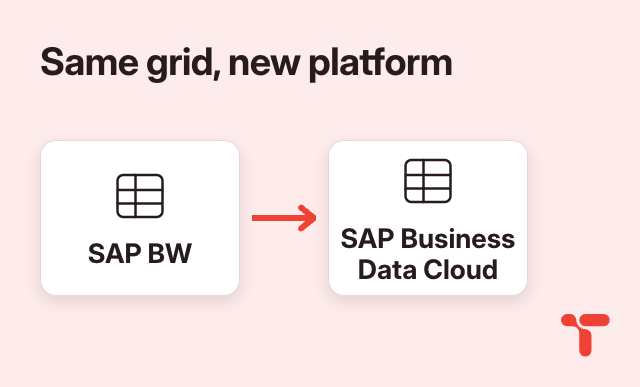
SAP BW today or SAP Business Data Cloud tomorrow: the same gridOne runs inside your SAP Business Warehouse (BW) as an add-on, the other as a service on your enterprise data platform. The grid, validation at entry, import and embedding work the same way on both. Where it runs, who signs in, and how each platform keeps changes validated, authorized and auditable is what differs.
1 minute read