

2 minute read

Meet the Authors
Key Takeaways
What you need to know
Cloud sovereignty is shifting from a compliance concern to an architectural priority, impacting how enterprises design their cloud environments and necessitating careful consideration of data, operations, and technology choices.
Sovereignty decisions extend beyond mere data residency, emphasizing operational control and technology governance, which are crucial for organizations to navigate regulatory landscapes effectively.
Adopting hybrid cloud architectures allows organizations to segment workloads based on sensitivity, enhancing sovereignty while still benefiting from the scalability and innovation of public cloud solutions.
Cloud sovereignty is becoming a defining factor in how enterprises design, operate, and scale their cloud environments. According to T-Systems’ analysis, the growing interdependence of data, operations, and technology choices is shifting sovereignty from a compliance concern to an architectural priority.
The first part of this series examined how sovereign cloud models reshape SAP migration strategy by addressing regulatory exposure and data residency risks. The next step is for enterprises to choose among cloud models once sovereignty becomes a requirement. The decision centers on how much control an organization needs and where trade-offs begin to constrain it.
Sovereignty as a Decision Lens
Sovereignty is often reduced to data residency, but in practice, it spans three layers: where data is stored, how systems are operated, and how easily technology choices can change over time.
Explore related questions
Ask SAPi
Most cloud models only address one or two of these layers. Public cloud environments deliver scale and performance but offer limited control over jurisdiction and underlying technology. Even with regional data centers, operational control and legal exposure often remain tied to the provider.
Private and sovereign models extend control in different ways. Private cloud improves data and operational control, particularly for proprietary SAP workloads, but can limit ecosystem access and flexibility. Sovereign cloud aligns data, operations, and technology within a defined jurisdiction, often using modular or open architectures to reduce dependency on a single vendor.
Where Cloud Models Break Down
No single model satisfies cost, scalability, and sovereignty requirements simultaneously:
- Public cloud is the most efficient for scaling SAP workloads and accessing advanced services, particularly for analytics and AI, but introduces legal and operational exposure.
- Private cloud improves control but can restrict innovation and platform access.
- Sovereign cloud offers the highest level of control, but often at the expense of ecosystem breadth and cost efficiency, making it most relevant for highly regulated industries.
Hybrid architectures emerge as a practical outcome. They allow organizations to segment workloads by sensitivity, keeping core SAP data in sovereign or private environments while using the public cloud for less-regulated, high-demand workloads.
Cloud Becomes an Operating Model Decision
SAP environments are inherently interconnected. Finance, supply chain, HR, and customer systems exchange data continuously across platforms, which means sovereignty decisions cannot be isolated to individual systems. They must account for how data flows across the entire landscape.
For example, placing core ERP data in a sovereign environment does not fully mitigate risk if that data is replicated into analytics platforms or integrated with external systems under different jurisdictions.
This shifts the architectural focus. SAP teams must design not only where systems run, but how data moves, how it is governed, and how dependencies are managed across environments. Sovereignty becomes a matter of controlling system-wide behavior, making cloud selection an ongoing operating model decision rather than a one-time infrastructure choice.
Practical Steps for Sovereign SAP Migration
SAP teams must first classify which data and processes are subject to regulatory constraints. From there, workloads can be segmented across sovereign, private, and public environments based on sensitivity and performance requirements.
The next step is defining data boundaries—how information moves, where it is replicated, and how it is governed. Integration design becomes critical because sovereignty risks often emerge from data flows rather than from system placement. Only then should infrastructure decisions and migration sequencing be finalized, typically starting with less sensitive or less interdependent workloads.
What This Means for SAPinsiders
Sovereignty decisions must extend beyond data residency to full operational control. Many SAP teams equate sovereignty with where data is stored, but operational and technological control are also important. If application management, access controls, or platform dependencies remain external, sovereignty is incomplete. SAP teams should evaluate who controls operations, not just where systems reside.
Hybrid architectures require intentional workload segmentation. Their effectiveness depends on how environments are structured across data sensitivity, regulatory exposure, and performance needs. This enables organizations to maintain sovereignty while still leveraging public cloud scalability and innovation.
Data flow governance is a core architectural responsibility. Sovereignty cannot be maintained if data moves freely across systems without oversight. As SAP landscapes become more integrated, organizations must define how data is shared, replicated, and accessed across environments. Establishing clear governance policies ensures sovereignty is preserved throughout the lifecycle of SAP-driven processes.
More Resources
See All Related Content

The Mandatory Transformation Your Business Didn’t Choose Could Be Its Biggest OpportunityThe mandatory migration to S/4HANA, often viewed as a disruption, can be transformed into a strategic opportunity through Lemongrass's Brightfield approach, which integrates AI from the onset to streamline the process, reduce costs, and unlock business value before go-live.
6 minute read

Navigating SAP cloud hosting options: is it time to worry?Navigating SAP cloud hosting options offers various strategies, particularly through hybrid setups that preserve critical local workloads and optimize legacy hardware, allowing for a customized roadmap that addresses rising costs, evolving licensing models, and operational needs while minimizing migration efforts and expenses.
4 minute read
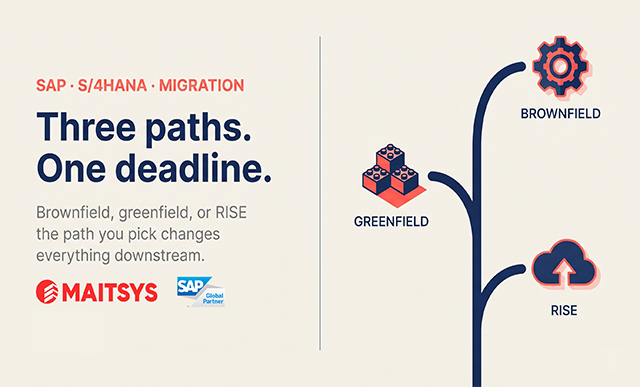
ECC to S/4HANA: Brownfield, Greenfield, or Selective Data Transition?To effectively transition from SAP ECC to S/4HANA, organizations must separately decide on their system transformation approach—whether through system conversion, new implementation, or selective data transition—and their operational model, with RISE with SAP primarily addressing the latter.
8 minute read