

2 minute read
Meet the Authors
Key Takeaways
What you need to know
The transition to advanced treasury architecture at Sun Chemical exemplifies how automation and embedded systems like SAP transform daily finance operations, allowing treasury teams to focus on strategic forecasting rather than manual data entry.
The shift towards centralized cash application, payment processes, and fraud controls is crucial for companies undergoing acquisitions, as it ensures seamless integration and operational control across disparate financial entities in a global footprint.
Effective finance transformation hinges on nurturing cross-functional talent and forming strategic partnerships, enabling organizations to adapt their SAP solutions to evolving business needs and maximize outcomes beyond mere software costs.
For finance and technology leaders, the most important question about any new platform is not what it does but how it will change daily work across treasury, payments and cash operations. Sun Chemical’s SAPinsider Las Vegas 2026 session, “Sun Chemical’s Journey to First-Class Finance,” highlighted its long-running finance transformation offers a clear view of what that shift looks like when automation, embedded in SAP, becomes the backbone of global treasury.
What a Modern Treasury Stack Changes
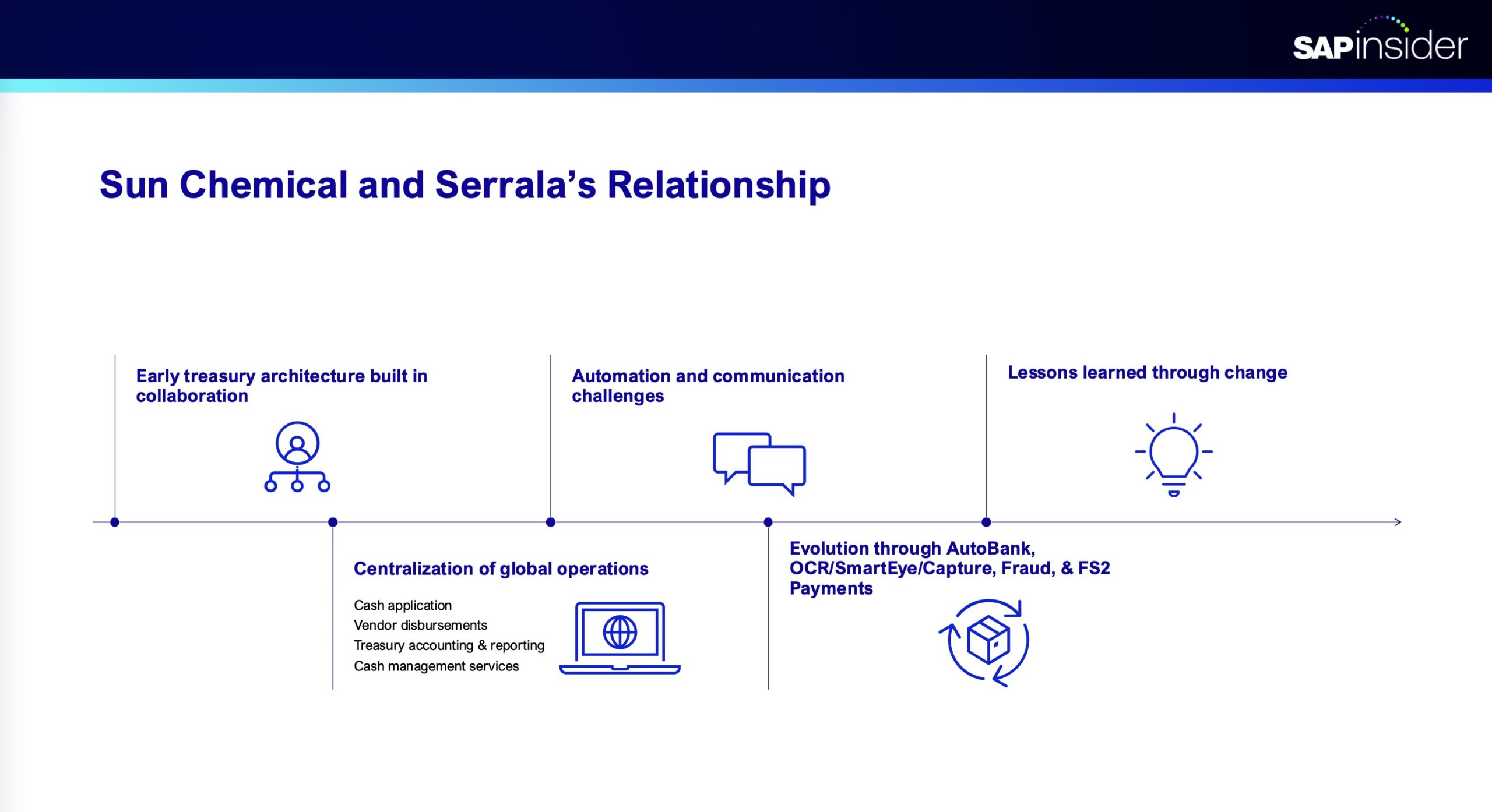
Sun Chemical’s early treasury architecture was built collaboratively around SAP to cover core functions such as cash application, vendor disbursements, treasury accounting and reporting, and cash management services. Over time, the company expanded this foundation with tools including AutoBank, optical character recognition and capture for remittances, fraud controls and advanced payments capabilities. That evolution matters because it shows that even a highly distributed manufacturer can centralize key processes without forcing a one-size-fits-all approach on every region.
For day-to-day treasury teams, this architecture changes where time is spent. Instead of keying remittance data and reconciling exceptions by hand, analysts work from automated posting proposals and exception lists generated directly from SAP data. Cash managers gain earlier visibility into expected inflows and outflows, which improves forecasting and supports more disciplined use of credit facilities and surplus cash.
Explore related questions
Ask SAPi
The Sun Chemical story also highlights how automation helps companies scale through acquisition. As new entities join the group, consistent cash application and payment processes provide a template for integrating local finance operations into the global model without sacrificing control.
From an IT perspective, embedded automation tightens alignment between treasury and SAP teams. Treasury requirements for new payment formats, fraud checks or bank connectivity can be addressed as part of SAP change cycles rather than as side projects, which reduces integration risk and keeps master data, configuration and workflows synchronized.
How to Evaluate and Prepare for Next-Generation Finance Automation
The session also offered practical guidance on how finance and technology leaders should evaluate solutions and prepare their own SAP roadmaps. Sun Chemical’s experience reinforced that business needs should shape system design, not the other way around, and that no single solution will be the right fit for every scenario across a global footprint. For executives, that means starting with concrete objectives such as reducing days sales outstanding, improving payment on time performance, or tightening fraud controls, then mapping those to the capabilities of SAP and potential partners.
When weighing SAP-native options against specialist tools, the company emphasized looking beyond license price to total value. Factors such as the cost of bank integration, the level of automation achievable without custom development, and the ability to support future changes like new payment schemes or fraud patterns are all part of the equation. Strong partnerships that allow room to evolve, adjust and improve over time were cited as a key success factor, particularly as legacy decisions continue to influence S/4HANA strategy.
Sun Chemical’s roadmap also underscores the importance of talent and governance. The company highlighted the need for strong internal teams capable of owning Treasury and SAP design decisions even when working closely with external providers. For technology executives, this translates to investing in cross-functional skills that span cash management, SAP configuration and integration so business and IT can make informed trade-offs together.
Integrating fraud controls into the same payments architecture that handles routine vendor disbursements allows finance teams to monitor anomalies centrally instead of relying on regional workarounds. Payment reviews and phased implementations give organizations a way to harden controls without disrupting operations, which is critical for companies that process large transaction volumes across many banks and currencies.
Looking ahead, Sun Chemical’s planned S/4HANA migration will test how well its finance architecture can adapt to new deployment models and release cycles. The company’s emphasis on process discipline, automation and partnership suggests that success will depend less on any single product and more on how well treasury, IT and providers coordinate around a shared roadmap.
What This Means for SAPinsiders
Treasury automation will reshape finance operating models. Leaders must treat embedded cash application, payments and fraud controls as core architecture decisions that determine how effectively global finance teams can scale, safeguard liquidity and support growth.
Partnerships and talent become transformation force multipliers. Enterprises that pair strong internal treasury and SAP skills with adaptable solution partners will navigate S/4HANA moves and ongoing change more successfully than those relying on tools alone.
Value measurement must extend beyond license cost. CIOs and CFOs should evaluate finance automation through end-to-end outcomes like control strength, integration flexibility and scalability rather than focusing narrowly on initial project and software pricing.
More Resources
See All Related Content

SAP Licensing Is Becoming a FinOps DisciplineOrganizations transitioning through various SAP landscapes face increasing challenges in managing and understanding SAP licensing costs, necessitating a shift towards continuous financial governance and transparency similar to FinOps principles to prevent overspending and compliance risks.
2 minute read

SAP Releases Accounting Accruals Agent for Month-End CloseSAP has released an AI agent that applies company accrual policies, retrieves financial data, calculates accruals, and prepares journal entry proposals. The agent works through Joule in SAP S/4HANA Cloud Public Edition and is under Restricted Availability.
3 minute read