The latest version of the Material Ledger is a significant upgrade and includes two important inventory reporting options: compilation of actual bill of materials and automatic tracking of multilevel variances from standards.
I have known about the Material Ledger since R/3 release 3.0B. But perhaps like a lot of field consultants, did not get too excited about its functionalities until I first saw the 4.6 release’s version. After just one day of running test scenarios (in preparation for co-teaching the SAP class on Material Ledger, course #AC510), I called the controller from a project I worked on in 1998. He had been unhappy after the cutover to R/3 because two of his favorite inventory analyses became impossible to perform. I knew he had gone through a recent upgrade to the 4.6 release.
I asked him if the upgrade’s scope had included the addition of the Material Ledger to the existing design. "No? Then, I must show you something!"
At the end of this article, you will know what I know — that for a wide variety of businesses, the 4.6 version of the Material Ledger represents a major upgrade in functionality for the accounting department, especially in regard to two kinds of inventory reporting that are extremely difficult (if not impossible) to achieve anywhere else in R/3:
- The compilation of the so-called "Actual BOM" (bill of materials)
- The automatic tracking of so-called "Multilevel" variances from standards
Before I present my findings on these two kinds of hard-to-get analyses that come standard with the 4.6 Material Ledger, I will first explain what the Material Ledger is and define three potentially troublesome SAP terms in the Material Ledger.
What the Heck Is the Material Ledger?
Without the Material Ledger, a business using R/3 has two options for establishing a value on its balance sheet for each kind of inventory it buys, makes, or sells. These are Standard Costing and Moving Average Costing. The Material Ledger offers a third option, which I have sometimes heard called "Moving Average Actual" or "Actual Costing."
As a cost accountant, I have difficulty with any term that pretends to represent the actual value of anything (so many assumptions go into any kind of a calculation). Okay, I know what people who use the terms are trying to say. Still, for the rest of this article, I will refer to the third option offered through the Material Ledger by the formal field name given to it by SAP. This name is "Periodic Unit Pricing."
Periodic Unit Pricing removes the two biggest causes of headaches for the accounting department that come from Standard Costing and Moving Average Costing:
1. After a variance-from-standard has been recorded, neither the standard nor moving average costing options offer the chance to track that variance through the remainder of the production and sales cycle. This lack of tracking makes for extremely difficult allocation decisions at month-end in regard to how much of that variance to put on the balance sheet (because you still own the inventory or its output) and how much to expense to the P+L (because you’ve sold or scrapped the inventory).
2. For no reason other than timing differences, inventory valuations can become 100 percent invalid. This phenomenon occurs with inventory set up as a "moving average" material. Figure 1 shows an example.
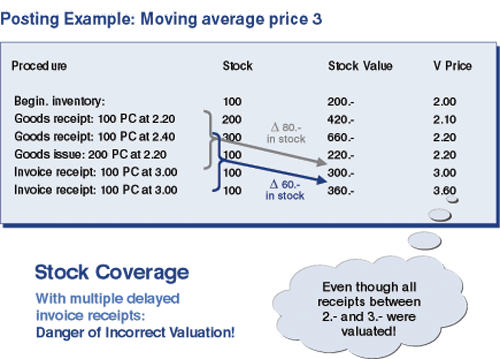
Figure 1
Timing Differences as the Sole Cause of Inventory Valuation Fluctuations
Three SAP Vocabulary Words in the Material Ledger to Be Careful With
As with all software, functionality has to be described, and sometimes those descriptions can be misleading. That, in turn, can cause confusion and perhaps even lead to a decision not to implement something that otherwise would be useful.
To me, the Material Ledger has three such vocabulary words, which are as follows.1
Actual Costing: Cost accounting is always based on assumptions, and the assumptions made at one business to come up with "actual cost" might hold up each and every period, or might not hold up each and every period. The Material Ledger does not track or measure these assumptions for you. It is simply accounting for each and every inventory movement and presenting that information to you in an easy-to-research format.
Inventory Subledger: I have seen the Material Ledger referred to as R/3’s inventory subledger. This is nonsense. Every site that uses the FI/CO and MM modules has an inventory subledger whether or not the Material Ledger is turned on. This inventory subledger is made up of three database tables called MKPF, MSEG, and MBEW. It does not go away just because a site decides to also activate the Material Ledger.
Parallel Valuation: This term comes across as an innocent and harmless option in the Material Ledger to store the balance sheet value of your materials in more than one currency. You must think through how you use parallel valuation very carefully because retroactive changes can be made only with great effort. Worse, the setting can actually lead to a system-enforced shutdown against any and all transactions related to a plant. That particularly unpleasant surprise can occur if you choose to activate the functionality in Profit Center Accounting known as Transfer Pricing anytime after you have activated the Material Ledger, and in doing so, you realize that the currency settings in your Profit Center Accounting’s Controlling Area need to be changed in order to support your Transfer Pricing goals. R/3 warns you not to do it, but allows the change. At that point, all materials linked to plants linked to company codes linked to that controlling area become unusable.
T
wo Kinds of Hard-to-Get Analyses that Come Standard with the Material Ledger
Several new kinds of analyses in R/3 become much more simple to accomplish with the Material Ledger active for the materials of a given plant. For me, two of these seem more dramatic than the others, especially given the ease with which I was able to get both of them operational my first time trying.
1. The compilation of the Actual BOM
2. The automatic tracking of Multilevel variances from standards
If during the month any of the materials that you manufacture have multiple production orders, the Material Ledger will offer you a standard report that shows you the exact quantity of recorded inputs vs. recorded outputs in total. The title given to this kind of analysis is the "Actual BOM" report. The benefits of such a report to each kind of business might vary, but I do not know any other source in R/3 to so easily get this kind of data summarized in this fashion. My first time working with it, I got it running with almost no customization or learning-curve effort at all. An example of the report is shown in Figure 2.
Convincing the Material Ledger to give me the Multilevel variance report took a bit more effort, but only because the navigation to it is confusing. I found the customization effort, however, to once again require very little on my part. Within my first two hours, I could run reports such as the one shown in Figure 3. As help for interpreting the data shown in the screenprint, I have also provided in Figure 4 a screenprint of the Single Level variance report for one of the raw materials used in the BOM for material C10000020.
You’ll need to look closely, but notice in Figure 4 how that raw material had total receipts during the period of 4,000 pounds. That quantity was recorded in the G/L at a standard cost value of 1,000 Euro and a variance from standard of 950 Euro. That 950 Euro represents the total cost variance for the 4,000 pounds. But, of the 4,000 pounds, only 305 pounds is still in inventory at period end. So, only 305/4000 of the 950 Euro variance (72.44) is factored into the Ending Inventory price, the so-called "Single-Level Price Determination." The remainder of the 950 Euro variance gets passed on to the materials that consumed this raw material. One of these is material C10000020. Based on the quantity consumed, 237.50 of the 950 Euro variance got passed to material C10000020. You can see that in both Figure 4 and in Figure 3.

Figure 2
An Example of the Material Ledger’s Actual BOM Standard Report

Figure 3
An Example of the Material Ledger’s Multilevel Variance Standard Report

Figure 4
An Example of the Material Ledger’s Single Level Variance Standard Report
Summary
I have offered my personal experiences with the release 4.6 version of the optional FI/CO functionality known as the Material Ledger, with a special focus on two kinds of inventory analyses I have found to be very difficult (if not impossible) to get anywhere else in R/3. In both cases, these reports come standard with the Material Ledger. They become simple due to the fact that the Material Ledger brings to us a third option for inventory accounting, called Periodic Unit Pricing, to go along with our traditional options of Standard Costing and Moving Average Costing.
These two analyses represent a huge upgrade for any business that currently spends a great deal of time during period-end closing on inventory accounting due to either of the two drawbacks inherent in Standard Costing or Moving Average Costing. These drawbacks include the inability to account for variances-from-standard of raw materials throughout their use in the production cycle, as well as the problem of timing difference causing 100 percent invalid valuations to moving average valued materials.
My goal with this article was merely to make you aware of the Periodic Unit Pricing option that the Material Ledger offers. I will write future articles offering specific "how to" customization and usage steps. For example, I will offer an article on the special relationship between the Material Ledger and the functionality in Profit Center Accounting called Transfer Pricing in the next issue of FI/CO Expert.
1
Kurt Goldsmith
Kurt Goldsmith is a senior business consultant for Enowa Consulting, specializing in the diagnosis and resolution of productivity-related integration issues between a company’s division of labor (end users, managers, executives) and SAP software (R/3, BW, APO, CRM). He also has a lifetime performance record of one win and two third-place finishes from five career starts as a thoroughbred racehorse trainer.
You may contact the author at kurt.goldsmith@enowa-consulting.com.
If you have comments about this article or publication, or would like to submit an article idea, please contact the editor.