
1 minute read

Meet the Experts
Key Takeaways
What you need to know
Data has evolved from a passive repository into a strategic asset that drives innovation, workforce planning, and business growth across the IT industry.
Operational data, asset data, and customer data are three key elements IT practitioners can use to close skill gaps and identify market opportunities.
Intelligence-led transformation requires more than cloud and analytics platforms, it demands enterprise-wide alignment between technology, leadership, and workforce strategy.
Countless organizations now recognize data as a strategic asset because it drives improved operational efficiency, customer experience, decision-making, and modernization. Organizations are advancing in cloud platforms, data governance, AI/analytics, digital transformation, and cybersecurity initiatives to increase the long-term value of their data. However, some organizations still struggle with siloed data, limited leadership alignment, legacy systems, lack of clear data strategy or skilled talent, and budget constraints.
Here is why data and strategies for Intelligence-Led Transformation matter in the Information Technology (IT) industry.
Why Data Has Become a Strategic Asset
Data in the IT industry differs from other businesses. That is because these organizations usually have a diverse portfolio across business verticals, resulting in massive volumes of data. Some examples of data that these organizations hold include:
Explore related questions
Ask SAPi
- Big data (Human and Machine data)
- Operational data (Employee data, Logistics, and financial data)
- Assets (Training data, Project data, Software/Hardware data)
- Real-time data (HR Data, Human experience data, X-Data, Employee personal financial data)
- Customer data (Geographically detailed customer data, Research data)
All these data types are interlinked. Historically, when data was fragmented across multiple systems, developing a unified data strategy was extremely difficult. However, today, Cloud storage has made it easier to store large volumes of data. Additionally, data is generated across different organizational portfolios, and various teams work to analyze it. Organizations have various tools and skill sets for deciphering learning patterns, building algorithms, and developing data intelligence and analytics.
By using these tools, organizations eliminate data silos, make data more accessible, and foster collaboration across portfolios and departments. Thus, they are setting clear goals for data management and use, and planning to use data to develop innovations.
Data Storage and Challenges
There are different ways to store data. In some areas, it is integrated, but in others, it is kept separate. For example, Tax and Audit, Merger-Acquisition, Consulting, Analytics, Cloud, and customer data are kept within that business.
However, data related to Assets (Training data, Project data, Software/Hardware data) is kept integrated in one place. This is because the latter is used to build a knowledge base across portfolios and build technical skill sets in areas such as new technologies, project management, collaboration, and business operations. Another centrally stored data type is employee data, as it helps identify employees’ geographic locations and skill sets and compares them with current workforce demand.
Earlier, data was stored on the company’s own servers, which added the burden of infrastructure costs for managing them. However, Cloud Storage has ensured a massive reduction in this cost while increasing data storage capacity.
Still, data integration faces two key challenges:
- Process challenge: Customer data must be kept geographically separate due to security restrictions. Very high-level information is available globally, but detailed information is available only locally for the respective portfolio.
- Technology challenge: Integrating systems to collect data and bring it to a common platform is another challenge. This is because some systems rely on legacy technologies and are difficult to integrate with modern ones.
Data Application: Innovation of New Products or Solutions
In the IT industry, data being generated or available is more useful for innovation than for predictive analytics. The latter comes into play in industries where repetitive data is generated and can be useful for understanding machine or customer behavior. In the IT Industry, this percentage is very small (hardware). However, this machine data and hardware data can be used to build predictive analytics models to understand maintenance patterns and gain predictive insights.
In contrast, major data (e.g., Big data, assets, customer data, operational data, etc.) is used to develop new products and solutions. Typically, it includes these five areas:
- Market research on the hottest topics in the current market. For example, smart solutions/AI technologies across software platforms such as SAP, Oracle, Java, and JD Edwards.
- Getting real-time employee data and their skillsets to identify skill and workforce gaps
- Employee surveys to improve training and employee experience
- Alignment of real-time data and X-data to strategize on future innovations and services
- Creating a data strategy roadmap and assigning individual goals based on that roadmap to work in the respective areas of data analysis
Data Strategies For Overall Benefits
Today, virtually every organization recognizes data as a strategic enterprise asset. Whether in manufacturing or the IT industry, building data from different silos and keeping it available for various analyses is essential. That is because without a strong database, it is difficult for any organization to develop transformation strategies. Thus, in terms of data strategy, organizations must segregate data and focus on innovation. This will be a starting point to see which data types could be useful for innovation.
In the IT industry in particular, operational data, asset data, and customer data are three key elements of innovation. IT practitioners can use the data they have to answer these key questions and perform an analysis:
- What is the market requirement (Customer data)?
- What skills/workforce do we have (Operational data and asset data)?
- What do employees want to be, and are they getting what they need in terms of their career perspective? (Conduct the survey and collect user experience data.)
If the data show a gap between demand and supply, prepare a plan to fill it. In this case, the gap could be a missing skill set or a knowledge gap. Since the IT industry is primarily a service industry, employees are its main asset. Therefore, building a strong knowledge base is key to success. Take the example of a Digital transformation project. After getting the project, if there is a shortage of the right resources and knowledge, it could be a disaster.
To avoid this pitfall, the organization should use Customer Data, Operational Data, and asset data to develop innovations. That way, there will be a workforce available to work on innovations and look for the market requirements. This will also ensure that employees interested in innovation can change their path and work on building research areas.
Conclusion
Technology investment is not solely responsible for successful and effective enterprise transformation; it also requires that organizations convert data into strategic intelligence. Companies that continue to operate with fragmented systems, siloed business functions, and reactive decision-making models will struggle to remain competitive in an increasingly digital economy.
In the IT industry, data is no longer restricted to operational reporting. It has advanced into a foundational driver of workforce revolution, innovation, long-term business strategy, and customer engagement. Organizations that effectively integrate customer visions, operational intelligence, knowledge, and workforce competency data will be better positioned to anticipate market trends and create sustainable competitive advantage.
Finally, intelligence-led transformation needs more than cloud embracing, data storage, or analytics platforms. It demands an enterprise-wide position between technology, leadership, innovation goals, and workforce strategy. As artificial intelligence, automation, and digital ecosystems continue to evolve, organizations that consider data as a strategic enterprise asset — rather than a byproduct of processes — will outline the next generation of business control.
More Resources
See All Related Content
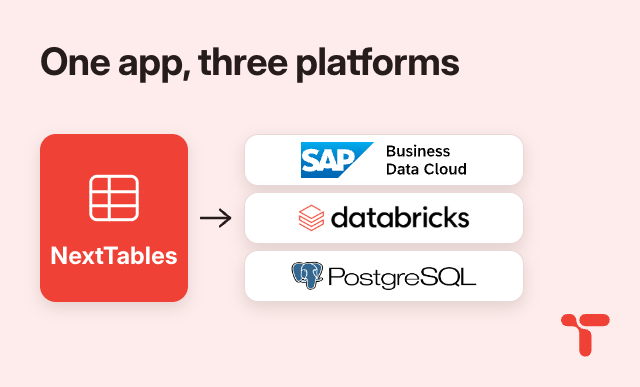
One data maintenance app, three enterprise data platformsBuild data maintenance apps, guided for business teams, trusted by IT. Business teams update their own data, with validation at entry, role-based authorization down to the row, and an audit log of every change stored inside your data platform.
1 minute read

Every change validated, authorized, and on the recordEvery entry is checked against your master data before it is written, access is decided by roles down to the row, and every change is on the record in your own platform. Business data stays where it is. NextTables keeps configuration only.
1 minute read