3 minute read

Meet the Experts
-

Marc Hoppe
Expert since 2023
Key Takeaways
-
SAP Customer on SAP S/4 HANA will lose Tcodes MD05 and CM25 by end of this year through the compatibility pack. Besides SAP Standard Offerings there are also two new Consulting Solutions available to replace these Tcodes: With the advanced MD04 you can replace the MRP List (MD05). And with LMPC you can replace CM25.
-
There are two new transactions available in SAP S/4HANA for MRP post processing with SAP SCM Consulting solutions: MRP Exception Monitor (new MD06) and the advanced MD04 (new MD04). You can use them in SAP ECC 6.0 and or in SAP S/4 HANA.
-
There are new transactions available in SAP S/4HANA for Capacity Planning & Detailed Scheduling with SAP SCM Consulting solutions: CRP Monitor (new CM01) and LMPC (new CM25) as well as LRP (new MF50). You can use them in SAP ECC 6.0 and or in SAP S/4 HANA.
When SAP S/4HANA was introduced SAP tried to get rid of redundant old functions (Simplification) to reduce the effort of support etc.
- Some functions were eliminated already with the first versions of SAP S/4HANA (e.g. storage location-related Materials Planning, source of supply determination without production version)
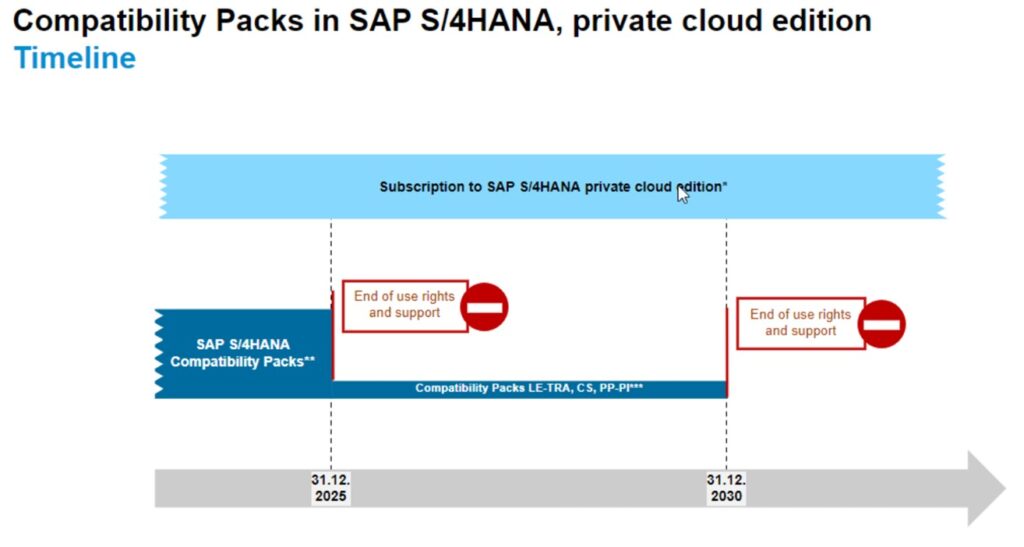
- For some other functions, SAP granted limited usage rights until the end of 2025 resp. 2030 (“Compatibility Packs/Scope/Package/…”)

Explore related questions
Source: https://blogs.sap.com/2022/08/09/compatibility-scope-what-happens-after-2025-2030/
What does “End of Use Rights of Compatibility Scope Items” mean?
- Compatibility Scope use rights expire automatically on December 31, 2025 for all SAP S/4HANA versions independent from their release date.
- So irrespective of the SAP S/4HANA version, customers no longer have a contractual right to use Compatibility Scope functionality after that point in time even if the affected SAP S/4HANA system release is still in mainstream maintenance.
- Furthermore, support stops for Compatibility Scope items after December 31, 2025, with the expiration of the usage rights.
- For SAP S/4HANA systems operated under a cloud subscription contract, the compatibility pack use right will expire in December 31, 2030.
Compatibility Scope Matrix for SAP S/4HANA
The compatibility scope is described in SAP notes and SAP Help Portal (SAP S/4HANA Compatibility Scope Matrix)
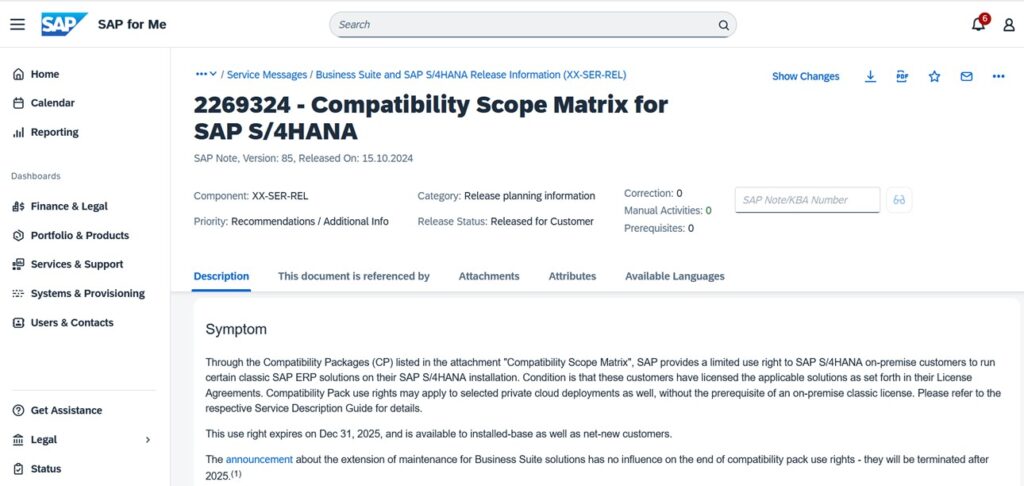
Source: Most important source: https://me.sap.com/notes/2269324
In the attachment you will find a pdf:

In that you will find the Compatibility Pack ID:

What happens on / after expiry of use rights?
(a) Customers who keep using compatibility packs are using unsupported and unlicensed software. They are in commercial non-compliance.
(b) With the end of the use rights, support ends.
(c) SAP will start to disable compatibility packs functionalities as of release 2025. Respective announcements will be done via business impact notes at least one year before.
What can I use instead?
With / up to release 2023, SAP has shipped go-to solutions as replacements for the compatibility packs ending in 2025, many of which are non-disruptive. The WayForward excel in SAP Note 2269324 lists the go-to solutions.
Additionally, SAP Services had created so called Consulting Solution as alternative Solutions for some of the Scope items. In the following I will cover three of them.
Most Important Parts for SCM Planning Topics
I will focus in this article on the three most important items of the Compatibility Scope Matrix:
- ID451: Graphical Planning Table à Details in Note 2268050 à Alternative Solution: SCM Consulting Solution: LMPC
- ID443: MRP Lists à Details in Note 2268085 à Alternative Solution: SCM Consulting Solution: advanced MD04
- ID452: Logistics Information System à Details in Note 2268063 à Alternative Solution: SCM Consulting Solution: Inventory Controlling, Service Level Controlling. Production Controlling
Item no. 1: Graphical Planning Table (Note 2268050)
Graphical planning tables (also known as graphical planning board or Gantt chart) can be used for capacity load levelling and sequence planning. SAP offered basic capacity planning by means of transactions CM21, CM22, etc. and advanced capacity planning in PP/DS. This note is relevant for basic capacity planning by means of CM* transactions.
Transactions CM21, CM22, CM23, CM25, etc. with graphical planning table are still available in SAP S/4HANA on-premise edition but not considered as the target architecture. Graphical Planning Table is part of the SAP S/4HANA compatibility scope, which comes with limited usage rights. For more details on the compatibility scope and its expiry date and links to further information please refer to SAP note 2269324. In the compatibility matrix attached to SAP note 2269324, Graphical Planning Table can be found under the ID 451.
Transactions CM* will be replaced by apps like Manage Work Center Capacity, Capacity Scheduling Table, and Capacity Scheduling Board in SAP S/4HANA. The use-cases covered and the features provided by the new apps are similar to the classic CM* transactions. The new apps are available from release SAP S/4HANA on-premise edition 1909 and in cloud from 1908.
Alternatives:
- CPS (see aboves apps)
- SAP Digital Manufacturing Cloud DMC component Resource Orchestration REO
- Embedded PP/DS
Alternative Solution: SCM Consulting Solution: LMPC. We reached an agreement with product management that we can use the functions also in the future!
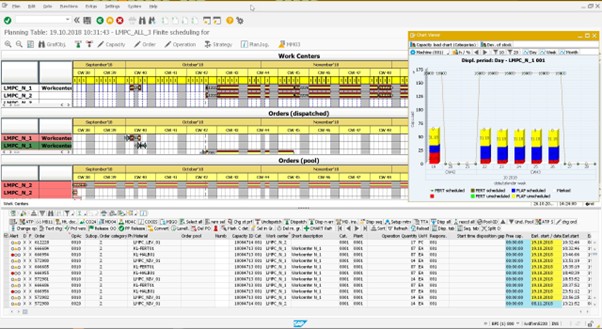
LMPC Screen Shot: Enhancement of the graphical planning table with the tabular planning table below and the chart viewer on the right.
Item no. 2: MRP List (Note 2268085)
MRP lists were intended for checking the MRP result. MRP lists were used to find materials with issues quickly. MRP lists are snapshots of the material supply and demand situation at the time of the last MRP run.
The snapshot is often outdated.
With HANA, stock/requirements lists can be read with high speed. The MRP apps determine materials with issues in real-time.
In SAP S/4HANA there is no need for outdated MRP lists.
Alternatives:
- MRP Cockpit Apps
- FM: BAPI BAPI_MATERIAL_STOCK_REQ_LIST is official released function module and therefore recommended to use
- FM: MD_MDPSX_READ_API is not official released and the interface or results may change via future SAP Notes / Service packs or releases
Alternative Solution: SCM Consulting Solution: advanced MD04
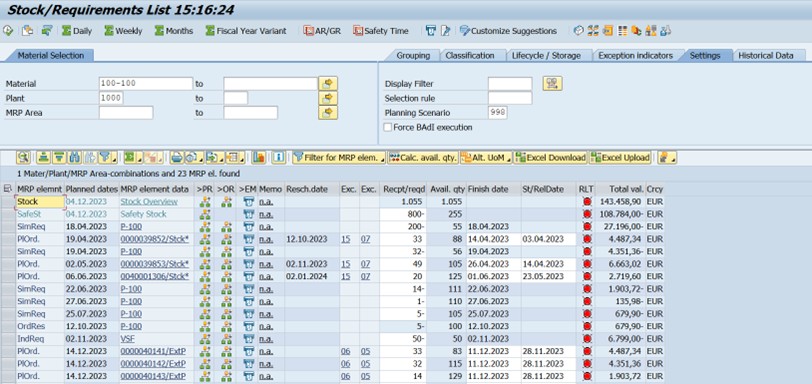
Consulting Solution: advanced MD04
Item no. 3: Logistics Information System (several Notes)
- 2267348 – S4TWL – Simplification in SD Analytics
- 2268063 – S4TWL – Logistic Information System
- 2267414 – S4TWL – Vendor evaluation based on LIS
LIS is part of the S/4HANA compatibility pack.
SD Analytics based on Logistics Information System (LIS) is part of the SAP S/4HANA compatibility scope, which comes with limited usage rights. For more details on the compatibility scope and its expiry date and links to further information please refer to SAP note 2269324. In the compatibility matrix attached to SAP note 2269324, SD Analytics based on LIS can be found under the ID 481.
We recommend that you use the SAP HANA reporting capabilities for vendor evaluation based on CDS views and smart business technology.
Future production analytics will be based on HANA, CDS views aggregating transactional data dynamically, and powerful analytical UIs for multi-dimensional reporting. With this it will be possible to replace the current LIS. You will be able to use classic LIS and the future production analytics in parallel for some time as long as you do not switch off the update of the LIS tables (The functionality is available in SAP S/4HANA on-premise edition delivery but not considered as a future technology).
Enhancements and modifications of the LIS will not work for the future analytics solution. Moreover, custom reports reading one of the following tables will not work after the update of the LIS tables is switched off.
The following analytical Fiori Apps already provide calculated measures:
- F2034: Material Scrap
- F2034: Operation Scrap
- F2171: Excess Component Consumption
- F2172: Execution Duration
- F2216: Scrap Reason
Alternative Solution: SAP Services provides 3 different SCM Consulting Solutions in Controlling & Reporting capabilities:
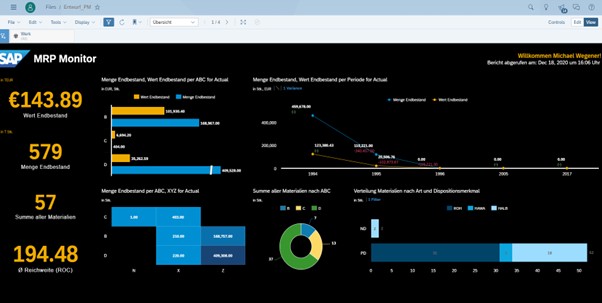
- The Inventory Optimization Cockpit provides access to a variety of functions for analyzing MRP-relevant key figures, classification results, and material master settings. Here are the main features of the Inventory Controlling Cockpit from Consulting Solutions:
- Single- and multi-level aggregation and disaggregation of inventory-relevant metrics such as inventory value, coverage, inventory turns and dead stock.
- Filter function that allows users to search and filter data by specific criteria.
- Aggregated data is displayed graphically with bar charts and pie charts after analyses, and past performance trends are provided to the user.
- Obtain accurate historical trends of key metrics.
- Display hit lists that list materials with the highest inventory and coverage costs or with the dead stock
- Perform an Inventory Quality Ration (IQR) Report
- Inventory Controlling on SAP Cloud Analytics (also available on S/4HANA, BTP or Fiori)
- The Production Controlling Cockpit records production planning at a glance and monitors the decisive key performance indicators such as quality, time, costs and production volume of the orders. These are the most important functions of the Production Controlling Cockpit:
- Aggregation, analysis and preparation of the relevant data based on the production order confirmations.
- Possibility to limit the results e.g., by setting a time period in the selection screen.
- Overview of the most important production key figures in terms of quality, time, costs and volume for production orders in form of structured tables and various diagrams
- Identify bottlenecks
- The Service Level Cockpit (SLC) measures delivery performance with the ability to provide a comprehensive overview of key metrics, such as delivery reliability and delivery capability. Users of the SLC can profit from the following functionalities:
- Various delivery key figures provide information about the relationships between the requested, confirmation and delivery dates. The key figures are calculated as a percentage to also make a statement about proportional delivery. Further key figures about margin and values of the items give the use a feeling for different priorities of items.
- The aggregation table shows the key figures calculated at item level aggregated to material, customer, or order level. Here, the months can be viewed in comparison to make a temporal evaluation documents to include the initial confirmation in the calculations.
- With the help of settings about delivery tolerances, the selection of different desired confirmed and actual delivery dates, different currencies, and many settings more, the SLC offers a high degree of customization for each individual user.
- The SLC provides an evaluation with a ranking across different customers, materials, or commodity groups by value or delivery metrics. In this way, patterns in weaknesses against certain materials or the like can be identified.
- The SLC supports the business report, Tasks functionality, Formulas and Alerts.

Service Level Controlling on SAP S/4HANA (also available on SAC, BTP or Fiori)
More Resources
See All Related Content
Clorox Completes Five-Year SAP S/4HANA TransformationClorox successfully transitioned from a legacy SAP platform to a cloud-based S/4HANA system across 21 manufacturing plants in 2026, facing initial supply chain disruptions and training challenges but positioning itself for strategic growth.

6 Key Features of SAP Transportation Management (TM)SAP Transportation Management (TM) offers wholesale distributors advanced features such as transportation planning, freight management, real-time visibility, and carrier collaboration to streamline logistics processes and enhance efficiency amidst complex supply chain challenges.
3 minute read

SAP Pushes Agentic AI to Center of Supply Chain Resilience StrategySAP is enhancing its investment in agentic AI and orchestration capabilities to enable supply chain professionals to transition from reactive to proactive decision-making by 2026, focusing on agentic AI, advanced orchestration, and data excellence.
2 minute read

Multichannel e-commerce software: A guide to managing listings at scaleDon’t get left behind by the competition. Find the right PIM to transform your business. Thanks to increasingly complex supply chains, tightening regulations, and more competitive sales channels, being able to successfully manage your product data has never been more important. That’s why so many leading B2X businesses are turning to the power of Product […]
1 minute read