Explore critical topics shaping today’s SAP landscape—from digital transformation and cloud migration to cybersecurity and business intelligence. Each topic is curated to provide in-depth insights, best practices, and the latest trends that help SAP professionals lead with confidence.
Discover how SAP strategies and implementations vary across global markets. Our regional content brings localized insights, regulations, and case studies to help you navigate the unique demands of your geography.
Get industry-specific insights into how SAP is transforming sectors like manufacturing, retail, energy, and healthcare. From supply chain optimization to real-time analytics, discover what’s working in your vertical.
Dive into the most talked-about themes shaping the SAP ecosystem right now. From cross-industry innovations to region-spanning initiatives, explore curated collections that spotlight what’s trending and driving transformation across the SAP community.
Explore critical topics shaping today’s SAP landscape—from digital transformation and cloud migration to cybersecurity and business intelligence. Each topic is curated to provide in-depth insights, best practices, and the latest trends that help SAP professionals lead with confidence.
Discover how SAP strategies and implementations vary across global markets. Our regional content brings localized insights, regulations, and case studies to help you navigate the unique demands of your geography.
Get industry-specific insights into how SAP is transforming sectors like manufacturing, retail, energy, and healthcare. From supply chain optimization to real-time analytics, discover what’s working in your vertical.
Dive into the most talked-about themes shaping the SAP ecosystem right now. From cross-industry innovations to region-spanning initiatives, explore curated collections that spotlight what’s trending and driving transformation across the SAP community.
BCG Platinion successfully transformed a struggling ERP project by realigning its cost, scope, and structure to meet realistic delivery capabilities, demonstrating the need for sustainable management in large-scale transformations.
The case study highlights the importance of continuous discipline and business readiness in ERP projects, as these elements require ongoing effort to prevent regression, unlike fixed decisions which can be resolved once.
Organizations embarking on ERP transformations must engage both technical and business teams consistently throughout the project lifecycle to ensure that both are prepared and aligned, preventing delays and ensuring successful implementation.
BCG Platinion successfully guided a major global enterprise through an ERP transformation reset, addressing critical issues of discipline and business readiness while ensuring cost and technical scope were aligned with realistic delivery capabilities.
BCG Platinion led the reset of a leading global enterprise’s struggling ERP transformation, closing the gap between ambition and delivery capacity while rebuilding the discipline and business readiness needed to bring the reset to reality.
The Challenge
Large ERP transformations rarely fail all at once. They drift, quietly, until the gap between plan and reality is too wide to ignore. A program board doesn’t usually admit that with a statement. It admits it in a budget line.
What follows is a reset, and every reset has two dimensions, one far easier to manage than the other. Resets are very good at fixing what can be planned and measured: cost, scope, the technical build. But they are not so good at fixing what needs to be maintained continuously: discipline and business readiness.
This case study follows one recent global ERP transformation, a multi-year, multi-market SAP program with the program de-risking and PMO led by BCG Platinion. It illustrates these challenges and how our team helped the client overcome them.
The Approach: Reset to get back on track
The initial reset levers of the ERP project tell the first part of their story: Cost run-rate nearly halved. Technical scope narrowed to a Bluefield MVP migration ensuring Buy – Sell – Make – Move – Collect Cash – Close Books operate like BAU. Transformational changes (e.g. New Master Data system) were shifted to the later innovation releases where feasible. And structure was streamlined through clearer decision rights across central delivery team, deployment teams, PMO, and system integrator. Ultimately, this transformation reset was not a pivot, but a program narrowing its cost base, scope, and structure to what it could realistically deliver.
This is a more common story than most sponsors would like to admit. BCG’s own transformation research points to the same pattern: cost overruns, timeline slippage, and value left on the table are the norm, not the exception, for large-scale change. But what makes this ERP case worth studying isn’t the reset itself. It’s what happened next.
The economics got fixed. Two harder problems didn’t.
The reset solved everything that could be redesigned on paper: cost, scope, structure. Two other problems needed continuous effort, not a one-time fix, and both crept back within months.
Discipline didn’t hold. The recovery reinstated a strict “reject-by-default” change freeze for both new scope items and legacy changes, including a review of pre-reset changes. Months later, the same problem resurfaced as a worsening risk: the legacy platform kept changing during the freeze, making the new system’s design outdated.
Business didn’t keep pace. At the same checkpoints where the technical build was complete or on track, the business side lagged: test cases still being finalized, <50% of data validation approved, staffing still ramping weeks before execution. To resolve this, a sustained push on business engagement was needed throughout user acceptance testing, data validations, and cutover.
This shows that whatever could be planned and measured in the technical lane got there on time. Discipline and business readiness lagged instead, as both depend on sustained effort, not a one-time fix. The program even named this root cause, escalated it, and secured executive backing to address it. The same behavior still came back.
Looking Into the Future: The takeaway
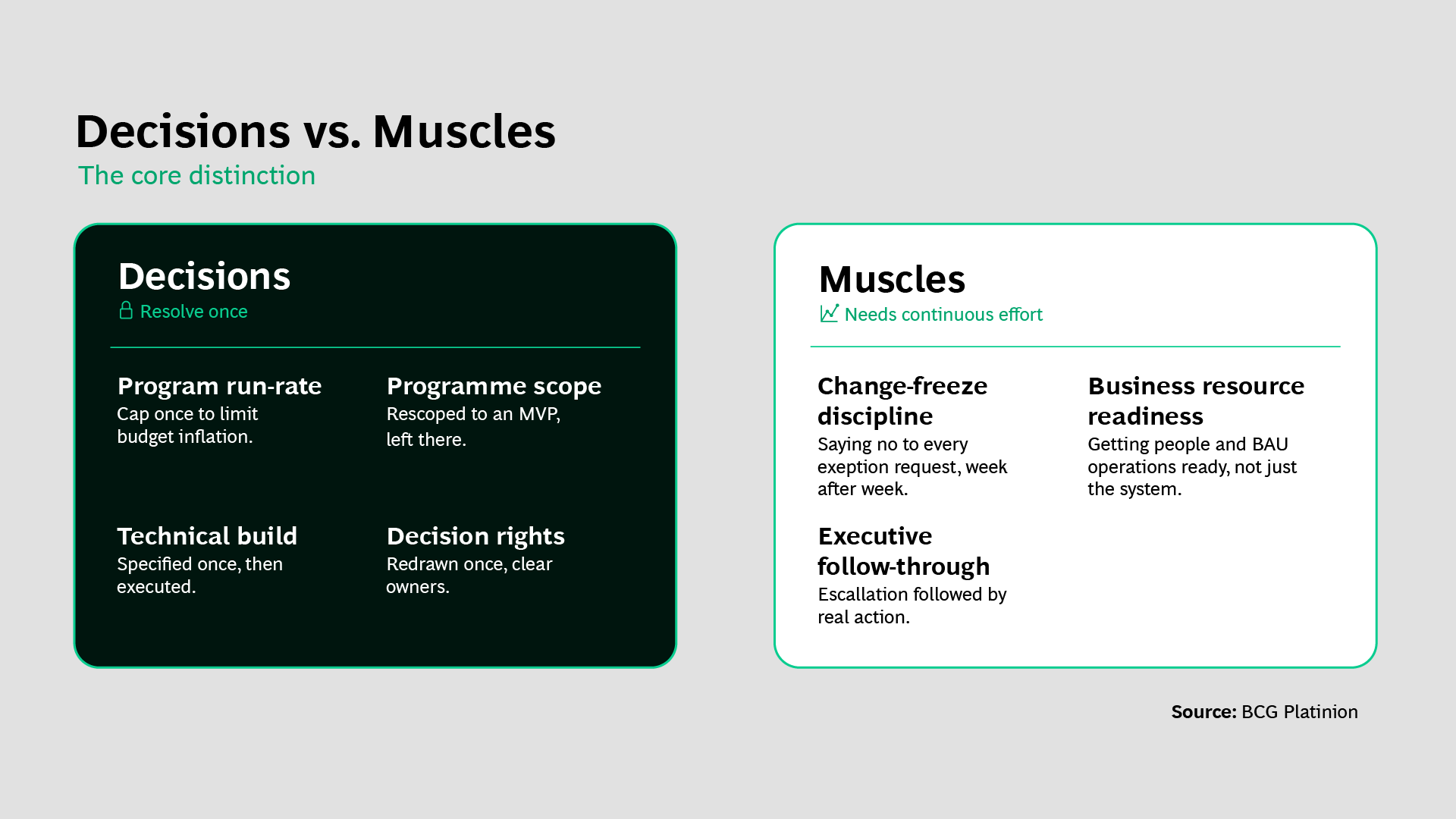
Cost, technical scope and structure are decisions. Resolve them once and they stay resolved.
Discipline and business readiness are muscles. They must be exercised continuously, and they atrophy the moment attention moves elsewhere.
A clean reset plan fixes what can be planned and measured. It says nothing about whether the harder, behavior-dependent parts will hold. Treat the reset as the start of that test, not the end of it.
The Impact: Where BCG Platinion changed the outcome
The value BCG Platinion brought wasn’t a reset plan; most experienced advisors can produce one of those. BCG Platinion owned the scope redefinition, program plan, and PMO strategy end-to-end, carried delivery accountability, and held client teams and third-party vendors to their commitments throughout. That ownership and oversight is what made the reset stick, and it’s what let BCG Platinion catch old behavior before it became the next crisis. Five moves made the difference:
Closed the gap between ambition and capacity. The MVP scope and Bluefield approach kept ambition matched to delivery capacity, rather than quietly bringing back the same over-ambitious scope.
Turned governance into a nerve center, not a chart. The rebuilt PMO came with decision rights and escalation routes; the previous structure had failed because nobody clearly owned the “yes/no.”
Made risk visible early enough to act on. A shared risk framework applied consistently across workstreams let the change-freeze erosion surface as a named, trackable item at the top of the program.
Put business readiness on the same clock as the technical build. Support spanned UAT, data validation, migration, and cross-functional mobilization, so business readiness didn’t get compressed into the final weeks. This was governed supported by data-driven reporting on business readiness and execution.
Stayed in the room through delivery, not just the redesign. Support carried through regional cutover planning and the UAT, Dress Rehearsals 1 and 2, and Cutover Execution itself, the reason the recurring change-freeze risk was caught in near real time.
These five moves add up to a reset that is built to be run, and a team that stays long enough to catch old habits before they resurface, together making the difference between surviving a reset and quietly needing a second one.
The proof came on go-live weekend. Over 72 hours, the program navigated 25 checkpoints and executed more than 10,700 cutover activities. It connected a business spanning ~11,000 users, 82 manufacturing sites, 472 warehouses, and 2,400+ external interfaces. After that, within 4 days, the business had already ramped back up to cover 95% of the 180+ markets by net sales value.
With BCG Platinion’s support, the client finished what the reset started, sustaining the discipline and business readiness that resets alone can’t buy. That effort and awareness turned a large, troubled ERP transformation into one that was executed successfully within 12 months.