3 minute read

Meet the Authors
Key Takeaways
-
Dodge Industrial transitioned from a fragmented legacy data system to a unified data landscape by adopting SAP Datasphere and SAP S/4HANA, ensuring better agility and governance for real-time insights.
-
The shift from traditional BW systems to cloud data warehousing allows Dodge to utilize modern SQL skills and simplifies complex data pipelines, significantly reducing reliance on niche expertise and improving operational efficiency.
-
By centralizing data governance and allowing business users access to curated data models, Dodge maintains consistency in reporting while providing flexibility for analysis, ultimately enhancing decision-making and reducing chaotic data scenarios.
The data landscape of Dodge Industrial, like many manufacturers, was traditionally a mix of legacy stability and silent fragmentation. SAP BW—a black-box setup 20 years old that few internal staff understood—hummed along in the background while business users, desperate for agility, turned to Power BI to fill the gaps. The result was a shadow data warehouse built on shaky ground.
The breaking point came when a business user, attempting to model massive datasets entirely in Power BI, inadvertently brought down the entire Dodge tenant. This moment of silence was the catalyst for Daniel Garrett, Data & Analytics Manager at Dodge Industrial, to lead a radical transformation at the company.
Moving under the IT umbrella and partnering with Protiviti, Garrett’s team didn’t just patch the leak—they re-architected the flow. By adopting SAP Datasphere alongside their migration to SAP S/4HANA, Dodge replaced fragile workarounds with a Bronze-Silver-Gold governance model that finally balanced speed and security. SAPinsider sat down with Garrett to discuss how Dodge turned a spaghetti architecture into a unified truth.
Explore related questions
Q: Modernizing a data strategy simultaneously with an SAP S/4HANA migration is a massive undertaking. Why did Dodge decide to tackle both at once rather than stabilizing the ERP first? How did Datasphere specifically simplify the complexity of that transition?
DG: We knew our legacy BW system wouldn’t be compatible with SAP S/4HANA without a significant move to BW/4HANA—another system we didn’t know or understand. More importantly, SAP S/4HANA is a structural change that fundamentally alters the data. Since we had to retool our connections and reporting anyway to accommodate these changes, it made sense to do it all at once.
Datasphere simplified this by giving us our first authentic cloud data warehouse that wasn’t a black box. It allowed us to use modern skills like SQL—which my team was already strong in—rather than hunting for niche BW expertise. It gave us a comfortable, transparent way to model the new SAP S/4HANA data structures immediately.
Q: A standout part of your session during the SAPinsider Las Vegas event in March is the integration of non-SAP sources like Snowflake, Salesforce, and MS SQL Server. In a world where many strive for a unified data fabric, what was the most significant hurdle you faced when trying to stitch these disparate platforms into a bi-directional flow with SAP?
DG: The biggest hurdle was the hidden technical complexity of connecting those external sources. While SAP Datasphere is excellent at connecting to SAP S/4HANA, the non-SAP connections often require significant backend heavy lifting.
For example, connecting to SQL Server or Snowflake isn’t just a matter of clicking a button in the UI. It involves setting up a Data Provisioning Agent and a Cloud Connector, which requires command-line configuration on a separate server. There is no pretty user interface for that part. We relied heavily on our partner, Protiviti, to navigate those infrastructure barriers. We also had to find a middleware solution—ultimately landing on MuleSoft—because we needed a tool flexible enough to handle APIs without requiring a massive engineering team to manage it.
Q: Can you share the learning curve your team experienced when moving from legacy BW pipelines to the more agile, native ELT functionalities in SAP S/4HANA and Datasphere?
DG: The shift was a relief because it brought us back to principles we knew, like SQL modeling. However, the move to an Extract, Load, Transform (ELT) approach required a change in mindset. In the old world, we were used to fragile stored procedures and moving data from a staging table to a final table.
In Datasphere, we had to get comfortable with the idea of virtualization—dumping data into a table and then building views on views on views to transform it without physically moving it again. We structured this using a Bronze, Silver, Gold methodology. Bronze is raw data; Silver handles the facts, dimensions, and cleaning; and Gold is the composite model ready for reporting. Once the team realized we just had to get the data into Datasphere and could model it virtually from there, it became much faster than the old waterfall development cycles.
Q: Many organizations claim to have a single version of the truth, but governance often falls by the wayside in favor of speed. How has Dodge balanced the need for increased delivery agility with the strict governance required to keep that data landscape stable and scalable?
DG: We had to make a controversial decision to rein in the business users. Previously, we empowered operationally savvy users to build their own reports from scratch, which resulted in chaos—two people would walk into a meeting with two different numbers for Orders because they used different logic.
Now, we use a centralized IT model for the heavy lifting. My team manages the complex modeling and logic in the Silver layer. If we change a logic definition there, it cascades down to every report instantly, ensuring consistency. We still give business users access, but we do so by handing them curated exploration models, or the Gold layer. They can play with the data, build ad-hoc reports, and analyze freely, but they are playing in a sandbox where the data definitions are already fixed and governed.
Q: Looking back at the choices made during this journey, what is the one thing you know now that you wish you had known at the start of the project? What advice would you give to a peer who is currently staring down a similar siloed data landscape?
DG: My advice is to perform more pre-work than you think you need. You must talk to the business early to understand what they are doing with their data today—not just what the system documentation says. We had several fire drills right before go-live because we discovered siloed processes we didn’t know existed.
Also, don’t separate the projects. I strongly encourage peers to do the data migration alongside the SAP S/4HANA implementation. You are going to pull skeletons out of the closet anyway; you might as well deal with them when you have the resources and experts on hand to fix the architecture properly.
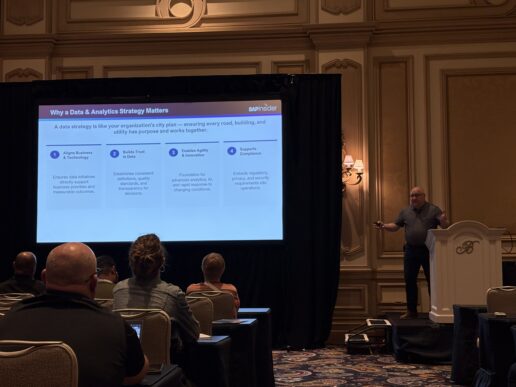
This Q&A gives SAP project leaders, IT operations teams, and program managers a practical look at how SAP Datasphere and SAP S/4HANA unified Dodge Industrial’s data for seamless, real-time information. Interested readers can see Daniel Garrett and Michelle Orozco share additional insights during the session on Dodge Industrial’s data unification journey at SAPinsider Las Vegas 2026.
More Resources
See All Related Content