
The shift from integrated business planning to orchestrated planning is redefining enterprise performance management by reducing decision latency, enabling businesses to act on insights in real time rather than waiting for manual processes, ultimately resulting in better business outcomes.
Orchestrated planning integrates people, data, processes, and AI in a governed environment, allowing organizations to swiftly identify changes in the market, make timely decisions, and execute those decisions effectively across various departments, thus enhancing overall operational efficiency.
Finance leaders are uniquely positioned to spearhead orchestrated planning as they manage both strategic and operational dimensions, fostering collaboration between departments and leveraging AI's capabilities to ensure that financial governance aligns with business context, driving sustainable growth.
The evolution of enterprise performance management is transitioning from merely connecting data across departments to orchestrated planning, which emphasizes real-time decision-making and action execution through the integration of AI and governed financial and operational data, addressing the challenges of decision latency as organizations face increasing data complexity and volatility.
For years, the evolution of enterprise performance management has been about connection.
Organizations moved from disconnected spreadsheets and functional budgets toward integrated business planning (IBP) and extended planning and analysis (xP&A), connecting Finance with Sales, HR, Operations and other areas of the business.
That was an important step forward. But today, connection alone is no longer enough.
Businesses are operating with more data, more volatility and more decisions to make than ever before. And while AI has dramatically increased the speed at which teams can surface insights, the ability to act on those insights has not necessarily accelerated at the same pace.
There’s still too much variability in how plans are interpreted by the rest of the business and how they translate into follow-through.
That creates a new constraint: decision latency.
Decision latency is the gap between when a business signal emerges and when a corresponding decision is made and—crucially—turns into real, coordinated action. When data lives in different systems, financial and operational planning happen in different environments, and decisions move through a chain of manual handoffs. In these cases, even a good decision can arrive too late.
That is why I believe orchestrated planning represents the next maturity stage of enterprise performance management.
Orchestrated planning connects people, data, processes and AI agents in a governed operating model so an organization can move continuously from insight to decision to action—while the signal they’re responding to still matters.
Instead of simply helping a business build a more integrated plan, it is designed to help the business execute that plan on time.
And increasingly, AI is what makes that level of orchestration possible.
What Is Orchestrated Planning?
Orchestrated planning is an enterprise planning and decisioning model that aligns people, financial and operational data, business processes and AI agents so organizations can turn insight into on-time execution at speed.
It builds on the foundation created by IBP and xP&A, but addresses a problem those models were not originally designed to solve: what happens after the plan is aligned.
Integrated planning helps an organization answer questions such as:
- What are we trying to achieve?
- How do finance and operational plans relate?
- How will changes in one area affect another?
- What scenarios should we prepare for?
Orchestrated planning goes a step further to zero in on:
- What has changed in the market or business?
- What decision does that change require?
- Who (or what AI agent) needs to act?
- What information and context do they need?
- How does that decision flow into the systems where work happens?
- How do we preserve governance, accountability and an audit trail around all decisions?
The biggest distinction, as you’ll see, is that these actions don’t all depend on a human to carry them out. AI and automation can help coordinate some of these actions, with Finance remaining in the driver’s seat.
The difference between “integrated” and “orchestrated” matters because businesses increasingly do not suffer from a shortage of insights. They suffer from friction in getting from insight to execution.
Vena’s 2026 FP&A Impact Report illustrates that challenge. Among 431 finance professionals surveyed, 45% said their FP&A teams need a week or more to deliver a decision-ready forecast when market conditions unexpectedly change. Forty-three percent cited limited alignment with other business units as a leading bottleneck, while only 34% had fully integrated operational drivers such as unit sales, headcount and marketing spend into financial forecasts.
Those are not simply forecasting problems. They are orchestration problems.
Why Integrated Planning Is No Longer Enough
IBP and xP&A solved a fundamental finance challenge: breaking down planning silos.
But enterprises have changed.
The amount of available data has exploded. Operational signals arrive continuously. Business conditions change faster. Planning is increasingly distributed across finance and business teams. And now AI agents are becoming active participants in analysis and planning workflows.
The result is that organizations can know more, sooner, while still struggling to act quickly.
That is the paradox of modern planning: time to insight is falling faster than time to action.
If an AI agent can identify a material variance in seconds but it still takes days to validate the data, determine which assumptions need to change, align Finance and Operations and update the plan, the organization has not captured the full value of AI. It has accelerated one stage of the process while leaving the rest untouched.
Effective orchestration, however, addresses the entire decision flow.
Consider a common example. A sales forecast changes materially halfway through the quarter. Finance detects the variance, but the supporting data sits across multiple systems and resides undocumented inside people’s heads.
The finance team may need to go back and forth with business leaders to understand what happened. Plans are updated. Operational owners then translate the decision into changes in hiring, spend or capacity, often outside the systems Finance is using to manage the plan.
Every export, data validation, email and manual handoff adds latency. By the time the organization acts, the original conditions may already have changed again.
That is why reducing decision latency is not simply about making analysis faster. It requires bringing the data, context, decision and execution environment closer together.
Our 2026 research also found that 58% of finance professionals named data quality and availability as a top bottleneck, with 48% citing improving data integration across systems as a top priority for the year ahead. Meanwhile, 70% said executive leadership is mandating AI adoption in finance.
Those findings point to an important reality: an organization cannot solve decision latency by putting AI on top of fragmented processes and unreliable data. And yet, AI capabilities are essential for orchestrated planning to happen.
A sound data foundation has to come first.
What Are the Core Elements of Orchestrated Planning?

1. Governed Data
The organization needs a trusted financial and operational data foundation.
AI cannot compensate for fragmented or poorly governed data indefinitely—in fact a solid data foundation is a prerequisite for getting any material value from investment in AI. If Finance and the broader business are working from different definitions of revenue, headcount or customer performance, adding another intelligence layer will not solve the underlying problem.
2. Shared Business Context
Data tells you what happened. Context helps explain what it means.
Models, assumptions, definitions, prior decisions, organizational structures and workflows all provide context that humans naturally use when making a decision. AI needs access to that same institutional understanding for its outputs to be valuable. That is the role cumulative context can play.
3. Signal-Based Connected Planning and Decisioning
Planning cannot be treated as a static exercise that happens once or twice a year, disconnected from daily operating decisions. As conditions change, organizations need to evaluate scenarios with every new signal that emerges, understand the financial impact and update plans continuously.
4. Human and AI Collaboration
AI agents will increasingly perform more portions of the work finance teams do every day. In fact, 37% of respondents to Vena’s 2026 FP&A Impact Report survey expect more than half of their current FP&A workflows to be fully operated by AI agents within two years.
But orchestration does not mean removing humans from the process. It means determining which work AI can execute, which decisions require human judgment and how both operate inside the same governed framework.
5. Execution in the Flow of Work
A decision only creates value when it changes what the business does. Orchestration therefore has to extend into the tools and workflows where people actually work rather than stopping at a dashboard, report or completed forecast.
Why AI Is Essential to Orchestrated Planning
AI helps organizations achieve orchestrated planning in three ways:
1. AI compresses analysis. AI agents can help teams explore data, identify anomalies, generate scenarios, update forecasts and explain variances far faster than traditional manual workflows.
2. AI can help connect stages of a decision process that were previously separate. An agent does not need to stop after surfacing an insight—they can take action. Within the right governed system, agents can support the next step of applying scenario logic, updating a plan, initiating a workflow or making information available to another team.
3. AI makes it easier to fuel context at enterprise scale.
But this last point is also where the most important limitation of AI becomes clear: AI needs business context.
A general-purpose model can know an enormous amount about the world while knowing very little about why your organization planned a particular number, which assumption changed last quarter, what a KPI means internally, which version of a forecast was approved or who has authority to make a particular change.
Without that context, faster AI simply produces faster uncertainty.
This is one reason Vena introduced Vena Omega™, our cumulative context engine for finance. Vena Omega is designed to connect governed enterprise data with the definitions, calculations, assumptions, workflows and prior decisions that give that data meaning. Instead of treating each interaction with AI as a new prompt, that context can deepen as an organization plans, analyzes variances and makes decisions over time.
For orchestrated planning, that distinction is critical. The objective is not for AI to simply answer a finance question, but for it to increasingly understand the business context surrounding the question.
AI in Finance Must Be Governed AI
Context alone is not enough. Finance also requires control.
As Brian Kobleur, Vice President, Microsoft Ecosystem at Vena, puts it: “AI does not create trustworthy numbers. It consumes them.”
And in Finance, trust is everything. Large language models are probabilistic by design. But Finance deals in absolutes. It depends heavily on deterministic systems, governed calculations and numbers that can withstand scrutiny from management teams, boards, auditors and regulators.
Brian describes the requirement simply: “AI in finance has to operate on deterministic financial data and governed calculations. The number itself has to be the same every time.”
That does not mean Finance should resist general-purpose AI. Quite the opposite. The right Microsoft Copilot prompts can dramatically increase individual productivity. But for AI to participate in enterprise planning and decisioning, organizations also need a governed financial foundation beneath those experiences.
As Brian told our team, “AI tools are fantastic. We embrace them. We love them. But we don’t rely on them alone. You still need a governed financial system.”
That is an important principle for every CFO evaluating an AI strategy. Don’t just ask what the AI can do. Ask: What data is it acting on? What business context does it understand? What permissions does it inherit? Which actions can it take? And can we audit what happened afterward?
What Governance Looks Like in Orchestrated Planning
Data governance cannot sit outside the workflow as a final approval layer. It needs to be built into how humans and AI interact with financial data while accounting for:
- Who can access particular data
- Who can change specific assumptions or values
- Which calculations and formulas can be modified
- Which versions of plans are held as the source of truth
- What approval processes must be followed
- What actions an AI agent is permitted to perform
- How every material change is logged and audited
Vena’s underlying architecture reflects that approach. Vena allows teams to continue working in Excel while ensuring their source data and processes live inside a governed environment, with controls over what can be changed, by whom and with a detailed history of those changes.
At the same time, Vena AI’s Planning Agent can generate forecasts, update plans and apply scenario logic using natural language, while Vena’s MCP Server can connect external AI experiences including ChatGPT, Claude and Microsoft Copilot with live, governed Vena data while retaining permissions, approvals and audit trails.
The result is an important combination: the flexibility people want from their familiar tools and AI assistants, with the controls Finance requires.
That is the kind of architecture I’d venture to say the success of enterprise AI hinges on.
Why Orchestrated Planning Matters: Decisions Rarely End Inside Finance
Finance may steward the financial model, but the business ultimately executes the decision.
A headcount change affects HR and department leaders. A revenue adjustment changes sales planning. A capacity decision may affect operations. A shift in demand can influence inventory, marketing spend and cash.
If financial planning and operational execution happen in disconnected systems, teams must continuously translate decisions from one environment into another. That creates misalignment and risk.
How Is Orchestrated Planning Different from xP&A?
The two concepts are related, but they address different stages of planning maturity.
xP&A extends financial planning and analysis across functions. Orchestrated planning helps make sure each function knows how act on those plans in their respective areas of operation.
Integrated planning and xP&A created alignment. Orchestrated planning is about turning that alignment into action.
You can think about the evolution this way:
| Planning Stage | Primary Objective |
| Traditional FP&A | Build the financial plan |
| IBP | Connect plans across the organization |
| xP&A | Extend FP&A disciplines and models across functions |
| Orchestrated Planning | Align people, data, processes and AI so insights and decisions can move continuously into coordinated action |
How Does Orchestrated Planning Reduce Decision Latency?

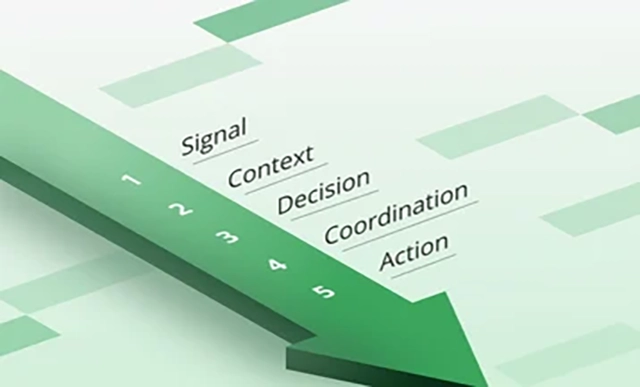
Reducing decision latency requires removing the friction between five stages:
Signal -> Context -> Decision -> Coordination -> Action
Imagine the earlier revenue-forecast example in an orchestrated environment.
Instead of waiting for teams to export and reconcile information, governed financial and operational data is already connected. AI detects an important variance. The system brings relevant historical assumptions and business context forward. Finance evaluates scenarios and determines the financial implications. Operational teams see the updated information in the connected Excel spreadsheets or Power BI reports where they work. AI agents can support appropriate portions of the process, while permissions, approvals and auditability remain intact.
Each individual improvement may save minutes or hours of previously manual communication and alignment. Collectively, they can eliminate days of decision latency.
To help illustrate what this framework of real-time insight looks like in practice, take the manufacturer LGG Industrial for example. Using Vena, the company’s executives have instant access to pre-configured dashboards that track EBITDA, sales, margin and operating spend by region and customer segment.
Why the Microsoft Ecosystem Matters
Our approach to orchestrated planning is intentionally Microsoft-native because we don’t believe transformation should require organizations to abandon the tools their people already know.
Excel remains deeply embedded in Finance. Power BI is widely used across operational teams. Microsoft Fabric increasingly serves as an enterprise data foundation. Azure provides the cloud and AI infrastructure underneath modern workloads.
Vena is designed to orchestrate financial and operational planning and decisioning across all of those environments.
That approach was recently reinforced with Vena earning the designation of Solutions Partner with certified software for Financial Services AI within the Microsoft AI Cloud Partner Program. The designation recognizes software that meets Microsoft program requirements and demonstrates interoperability with Microsoft Cloud technologies, including Azure, Microsoft 365 and Dynamics 365.
For me, the importance of that validation is less about the designation itself and more about what it represents as AI moves deeper into financial workflows: interoperability, governance and trusted infrastructure increasingly have to work together.
As Brian explains: “Finance teams want to take advantage of everything AI can offer, but they also need confidence in the technology foundation supporting the decisions they make. Our approach is to bring trusted, governed AI into the Microsoft tools and data environments organizations already rely on, helping finance teams adopt AI without creating another disconnected layer of technology.”
That is central to orchestrated planning. The goal is not to force every person into one application, but to allow Finance, IT and operational teams to work in the tools appropriate to their roles while keeping data, context, decisions and AI connected underneath them.
Why Finance Is Positioned To Lead the Orchestrated Enterprise
As AI adoption spreads throughout organizations, I believe Finance’s role will expand.
Finance sits at a unique intersection of strategy, operations, capital allocation, performance management and governance. Nearly every major business decision eventually has a financial consequence.
That makes the Office of Finance a natural orchestration layer for the enterprise.
Brian takes the argument even further. “By 2031, I believe the CFO will be one of the most important technology buyers in the enterprise,” he says. His reasoning is not that Finance will take over IT by any means, but that AI is making governed financial data increasingly important to decisions throughout the business.
I agree with that argument, especially since CFOs of technology companies are already being asked to serve as digital transformation partners within their organizations.
However, the CFO does not need to become the CIO. Instead, Finance and IT should become even closer partners.
Finance brings business logic, financial stewardship and decision context. IT provides the architecture, security, integration and scale that allow those capabilities to operate across the enterprise. Then business teams execute.
That is the operating model behind orchestrated planning: finance-led, IT-amplified and business-owned.
What Orchestrated Planning Means for the Future of FP&A
For FP&A teams, this evolution creates an enormous opportunity.
As we learned in our 2026 FP&A Impact Report survey, only 9% of respondents say their executives view FP&A as a critical driver of growth. Sixty-one percent said leadership still sees FP&A primarily as a transactional/reporting function or a reliable advisor on financials.
Orchestrated planning provides a path to change that perception.
When Finance can help the business not only understand what happened but determine what should happen next (and then help move that decision into execution), its strategic value becomes much more tangible.
The future of FP&A is therefore not simply better reporting, faster forecasting or even more AI adoption. It is decision orchestration.
The Next Stage of Planning Is About Action
The organizations that gain the greatest advantage from AI will not necessarily be the ones with the most agents, the largest models or the greatest volume of data. They will be the ones that can bring together trusted data, accumulated business context, human judgment, AI intelligence and governed execution in one continuous decision flow.
AI can make organizations dramatically faster.
Orchestration is what ensures that speed translates into better decisions—and that better decisions translate into action.
That is the next maturity stage of enterprise performance management. And I believe it is where modern FP&A is headed.