Explore critical topics shaping today’s SAP landscape—from digital transformation and cloud migration to cybersecurity and business intelligence. Each topic is curated to provide in-depth insights, best practices, and the latest trends that help SAP professionals lead with confidence.
Discover how SAP strategies and implementations vary across global markets. Our regional content brings localized insights, regulations, and case studies to help you navigate the unique demands of your geography.
Get industry-specific insights into how SAP is transforming sectors like manufacturing, retail, energy, and healthcare. From supply chain optimization to real-time analytics, discover what’s working in your vertical.
Dive into the most talked-about themes shaping the SAP ecosystem right now. From cross-industry innovations to region-spanning initiatives, explore curated collections that spotlight what’s trending and driving transformation across the SAP community.
Explore critical topics shaping today’s SAP landscape—from digital transformation and cloud migration to cybersecurity and business intelligence. Each topic is curated to provide in-depth insights, best practices, and the latest trends that help SAP professionals lead with confidence.
Discover how SAP strategies and implementations vary across global markets. Our regional content brings localized insights, regulations, and case studies to help you navigate the unique demands of your geography.
Get industry-specific insights into how SAP is transforming sectors like manufacturing, retail, energy, and healthcare. From supply chain optimization to real-time analytics, discover what’s working in your vertical.
Dive into the most talked-about themes shaping the SAP ecosystem right now. From cross-industry innovations to region-spanning initiatives, explore curated collections that spotlight what’s trending and driving transformation across the SAP community.
The payroll function is undergoing a significant transformation with the introduction of SAP SuccessFactors Payroll, which modernizes payroll processes by integrating real-time data and automating compliance management. This transition is crucial as it prioritizes accuracy and timeliness, impacting payroll teams and organizations that rely on seamless payroll operations.
Many payroll teams exhibit resistance to change due to a history of complexity and regulatory pressures, which can lead to a blame culture when issues arise. Understanding this inertia is vital, as it enables organizations to foster a collaborative environment where HR, Finance, and Payroll can work together more effectively to enhance overall operational efficiency.
Successful implementation of cloud-based payroll solutions not only simplifies processes but also encourages shared ownership and better communication between departments. This shift benefits everyone involved—from payroll professionals managing intricate regulatory requirements to employees seeking clarity in their pay, ultimately leading to increased trust across the organization.
Mark Mackenzie highlights the persistent resistance to change within payroll systems despite advancements elsewhere in HR and finance, emphasizing the importance of adapting to modern technology like SAP’s SuccessFactors Payroll to foster better integration, communication, and responsiveness in payroll operations.
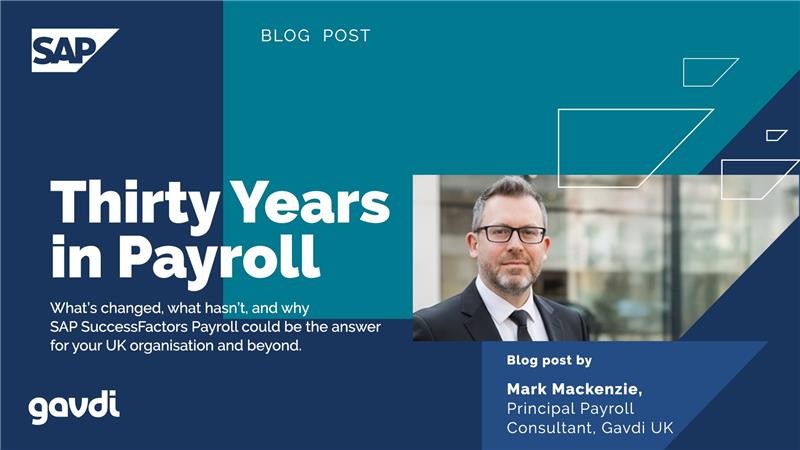
By Mark Mackenzie, Principal Payroll Consultant, Gavdi UK
I’ve been working in payroll since the last millenium. Long enough to remember staying late on a Wednesday night to get a file ready before a bank cut-off the following day. Long enough to remember preparing a magnetic tape, and later a cd, and sending it in a taxi to the local tax office before an “Inland Revenue” (now HMRC) deadline. Long enough to see paper payslips and noisy “z-fold” sealing machines give way to portals, spreadsheets evolve into platforms, and compliance go from annual panic to continuous scrutiny.
And yet, despite all that change, so much about payroll remains stubbornly… the same. In this article I outline some of the reasons for inertia in Payroll, the common organisational and cultural impacts of the “old school” payroll mindset and some key ways that SAP’s new SuccessFactors Payroll could make a BIG difference.
While HR and Finance functions have enthusiastically embraced transformation by moving from the likes of photocopied paper forms and clunky macro-loaded spreadsheets to using cloud systems with elegant workflow, AI, and predictive analytics, payroll has often been the reluctant passenger. Not for lack of need. Not for lack of opportunity. But because payroll sits at the intersection of complexity, regulation, and accountability in a way few other functions do.
When payroll changes go wrong and payments fail, people notice. Immediately. Employees complain, direct debits don’t get paid, Unions threaten to coordinate industrial action and production lines may even come to a halt.
So payroll teams develop habits: caution, stability, and, if we’re honest, a certain scepticism toward “the next big thing” and instead gravitate to “old school” processes that give stability and certainty. Over time, that mindset can look like resistance. But in reality, it’s often self-preservation.
Still, there’s a difference between being careful and standing still.
It’s Not (Just) the System
One of the biggest misconceptions I’ve seen over the years is this: that payroll challenges are primarily about system inability to perform complex calculations or respond to new legislative requirements. Or dealing with C-level executives who have the view that the only reason to investment in new payroll systems and processes is to make up for failings in the payroll team, or to save money. By the end of this article, you will see that these views are as much a part of the problem as any aforementioned “old school” mindset problem.
Yes, systems matter and can be the solution. Also payroll team members can make mistakes – we’re human after all. But they’re rarely the root cause of payroll pain. Equally the benefit to an organisation in investing in payroll should consider more than just the “price per payslip”. Payroll should be seen as sitting at the heart of HR and Finance related activities, not just a once-a-month button-press.
The real issues faced in payroll processing tend to be in how the function responds to change, usually requested by, or initiated by others. And with current technology and processes, both the payroll team and senior management may only investigate problems at the end of the period, not throughout the period, and therefore attribute faults in the wrong place or to the wrong people. This in turn can result in trying to fix the wrong solution or the right solution but with the wrong technology or process.
And that brings me to an unlikely but fitting analogy, that also re-affirms my age!
Castlemaine style graphic
The Castlemaine XXXX Lesson
If you remember the 1986 Castlemaine XXXX advert, you’ll recall the scene: a truck being loaded up with case after case of lager by some Australian sheep shearers, its suspension ultimately collapsing under the weight of an unexpected load when the final items – two bottles of sherry – are added for “the ladies”.
Politically incorrect, dated and misogynistic advertising aside, the advert highlights that farm workers blame the sherry for the damage to the vehicle, not the burden of the hundreds of cans of lager applied to the truck’s suspension all at once. Effectively, it was a 1980s reworking of the idiom “the last straw broke the camel’s back”.
Payroll often finds itself in the same situation.
When things creak or fail – missed deadlines, errors, stress – the instinct is to blame the Payroll department or the Payroll system:
“The payroll software can’t handle it.” “The technology is outdated.”
But more often than not, the problems (the payroll equivalent of sherry bottles) are elsewhere, in how the payroll function is expected to deal with changes initiated in by others. The size of the impact of the change is usually determined by these factors:
When payroll hears about change (often too late)
The volume of change hitting at once
The manual effort required to interpret, validate, and process it
The disconnect between teams feeding payroll data
Complex policy updates (written without the Payroll department in mind, and thus potentially impossible to implement in timelines communicated to employees, unions or other third-parties)
Ad-hoc adjustments and exceptions (rules applied requiring esoteric knowledge belonging to people, not system automation).
People doing the “heavy lifting”, and working around known system bugs rather than dealing with an “IT department that doesn’t understand payroll”.
The system is overloaded – not because it’s broken, but because of what’s being asked of it, and when – much like the truck’s suspension.
The “Them and Us” Problem
In the worst cases, these issues can result in a “blame culture”. Over time, this can lead to a familiar divide:
Payroll vs HR
Payroll vs Finance
Payroll vs “the business”
Employees vs Management
A narrative forms: the payroll team may feel blamed, underappreciated or misunderstood “They don’t understand payroll.” And equally, Operation, HR and Finance teams may share the view: “Payroll just says no all the time.”
This “them and us” thinking has been one of the biggest barriers to progress I’ve seen. This is because payroll doesn’t operate in isolation – it’s the final expression of decisions made across the organisation. Thus fixing payroll isn’t about isolating it further. It’s about integrating it better.
The exciting ways that SAP SuccessFactors Payroll is using technology to solve “what” and “when” problems and promoting cross-team collaboration.
After 30 years, my view is straightforward: payroll doesn’t need more complexity. It needs better flow, visibility, and responsiveness.
That’s where modern platforms like SAP SuccessFactors Employee Central Payroll (SF Payroll) come into their own.
Here are several key features, and more importantly, benefits that genuinely move the needle.
1. Real-Time Data Integration
Feature: Seamless integration with HR data (Employee Central)
Benefit: Payroll is no longer dependent on delayed or manually transferred data.
Changes in employee status, compensation, or working patterns flow directly into payroll – reducing lag, rework, and risk.
Why it matters: Payroll hears about change when it happens, not after the fact and has time to speak to the initiators of the change, to discuss any queries or concerns they might have, so it can be managed on time.
2. Automated Compliance Management
Feature: Built-in localisation and regulatory updates – daily. Unlike Employee Central’s twice-yearly updates, SAP deploys code changes to QA and Prod simultaneously, daily, with negligible downtime.
Benefit: Staying compliant with evolving legislation becomes a system-supported process, not a manual burden.
Why it matters: Payroll teams can focus on validation and insight, rather than chasing regulatory changes under pressure.
3. Embedded Analytics and Simulation – the “Continuous payroll” concept
The Payroll Dashboard
Feature: Constant payroll validation and variance analysis (similar to the “monitoring” validation rule alerts functionality in Employee Central Payroll)
Benefit: Issues are identified before payroll runs, not after.
Recommended by LinkedIn
Choosing a payroll and HR solution provider for your…
CanadianSME Small Business Magazine 3 months ago
Global Payroll Trends to Watch in 2026
Payslip 5 months ago
5 platform features our customers love
Payslip 2 years ago
Payroll professionals can test scenarios, understand impacts, and correct anomalies early.
Why it matters: It reduces firefighting – and increases confidence in outcomes.
4. Employee Self-Service and the Interactive Payslip
Interactive Payslip – and Joule AI powered Payslip assistance
Feature: Digital, interactive payslips with drill-down capabilities
It may sound simple, but it’s transformative.
Instead of being a static, end-of-process document, the payslip becomes:
A communication tool
A validation layer
A shared reference point
Benefit: Employees can understand their pay without raising tickets. They can see breakdowns, explanations, and changes clearly.
Employees, HR, and managers can engage with pay data earlier and more clearly – reducing queries, misunderstandings, and last-minute corrections.
It begins to dismantle that “them and us” divide.
Payroll stops being the black box at the end – and becomes part of the conversation throughout.
Why it matters: It reduces noise for payroll – and builds trust across the organisation.
Is it right for you?
SAP SuccessFactors Payroll isn’t just a re-platforming of payroll into the cloud – it’s a different way of thinking about how payroll operates.
At its core, it’s cloud-first, event-driven, and much closer to real-time than the traditional batch-driven approaches many of us grew up with. Rather than being one monolithic engine doing everything, it’s built on a far more modular, services-based architecture, sitting on SAP Business Technology Platform. That’s what enables a more joined-up, consistent experience across HR, payroll, and the wider landscape.
What’s also different is that the design starts with the business process, not the technical construct. So the essentials – like regular payroll runs – are there as you’d expect, but you also get localised capabilities out of the box, such as UK statutory changes delivered directly to your system, without a complex build and migration to a Productive landscape, and no longer dependent on other teams with their own timescales.
Under the covers, payroll isn’t one single block anymore. It’s broken down into distinct domains and scope elements – for example, gross and net calculation, benefits processing and time valuations combined with country-specific layers, like the UK, US etc. These run as dedicated “micro-services”, which makes the whole thing more flexible, more scalable, and ultimately easier to evolve over time.
In simple terms: it’s payroll designed to adapt, rather than payroll you have to work around.
Native integrations for data flows
SAP SuccessFactors Payroll Integration with SAP Modules
SAP provides out-of-the-box integration for SAP SuccessFactors Employee Central, core HR option, SAP SuccessFactors Employee Central Time Management, SAP SuccessFactors Employee Central Global Benefits, SAP S/4HANA Finance and SAP SuccessFactors Payroll. Real-time integration of employee data is available for SAP SuccessFactors Employee Central and Employee Central Time, ensuring data consistency and minimising manual data entry. Integration is achieved through the use of pre-integrated packages. It significantly simplifies and accelerates the integration setup process.
SuccessFactors Payroll’s initial UK-only availability is a deliberate move to support global SAP customers with UK employees. By focusing on this region at launch, the platform provides a dedicated solution for organisations already integrated into the SuccessFactors ecosystem. US is next and other countries will follow suit.
SF Payroll tends to be a strong fit for organisations that:
Are looking to bring UK payroll in-house, particularly where outsourcing has been driven more by operational constraints than regulatory complexity
Want to align with a long-term, global Employee Central and SAP Payroll strategy rather than maintaining separate local solutions and different vendors.
Have a straightforward or moderately complex operating model, typical of mid-sized businesses
Already manage a UK-based workforce and need a reliable, scalable payroll solution to support it
Aim to create a more connected experience by integrating HR, payroll, and employee-facing processes
In this context, SF Payroll supports both simplification and better alignment across functions without adding unnecessary layers of complexity.
Configuration Model
EC style navigation replacing old school SAP on-premise style skillset
Configuration is more like Employee Central (EC) than Employee Central Payroll (ECP) – no schemas, no PCRs, no legacy SAP rules, no coding.
Built through scope selection (tick-box choices) followed by fine‑tuning.
Simple Two-tier landscape: QA and Production.
Requires operational payroll knowledge, not ECC/ECP technical configuration knowledge for ongoing maintenance.
Therefore, once implemented, you may find yourself more-self sufficient and less reliant on partner support.
Timescales
Typical Project duration forecasts are 13 weeks for scoping, build, testing, and parallel runs (although depending on the state of your Employee Central landscape, more time may be required for build / remediation work).
Benefits for the Organisation
Short implementation cycle
Best practices
Low total cost of ownership (TCO)
Support for legislative changes
New reporting capabilities
Final Thoughts: What Really Needs to Change
After all these years, I don’t think payroll’s problem is technology.
And I don’t think it’s capability.
It’s context.
Payroll is still too often treated as the end of a process, rather than part of a connected system. Too often blamed for the weight it carries, rather than supported in managing it.
Like that Castlemaine truck, it’s not breaking because it’s poorly built – it’s breaking because of what’s being loaded onto it.
The future of payroll isn’t about rewriting everything. It’s about rebalancing:
Earlier visibility
Shared ownership
Better communication
Smarter tools
And when we get that right, payroll stops being the function that resists change… …and starts being the one that quietly enables it.