Explore critical topics shaping today’s SAP landscape—from digital transformation and cloud migration to cybersecurity and business intelligence. Each topic is curated to provide in-depth insights, best practices, and the latest trends that help SAP professionals lead with confidence.
Discover how SAP strategies and implementations vary across global markets. Our regional content brings localized insights, regulations, and case studies to help you navigate the unique demands of your geography.
Get industry-specific insights into how SAP is transforming sectors like manufacturing, retail, energy, and healthcare. From supply chain optimization to real-time analytics, discover what’s working in your vertical.
Dive into the most talked-about themes shaping the SAP ecosystem right now. From cross-industry innovations to region-spanning initiatives, explore curated collections that spotlight what’s trending and driving transformation across the SAP community.
Explore critical topics shaping today’s SAP landscape—from digital transformation and cloud migration to cybersecurity and business intelligence. Each topic is curated to provide in-depth insights, best practices, and the latest trends that help SAP professionals lead with confidence.
Discover how SAP strategies and implementations vary across global markets. Our regional content brings localized insights, regulations, and case studies to help you navigate the unique demands of your geography.
Get industry-specific insights into how SAP is transforming sectors like manufacturing, retail, energy, and healthcare. From supply chain optimization to real-time analytics, discover what’s working in your vertical.
Dive into the most talked-about themes shaping the SAP ecosystem right now. From cross-industry innovations to region-spanning initiatives, explore curated collections that spotlight what’s trending and driving transformation across the SAP community.
Nordic enterprises are facing a critical deadline as they must transition from outdated SAP ECC systems to S/4HANA by 2030, or incur significant fees for continued support, highlighting a pressing need for strategic ERP transformation.
The inertia in ERP transformation among Nordic companies stems from the perception that these upgrades are merely IT modernization with limited ROI; however, recognizing ERP transformation as a broader business opportunity can unlock significant competitive advantages in digital innovation and agility.
Companies that adopt a holistic, phased roadmap for ERP modernization—such as assessing readiness, defining a vision, delivering early value, and scaling boldly—will position themselves as digital leaders, leveraging upgrades to drive substantial business benefits.
Nordic enterprises face challenges in ERP transformation due to outdated systems and leadership changes, yet view the shift to S/4HANA as a critical opportunity for strategic business transformation, calling for a comprehensive approach that embraces hybrid migration methods and aligns with broader digital competitiveness goals.
Many large enterprises across the Nordic region feel trapped ‘between a rock and a hard place’ when it comes to ERP transformation.
As recently as the end of 2024, approximately 60%1of companies were still running outdated SAP ECC ERP systems. The extended S/4HANA deadline looms large in 2030, with support beyond this point incurring substantial fees – but reports reveal that up to 70%2 of ERP programs fall short of their goals, and roughly a third3 run over budget. So why the inertia?
Many already efficient Nordic companies that use standardized ways of working view the shift to S/4HANA solely as an IT modernization, one offering minimal efficiency gains and slow ROI. Others are considering the jump but fear running out of time. Regardless of efficiency or readiness, this is a once-in-a-decade opportunity.
A strategic roadmap is mission critical. Enterprises in the Nordics need an approach built around incremental wins tethered to business outcomes – it must also foster AI development and digital competitiveness. Too often we see AI programs being postponed because of the misguided belief that new ERP is a prerequisite.
It is time to flip the script – ERP transformation is far more than just another expense and there are multiple ways to go about it effectively. To plan a comprehensive roadmap, understanding the challenges is an essential first step.
Stalling and Stagnation
A set of compounding factors are causing enterprises in the Nordics to put their ERP transformation plans on hold. The speed of change in the economy is one of these forces, a challenge exacerbated by the fact that CEOs change every 4 to 6 years on average.
With transformation cycles taking place every 5 to 7 years, and changes in management causing significant delays, windows of opportunity for modernization are small and close fast. But as the S/4HANA deadline draws nearer, modernization cannot be postponed indefinitely.
Aligning your ERP program with new management agendas is critical. This means designing and implementing a transformation approach and governance model which can maintain continuity in spite of strategy and operating model changes.
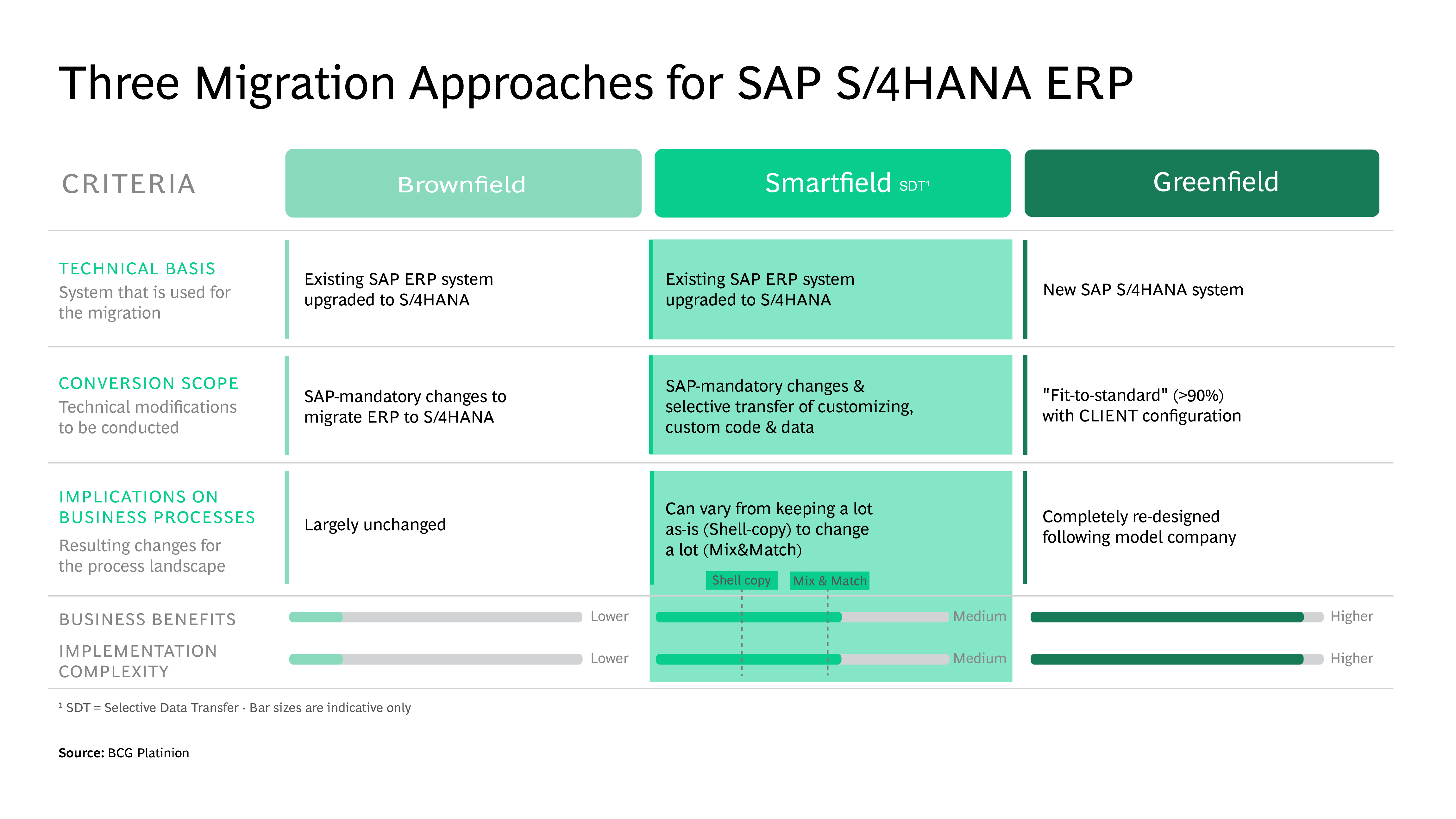
When it comes to the technical considerations associated with rebuilding an ERP system, there are three primary migration paths (but no one-size-fits-all approach):
Brownfield – Everything is kept in place with this approach, including existing inefficiencies, but it may be effective if existing processes are deemed largely fit-for-future (and require minimal change). If timelines are very tight and the existing system is clean and stable, a brownfield methodology may be viable
Smartfield (Selective Data Transition) – Sitting between the brownfield and greenfield options, smartfield approaches are quickly gaining popularity. They fundamentally update the ERP core and can be executed rapidly, aiding broader business transformations
Greenfield – This involves rebuilding from scratch on S/4HANA, requiring clean data and a new process baseline. This approach is ideal if your legacy system is heavily customized and hard to maintain – but it is more expensive and calls for considerable change effort
Smartfield Example
Shell conversions are proving particularly popular among organizations that opt for a hybrid, smartfield approach. This involves emptying the existing ERP system of its data, creating a new copy of the system, then converting the empty copy to S/4HANA. Enhancements are incorporated during the process, and data is selectively migrated into the new environment.
For example, we helped a global tech company achieve a major breakthrough with the shell conversion method. It was used in a targeted way to enhance key finance processes, resulting in the remediation of 30,000 customer code objects and the modernization of 320,000 lines of code. Maintenance and complexity-related costs were reduced substantially as a result.
In another instance, a leading semiconductor business called on BCG Platinion for support after more than 8 years of failed transformations. A tailored shell conversion made it possible for the company to finally move beyond its legacy limitations while minimizing business change.
In our experience, Nordic enterprises benefit significantly from hybrid, smartfield approaches, with many citing the game-changing advantages of selective migration. But in each case, it is critical to make sure that a hybrid method is the right choice for you – this will depend on your organization’s level of complexity5 and key characteristics.
The (Digital) Competitive Edge
Successful ERP modernization can help enterprises become formidable digital competitors in this next high-stakes chapter. But it is important to emphasize that advantages will not necessarily be unlocked by the upgraded ERP itself, but by the wider business changes that transformation entails.
This is a chance to make integral, value-adding modifications, including harmonization and standardization improvements (if required). Depending on the approach selected, enterprises can capitalize on having a clean core to implement AI, to introduce real-time analytics, or achieve modular cloud-readiness.
From greater speed-to-insight and improved regulatory agility, to the advanced resilience enterprises need in today’s world, those that approach the S/4 shift as a business transformation will leapfrog those that hesitate.
What a Winning Roadmap Looks Like
Having helped many enterprises overcome the S/4 hurdle and maximize business transformation benefits, we know what good looks like when it comes to roadmaps.
BCG and BCG Platinion also work with SAP6 directly to help ensure platform modernization is a business transformation catalyst. A phased model is recommended, featuring four critical steps:
Assess readiness – Evaluate the ECC landscape, including key pain points and constraints, to establish your main value levers
Define the vision – At this stage you need to design a target architecture, select one of the migration paths mentioned earlier in the article, and pick a hosting strategy – you may opt for a datacenter or hyperscaler approach, with or without RISE
Deliver value early – Focus on value delivery to help identify any issues with your approach while also building momentum and confidence
Scale boldly – Now is the time to integrate your approach with wider IT modernization and AI strategies, and to ensure that governance will outlast leadership cycles through value delivery capability and strategic flexibility
At BCG Platinion, we adopt a next-gen, holistic ERP approach when assisting clients with the complex process of migrating core systems. Data and Digital Platform (DDP) thinking is central to our methodology, putting the client’s valuable information at the core to work (and getting digital use cases up and running).
From Obligation to Opportunity
It’s true, 2030 is not far away and this reality should focus the minds of enterprise decision-makers – but ERP transformation is far more than a costly obligation. It is a strategic play for the business that transcends IT, one with the potential to become a powerful value-creation engine.
Take action now in the Nordics to not only beat the S/4 deadline, but to gain a lasting competitive advantage over the late movers. To continue the conversation, simply reach out to our experts.