3 minute read
Meet the Experts
Meet the Authors
Key Takeaways
-
AI increases confidence among enterprise users, but true credibility stems from human experience, highlighting the importance of community knowledge in navigating complex SAP landscapes.
-
The rise of generative AI creates a challenge of low-quality content, emphasizing the need for moderation and governance to maintain community integrity and ensure that expertise is validated and contextually relevant.
-
SAP Community engagement is evolving toward a measurable reputation system, where active participation and peer validation are essential for establishing real-world capability amidst the abundance of AI-generated information.
At SAPinsider Las Vegas, Josh “Bluebeard” Bentley, Head of SAP Community, made a clear distinction that cuts through much of today’s AI noise: Enterprise users may be gaining confidence from AI, but credibility still comes from human experience.
“AI built confidence, but community builds credibility,” Bentley said during his session. The difference, he argued, is becoming more visible as generative AI tools flood enterprise workflows with fast, surface-level answers that lack depth, validation, and context.
For SAP users navigating increasingly complex landscapes, that distinction is less theoretical and more operational.
Explore related questions
Confidence Without Context Is a Risk
Bentley described how easily AI can create the illusion of expertise. A user can ask a question about ABAP or architecture, receive a well-structured answer, and feel equipped to act. The problem emerges on the second question.
“You can get really confident by asking AI a question,” he said. “But when you ask that second question, it doesn’t follow through.” In other words, asking why something works or whether it will work in the system is where AI breaks down.
For instance, a first question might be something like, “What is SAP Cloud ALM?”—a straightforward, pattern-based query that AI can answer quickly and confidently. But the second question gets more complicated: “Why should I choose this approach over another in my specific system?” or “What happens if I try this in a hybrid SAP landscape?” Such follow-ups require context, tradeoffs, and real implementation experience—areas where AI often falls short and where community expertise becomes essential.
This gap matters in SAP environments, where decisions are rarely isolated. Whether evaluating SAP S/4HANA migration paths, ALM strategies, or integration architectures, users need not just answers, but experience-backed reasoning.
As Bentley put it, credible contributors are those with “battle scars”—people who can explain not just what works, but why it works in specific business and technical contexts.
AI Is Accelerating Noise
The rise of generative AI is also creating new challenges for platforms like SAP Community. Bentley pointed directly to what he called “AI slop”—content generated, copied, and posted without real understanding.
“Be very careful when copying and pasting something you don’t understand,” he warned. “You’re going to lose credibility in our community.”
This introduces a new moderation and governance problem. SAP is not only scaling community engagement but also managing increasing volumes of low-quality or unverifiable content. Bentley described an ongoing “game with AI,” where detection and filtering systems must continuously evolve alongside generative tools.
At the same time, SAP is integrating AI into the platform itself to support tasks like drafting posts, checking Syntax, or improving clarity. The goal is not to remove AI, but to contain its role as an assistant rather than a source of authority.
Community Is a Three-Layer Engagement Model
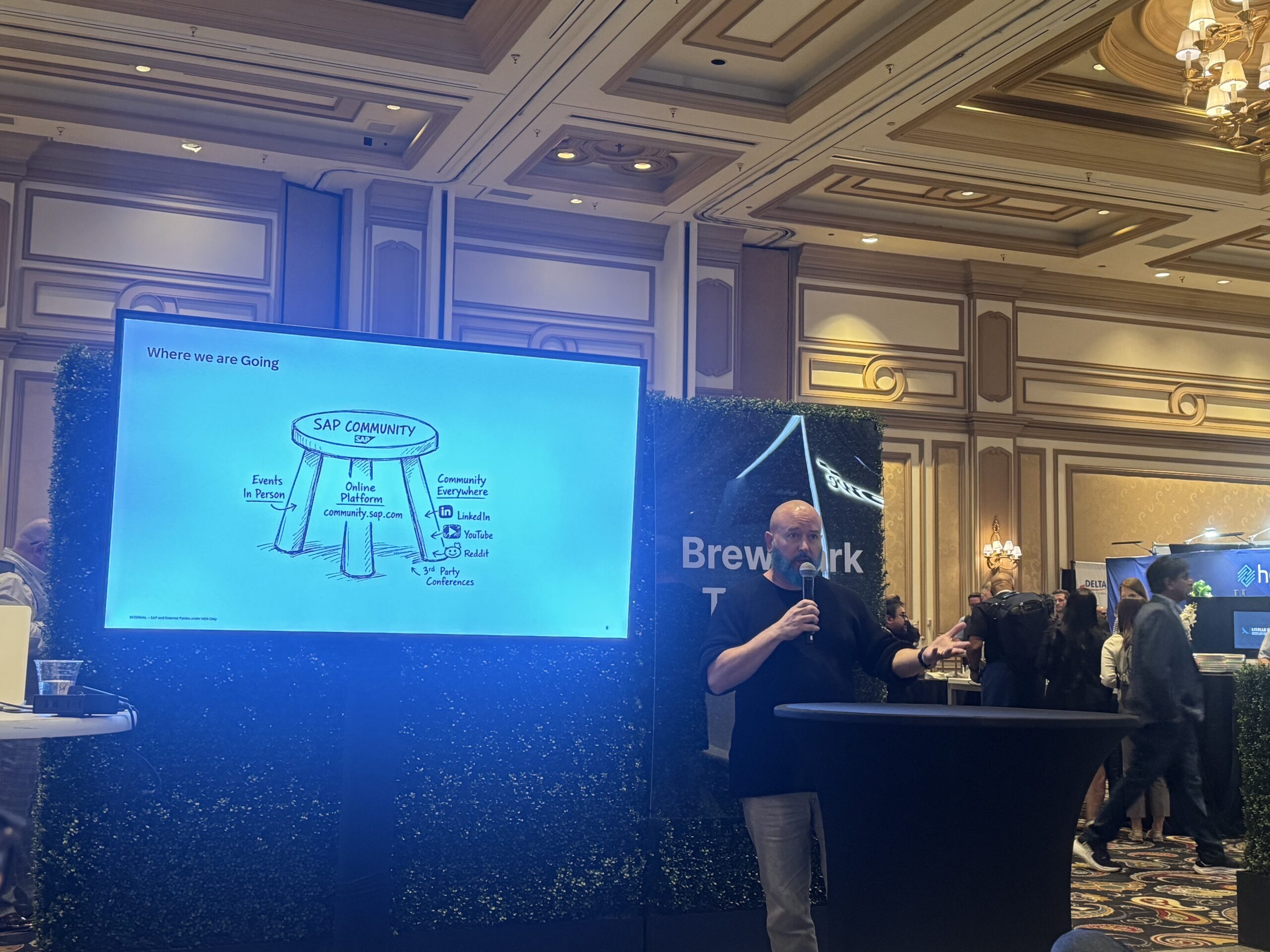
Bentley outlined a model for how SAP Community is evolving, centered on three connected layers: in-person interaction, digital platforms, and broader social channels.
The anchor remains human connection. “If I’m here talking to you and you’re here talking to me, nothing AI is going to do can replace that,” he said.
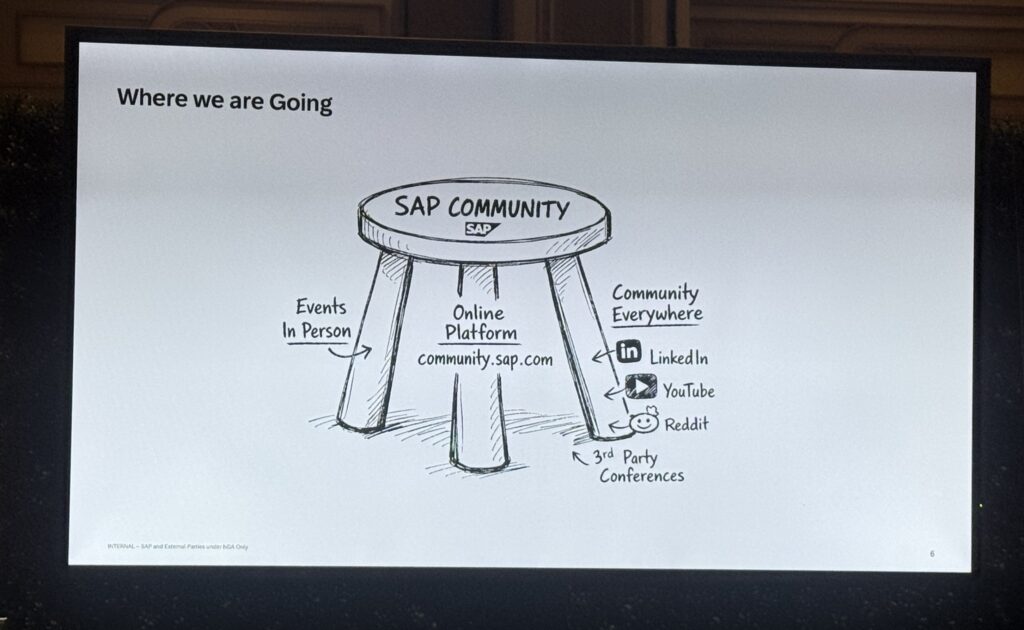
This is reflected in SAP’s continued investment in physical events like SAP TechEd, SAP Inside Track (SIT) meetups, and smaller “Stammtisch” gatherings. These environments allow practitioners to exchange knowledge in ways that cannot be replicated through static content or AI-generated responses.
At the same time, SAP is expanding its digital footprint across its community platform, YouTube channels, and LinkedIn presence to meet users where they already engage. The objective is not centralization, but continuity across touchpoints.
Reputation as a Measurable Asset
One of the more structural shifts Bentley highlighted is how community participation feeds into professional identity. SAP Community is not just a forum for Q&A—it is increasingly a system for building visible, trackable reputation, he said.
Users can document learning progress, contribute content, and establish expertise over time. That matters in a landscape where AI-generated answers are abundant but indistinguishable. In this model, credibility is cumulative. It is built through interaction, validation, and sustained contribution instead of single, insolated responses.
Bentley’s own experience illustrates this dynamic. His “blue beard,” initially an experiment to stand out, became an entry point for conversations that led to deeper technical exchanges and connections. “It breaks the ice,” he said. “Then we start to talk about community, and I connect people to the right experts.”
From Answers to Judgment
Perhaps the most important distinction Bentley made is the type of questions that belong in a community versus those that AI can already handle. “Don’t ask what Cloud ALM is,” he said. “You can ask any LLM that.”
Instead, the value of community lies in judgment-based questions:
- Why choose one architecture over another
- When to migrate versus optimize
- How decisions play out in real implementations.
“AI gets smarter about what to answer,” Bentley said. “Community gets smarter about why.”
That difference defines where enterprise knowledge is heading. AI can accelerate access to information, but it cannot replace the contextual reasoning required to apply it.
What This Means for SAPinsiders
AI will expand access to knowledge, but not trust. Generative AI is lowering the barrier to entry for SAP-related topics, but it is also increasing the risk of shallow or incorrect application. Organizations should treat AI outputs as starting points, not decision-ready inputs.
Community credibility gets more important as AI content scales. As AI-generated responses proliferate, validated expertise will stand out. Participation in SAP Community and similar ecosystems will increasingly function as a signal of real-world capability and experience.
Human networks remain critical to SAP program success. From architecture decisions to implementation trade-offs, the most valuable insights still come from practitioners with direct experience. In-person events, peer networks, and expert communities will continue to play a central role in navigating complex SAP landscapes.
More Resources
See All Related Content
Haleon Chooses SAP Solutions to Replace LegacyHaleon has selected SAP Business Suite to replace its legacy ERP system, establishing an AI-ready enterprise aligned with its growth strategy and exemplifying a new approach to cloud ERP migrations that prioritizes data harmonization and AI capabilities.