


1 minute read

Meet the Authors
Key Takeaways
What you need to know
Moving core ERP to the cloud is driven by the need for cost reduction, system consolidation, and leveraging innovations, with SAP BTP playing a critical role in this transition.
SAP BTP facilitates the consolidation of fragmented data and siloed processes, enabling organizations to create a clean core that accelerates innovation and reduces technical debt.
Successful cloud ERP implementation requires a shift in mindset towards configuration over customization, strong executive sponsorship, and alignment between business and IT, supported by a trusted partner throughout the journey.
The strategic decision to move an organization’s core ERP to the cloud is typically fueled by three powerful business drivers. These are the need to dramatically reduce operational costs, the necessity of consolidating disparate systems after acquisitions, and the desire to leverage new innovations. For companies embarking on this journey with SAP S/4HANA Cloud Public Edition, success depends on embracing standardized functionality while customizing for a competitive advantage.
This is where SAP Business Technology Platform (SAP BTP) becomes the enabler. It provides the essential foundation for extensions, data, integration, AI/GenAI enhancements, allowing businesses to maintain and follow clean core principles that accelerate flexibility and agility with innovation. From the pre-built content in SAP Integration Suite to AI-driven extension development, to foundational services like identity and application lifecycle management, SAP BTP provides the technological backbone for transformation.
But what does the path to successful cloud implementation with SAP BTP look like? Terry Penner, Senior Director, BTP Marketing at SAP, and Gianluca Simeone, Vice President, Global SAP CTIO and Gen-AI Leader at Capgemini, map out the why and how of this journey, highlighting the main role of SAP BTP.
Explore related questions
Ask SAPi
Accelerating the Move to Cloud ERP
According to Penner, the shift to SAP S/4HANA Cloud Public Edition allows companies to reallocate resources from basic upkeep to value-driving innovation. “SAP BTP can help with this move,” Penner notes.
He elaborates, “SAP BTP accelerates a company’s journey to the cloud by tackling two of the biggest challenges: fragmented data and siloed processes.”
SAP Business Data Cloud enables an organization to rapidly consolidate and govern its data, creating a clean foundation essential for analytics and AI. Simultaneously, SAP Integration Suite leverages pre-built content to quickly connect and optimize business processes across hybrid landscapes, bypassing slow, custom-coded integration projects.
This strategy allows an organization to take advantage of key BTP and ERP capabilities to accelerate its move to the cloud. “These factors can speed up innovation and help the organization realize the benefits of the cloud sooner,” Penner states.
SAP BTP also provides capabilities that can help companies reduce their technical debt. “This approach means you’ve set the foundation for the next generation of growth on a clean core,” Penner explains. “You’ve removed the technical debt that holds you back, so when you need to scale or acquire another company, it’s much easier to connect and grow. That’s what accelerating innovation really means: having the foundation to go faster than your competition who is still paying down that debt.”
SAP BTP: Maximizing Value in the Cloud
Once an organization makes the journey, the benefits extend far beyond cost savings. The single greatest advantage is the ability to keep pace with the continuous evolution of technology, particularly AI. “SAP is building AI into every product,” Penner explains. “If you’re not on the latest release, you’re not going to get the out-of-the-box functionality that has those AI-enhanced workflows.”
This creates a powerful incentive. On the one hand, there’s the clear benefit of gaining access to the latest and greatest capabilities. On the other, Penner notes, “There’s a fear of missing out, as the gap between legacy systems and modern cloud platforms widens, making future migration more costly and complex. Therefore, a cloud ERP environment, particularly a Public Cloud offering, provides the scalability needed for growth.”
He adds that this is where SAP BTP becomes indispensable as it acts as the bridge, enabling organizations to leverage the full power of their cloud ERP investment. To illustrate his point, Penner highlights SAP Integration Suite, which offers over 3,800 pre-built integrations to connect SAP and third-party systems, drastically reducing the effort of manual maintenance.
Moreover, SAP BTP provides SAP Build to create unique, differentiating extensions while maintaining a clean core, ensuring that the ERP system remains unaltered and easy to upgrade.
A Partner’s Perspective
While the case for moving to the cloud is clear, the path is not without its challenges. Simeone provides a pragmatic view of the roadblocks and best practices for a successful transition.
Simeone notes that a successful move requires a shift in mindset, from customization to configuration, from ownership to consumption. “Governance models must also evolve to support agile delivery and continuous innovation,” he emphasizes.
He adds, “SAP business transformations are not just IT projects; they require business process reengineering.” Therefore, a lack of business alignment can derail even well-funded programs.
Moreover, for many global organizations, ensuring data remains within specific geographic boundaries to comply with regulations like GDPR is a critical and complex sovereign requirement.
To navigate these challenges, Simeone outlines a set of best practices adopted by successful organizations in their journey to Public Cloud ERP. This means securing strong executive sponsorship and aligning business and IT early in the process. According to Simeone organizations must also embrace SAP’s standardized best practices instead of replicating customizations. “They must maintain a clean core by using SAP BTP for all necessary dimensions like extensions, integrations, and so on” he adds.
Some of the other best practices that Simeone points to include:
- Adopting agile implementation methods like SAP Activate, with Cloud ALM.
- Investing early in data readiness, governance, and integration planning using tools like SAP Integration Suite, moving to Business APIs principles.
- Prioritizing change management and comprehensive continuous user training, augmented by GenAI and Joule.
- Addressing compliance, data residency, and data sovereignty requirements from the outset.
- Adopting a continuous innovation mindset that treats the ERP as a living platform that evolves.
The Critical Role of a Partner
Still, navigating this complex journey alone is a tall order. Simeone emphasizes that a Partner is critical throughout the entire lifecycle. He states that a partner helps assess readiness, builds the business case, defines the target and intermediate enterprise architecture with transformation roadmap, and aligns stakeholders. He adds, “During the program, Partners lead fit-to-standard workshops, manage agile delivery, and ensure a smooth transition for data, integrations, and compliance.”
According to Simeone partners can also maximize value of the implementation. “Post go-live, a partner helps “drive continuous innovation, optimize processes, support user adoption, and extend capabilities through platforms like SAP BTP,” he notes. This expertise ensures a smoother transition, faster time-to-value, and sustained success.
By combining the power of SAP S/4HANA Cloud Public Edition with the versatile capabilities of SAP BTP and the strategic guidance of an experienced partner, organizations can build a resilient, agile, and innovative enterprise ready for the future.
As Simeone concludes, “The journey to Public Cloud ERP is not just a technical initiative: It’s a catalyst for reimagining how the business operates, competes, and grows in a digital-first world.”
Learn more about how SAP BTP can be the innovation partner for your organization.
More Resources
See All Related Content
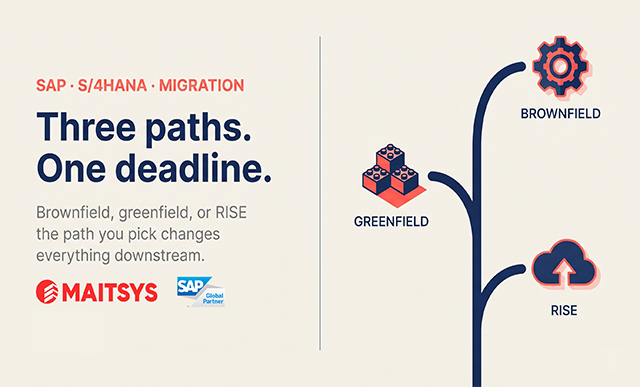
ECC to S/4HANA: Brownfield, Greenfield, or Selective Data Transition?To effectively transition from SAP ECC to S/4HANA, organizations must separately decide on their system transformation approach—whether through system conversion, new implementation, or selective data transition—and their operational model, with RISE with SAP primarily addressing the latter.
8 minute read


The Mandatory Transformation Your Business Didn’t Choose Could Be Its Biggest OpportunityThe mandatory migration to S/4HANA, often viewed as a disruption, can be transformed into a strategic opportunity through Lemongrass's Brightfield approach, which integrates AI from the onset to streamline the process, reduce costs, and unlock business value before go-live.
6 minute read