



Mar 16-19, 2026Las Vegas, Nevada, NV
SAP Global Tax Management
Featured Insiders
Upcoming Events
SAPinsider Las Vegas 2026
Related Vendors


Global Tax Management: An Overview and Key Considerations
What is Global Tax Management
Global tax management is the process by which tax managers evaluate the global taxability of an organization’s industry, corporate structure, business model, operations, products or services, business activities, and daily transactions.
To ensure global tax reporting requirements are met accurately and consistently by all subsidiaries across multiple tax jurisdictions, global tax management requires a holistic view of an organization’s entire flow of transactional data across its entire value chain.
Global tax management brings together disparate technologies from multiple vendors, such as SAP, Vertex, Sovos, Avalara, Thomson Reuters, and different currencies and various regulators, contributing to complexity across the tax function.
Global Tax Management: An Overview and Key Considerations
What is Global Tax Management
Global tax management is the process by which tax managers evaluate the global taxability of an organization’s industry, corporate structure, business model, operations, products or services, business activities, and daily transactions.
To ensure global tax reporting requirements are met accurately and consistently by all subsidiaries across multiple tax jurisdictions, global tax management requires a holistic view of an organization’s entire flow of transactional data across its entire value chain.
Global tax management brings together disparate technologies from multiple vendors, such as SAP, Vertex, Sovos, Avalara, Thomson Reuters, and different currencies and various regulators, contributing to complexity across the tax function.
For many organizations, global tax management typically involves these three steps:
- Define compliance needs worldwide across all operating units, lines of business, tax jurisdictions.
- Map businesss processes to govern how compliance should flow through the organization globally.
- Implement technology solutions that can accurately collect information and content updates from disparate sources in alignment with defined business processes to deliver master data and financial information asynchronously as required.
Key Considerations for SAPinsiders
Understand the growing complexity of global tax management. Organizations considering different areas of the world for new potential opportunities must be aware of how these business interests can affect the local country’s taxation. Changing legislation and mandates around global tax management is becoming ever more complex as organizations face growing challenges in evaluating how their growth initiatives may impact global tax liabilities.
Evaluate your content needs for effective global tax compliance. Tax managers need to consider what global activities may be taxed in which locations and ensure that they are meeting the tax requirements of each country accurately and promptly. Greater global tax compliance efficiency can help organizations reallocate accounting resources to support revenue-generating tax compliance opportunities.
Implement technology to simplify global tax management needs. The Ingram Micro and Dow Chemicals case studies provide best practices outlining how technology makes it possible to create a global view of the enterprise, enabling tax function managers responsible for global compliance, global reporting, and global controls. Content updates that provide real-time data on tax jurisdictions, tax rates, and tax content changes are critical for efficient global tax compliance.
183 results

HR: Case study: How the University of Tennessee automated the process of applying support packs and tax update bulletinsMar 5, 2019 — Learn how the University of Tennessee expedited the testing process for applying support packs and BSI tax update bulletins (TUBs) and/or BSI TaxFactory upgrades to its on-premise environment. HR2017_Musharbash_Casestudyhowtheuniversity Sam Musharbash If you have comments about this article or publication, or would like to submit an article idea, please contact the editor.
1 minute read


How to Automate Taxation of Wages Using a Flat-Rate Method During an Adjustment Payroll RunMay 14, 2018 —
SAP payroll schema and BSI TaxFactory 10.0 are tools that can be used to customize taxation of wages paid to employees. Learn how to customize and automate tax calculations on supplemental wages using a flat-rate method during adjustment payroll using SAP payroll and BSI TaxFactory 10.0.
10 minute read
How Utilizing a Cloud Tax Engine Can Lead to Increased ROIFeb 28, 2018 — Global enterprises continue to expand their cloud strategy, focusing efforts on specific back office business functions which can benefit from the elasticity, scalability, and faster ROI from cloud technologies. This session from Vertex’s Mark Sieczkowski and Brian Wilchusky offers insight into why a cloud/SaaS solution is a recommended approach for complex tax compliance issues such […]
1 minute read

Is Your Tax Technology Future Ready?Jan 25, 2018 —
Having the right tax technology in place is crucial for dealing with the many changes in the global tax landscape. Digital-era tax compliance demands are challenging companies, putting them at risk for non-compliance and pressuring them to move away from spreadsheets and ad hoc practices. Reliance on such homegrown applications is no longer an option for keeping up with the swift changes in tax rules and rate changes. Advanced tax-specific software that is integrated with a company’s ERP system can address these pressures. This article examines how to support an end-to-end tax life cycle with tax-specific software.
3 minute read
Improve Withholding Tax Calculations with the Little-Known Exclusion Functionality in SAP ERPApr 10, 2017 — Learn about functionality for calculating withholding taxes and the configuration steps to complete for the functionality to work correctly. SAP’s extended withholding tax now has additional functionality to exclude the withholding amount of expense line items. Key Concept Withholding tax is a common tax policy and is a legal requirement for the payer of an […]
10 minute read
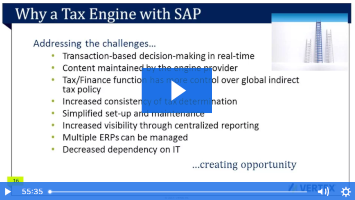
Considerations and opportunities: Realizing value from automating global indirect taxApr 5, 2017 — This conference session video is hosted by SAPinsider and sponsored by Vertex. This session explores the challenges tax departments face and the potential opportunities that exist for companies that implement a tax engine to support global indirect tax requirements — from project planning and technology considerations, to integrating with SAP business functions. Gain valuable insight […]
1 minute read
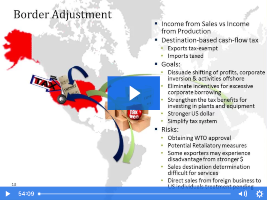
The world of tax affected scenario planningApr 5, 2017 — This conference session video is hosted by SAPinsider and sponsored by Vertex. What do Brexit and EU state aid cases, the U.S. House of Representative blueprint and audits have in common? They are all reasons to be equipped with tools and technology to answer your CFO and CEO when they ask “What does this mean […]
1 minute read
Automating Income Tax ProvisioningJan 25, 2017 —
Read the article from the SAPinsider Special Report on Financial Transformation. Nancy Manzano of the Vertex Chief Tax Office explores data connectivity for SAP BPC users, and outlines how connecting Vertex Tax Accounting with the data in SAP BPC can dramatically improve global provisioning.
Read the article to learn how Vertex can improve data accuracy and streamline the provision process.
5 minute read

Five Things You Should Know About Payroll Tax Filing SoftwareJan 10, 2017 — Maintaining control and accuracy of your organization’s payroll tax filings and liabilities is not only a huge responsibility, but can also pose a huge risk if not managed properly. In the past, employers had few options: either develop an in-house process and manage the associated challenges or outsource tax filing and remittance obligations to a […]
4 minute read