Management
Social media is becoming an invaluable tool for businesses to spread information, interact with customers, and collect public sentiment. If your company wants to create or improve its social media presence, read on to learn what tools to use and get tips for creating your initiative.
Social media tools have quickly made their way into the business world. Sites that began as ways to merely connect with friends, such as Facebook and Twitter, are now driving forces in marketing, sales, and public relations. Social media tools and services provide a low-cost, easy way to communicate a corporate message, promote products, improve public image through direct interaction with customers, and collect public sentiment about your company and products.
Companies that have already latched on to social media as a marketing and customer service tool are reaping the benefits. Well-known companies such as Dell, Comcast, and SAP itself have created strong online presences through social media sources including Twitter, Facebook, YouTube, forums, and blogs. “Most companies are very eager to develop a social media roadmap and find good ways to use these channels for improving sales, increasing brand awareness, and enhancing customer service,” says Mukunda Krishnaswamy, chief technology officer at Mimosasoft, a company that builds template applications such as SwiftConnect, a software solution that allows for rapid and automated publication of product information to multiple online channels and data pools through a single interface.
Not only are tools and services available to connect your company directly to your customer, but many are also available to collect public opinions of your company from sources such as Facebook, Twitter, blogs, and forums. Such tools can then analyze the sentiment contained in the data to create reports detailing what your customers are saying about you and what they think of your products.
These social media tools are becoming so prevalent in businesses today that the strategic value of creating a social media initiative has greatly increased. As Krishnaswamy notes, “On the competitive side, not doing anything is not an option.”
Guidelines for Creating Your Social Media Initiative
Though the benefits of creating a social media presence are myriad, the formation of the initiative must be well thought out and structured. Attention needs to be focused on not only what information you broadcast about your company to the public, but also on collecting and analyzing the sentiment the public is voicing about your company.
Push Accurate, Consistent Information to the Public
It’s so easy for anyone to join and begin using services such as Twitter that at many companies, employees begin sending out public Tweets about current products, projects, and company news and events that they see as harmless, but may contain information that the company doesn’t want to be available for all to see. Therefore, you should create structure around social media activity at your company — whether it’s part of a formal social media initiative, or merely employees taking to Twitter on their own.
Messages must be consistent, the amount of information able to be shared must be determined, and the information sources must be assigned. If these aren’t established, your staff may be releasing conflicting, inaccurate, and private information about your company and products in blogs, Tweets, and other public venues. Sooner rather than later, your company should create social media guidelines around appropriate language, topics, and information scope, and distribute them to all staff. Even if you don’t have a full-swing social tools implementation planned, a set of guidelines will prevent confidential or conflicting information from being disseminated to your customers and competitors.
“You need to put together policies and guidelines and educate your employees, and even your partners, for that matter. You need to provide them ready access to consistent and accurate information about your products and services as well as what the company procedures are when it comes to putting this information out there,” Krishnaswamy says.
“For example, if you have two sets of information about a product and they’re mutually inconsistent, then you could potentially have two people publishing different sets of information to the world,” he went on to explain. “Giving the right tools to these employees so that they can easily find the correct information to publish to the world is very important to the successes of this initiative.”
Appointing a social media manager to direct the initiative will help provide the structure needed to ensure the greatest success. The manager will not only plan the initiative and control the messaging, but he or she will also provide another necessary piece of a social media strategy — interaction with the customer. Once you set up an official Twitter account, for instance, the public will begin interacting with it. Questions, criticisms, and praise may be directed to the account and those Tweets need to be addressed. If they aren’t, your social presence won’t hold the same weight.
A social media manager controlling a corporate Twitter or Facebook account will also ensure one voice is representing your company. Customers will become familiar with that individual, creating a warmer, more personal interaction between the company and the customer.
This manager can come from different areas of the business for different companies. George Nashed, senior sales engineer at SAP, thinks that it’s important that the leader be a subject matter expert who understands unstructured data and knows what’s important, what’s not, and how to collect the information that will help your company improve and push out information that will improve your company’s image.
Krishnaswamy feels that the marketing department could provide the best candidate. “I think marketing departments have a significant responsibility here in terms of developing an overall standard,” he says. Marketing already has a good background in how your company’s message should be portrayed and can use that knowledge to create social media guidelines.
No matter where the social media manager comes from, both Nashed and Krishnaswamy agree that IT should be involved in the social initiative. IT will not only be able to build the applications and content framework to support your initiative, but also connect the data you collect to your BI structure to share your success and findings with the rest of the business.
While a presence on social networking sites can benefit your company’s customer service and public relations, publishing your product information to them can benefit sales. Content publishing tools, such as Mimosasoft’s SwiftConnect, can be used to populate social or search sites with your product information. SwiftConnect extracts product data from a company’s ERP systems including SAP Master Data Management (MDM) or SAP ERP Central Component (SAP ECC), and converts it into a format that is usable by the target channels such as a Facebook Page Google Shopping, or a data pool.
Such tools intend to ensure your products appear on searches and make product information available as readily as possible to customers. Because so many companies already have their product information available through these channels, syndicating your product information, its availability, and pricing in a consistent and automated fashion can help you compete effectively in the marketplace.
Collecting Public Sentiment
Tracking online concerns, questions, and praise regarding your products is an invaluable method of collecting public opinion. This isn’t an easy feat, however, with the vast amount of information available on the Internet today. “Now that we have everything digital and indexed and we can search on everything, we’re getting a lot of garbage in between,” says Nashed. “Companies want to narrow this. They know there’s data out there — they know it exists — they just don’t know how to analyze it. That’s where you see text analysis applications play a big role.”
Nash explained that when you do a general search for the term “SAP,” you get various results that are unrelated to the software company, such as those for tree sap. “The more data you get, the more garbage you get. To derive value, I need to filter out a lot of this garbage to get the golden nuggets I’m looking for.
While this can be done manually, many companies are using automated tools, such as Pulse Analysis by Mantis Technology Group. The tools quickly crawl the Web for mentions of products and services and then analyze that data to determine how products are viewed.
For SAP customers, that data analysis can be done using SAP BusinessObjects Text Analysis, a sentiment analysis tool that comes as part of SAP BusinessObjects Data Services 4.0. The tool analyzes unstructured data — sources including Tweets, blogs, emails, and Web sites — and draws out information such as top product mentions, trends, criticism, and praise (Figure 1). SAP BusinessObjects Text Analysis can then create reports of the findings in user-friendly formats.
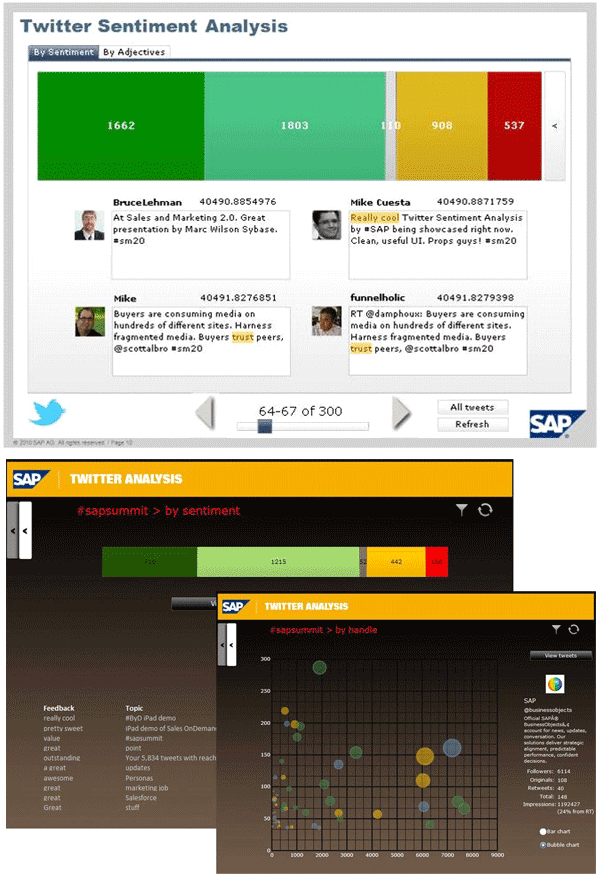
Figure 1
SAP BusinessObjects Text Analysis in action
SAP BusinessObjects Text Analysis was created based on research surrounding natural language processing. The tool is able to break down a sentence to identify its object, subject, verb, and noun for more than 30 languages. The tool analyzes data brought in from a Web crawling tool — SAP BusinessObjects Text Analysis itself doesn’t crawl the Web for data — and organizes it into a useful sentiment analysis.
“I can define ‘Washington,’ for example,” Nashed explains. “‘I went on George Washington’s birthday to Washington, D.C., to open a bank account at Washington Mutual.’ If you Google search Washington, you’ll get all those. But what the SAP BusinessObjects Text Analysis engine is capable of is to identify that George Washington is a person, Washington Mutual is a bank, and Washington, D.C., is a city.”
Tools such as SAP BusinessObjects Text Analysis are providing a much greater view into public opinion than companies have ever had. Prior methods of collecting public opinion, such as surveys and focus groups, are time consuming and less accurate. Now a company can set up Web crawling and sentiment analysis tools to automatically pull unstructured data from the Web and organize it into reports that describe exactly what is being said about your products, services, and company.
Nashed himself has been using SAP BusinessObjects Text Analysis to analyze data from Twitter involving SAP. He has scheduled a crawler to pull data daily and set up SAP BusinessObjects Data Services to process that data automatically as it comes in. Nashed then views the results in SAP BusinessObjects Explorer. He can see trending topics, top SAP-related Tweets, and from whom those Tweets originate.
“Any time a huge announcement breaks, like when SAP HANA [High-performance Analytic Appliance] was announced, I’ve immediately seen a spike in public response,” Nashed says. “By monitoring my dashboards I can see how quickly the word is being spread.”
Note
Earlier versions of SAP BusinessObjects integrated with SAP BusinessObjects Text Analysis through the use of a universe connecting the two, allowing analyses done by the tool to be displayed in SAP BusinessObjects Web Intelligence reports. As of the 4.0 release, however, the SAP BusinessObjects Text Analysis functionality is included as part of SAP BusinessObjects Data Services 4.0.
Beware of the Flood Gates
Unfortunately, as Nashed explains, the ease with which information is disseminated online now is a double-edged sword.
“When you use a fan page on Facebook it can go either way — people are going to say positive things and they’re going to say negative things. When something new happens, a Facebook fan page is the very best way for campaigning and marketing and pushing the word out there and getting a lot of market buzz,” he explains. “But the bad thing is that if something bad happens and people start posting it up online and talking about it, it’s also going to spread very quickly.”
Additional Social Media Tools
The options for social media tools that can benefit a business are numerous. Some of the available sites and services today are:
- Facebook: Facebook pages allow you to share content, announcements, and promotion with a targeted customer base. When a customer “likes” your Facebook page, any information you share through that page is pushed out to their Facebook account feeds, providing real-time updates to interested people. Many companies are creating promotions in which a coupon or contest entry can be obtained by “liking” the company’s Facebook page. This low-cost marketing campaign style is an easy way to bring your customers to you and employ work of mouth advertising as when a user “likes” your page, their feed displays that information to all their friends. Note that according to the site’s page terms, contact information for page fans cannot be obtained without fans’ consent.
- Twitter: Your company can use a Twitter account to make announcements, hold promotions, and directly interact with your customers by participating in conversations about your company, products, and services. Companies are often now seen responding to customer complaints through Twitter, something that not only may prevent the complaining customer from spreading negative comments on other Web sites, but also makes a company look responsive and attentive to its customers’ concerns. Twitter also offers advertising opportunities that include promoting Tweets to reach a wider audience.
- Paper.li: Where even 140-character Tweets are too time-consuming to keep up with, Paper.li comes in. The service organizes a Twitter stream’s links into daily newspaper-style Web sites. The content of Tweets is analyzed to group different stories, blogs, and videos, for instance, into sections based on topics or hashtags. Once set up, this is an automated service, so you can take advantage of this to provide constant content to your Twitter followers. The followers are mentioned by username in the Tweets that go out announcing a new edition of your daily, thereby increasing your online communication as well.
- YouTube: Many companies are setting up corporate YouTube accounts to send out messages to their customers, provide additional information or instruction on their products, or share a look at the inner workings of the company. Videos provide a more personal connection to your customers than simply releasing text-based announcements. You can turn to YouTube to share videos detailing the creation of your products, tours of your headquarters, messages from your CEO, or instructions for your products, for example.
- Wikipedia: Companies that are noteworthy may consider creating a Wikipedia entry. Anyone can create and edit a Wikipedia page, so creating your own ensures the correct information you want is on the page. According to Wikipedia’s guidelines, a company is allowed to have a Wikipedia entry “if it has been the subject of significant coverage in reliable, independent secondary sources,” so be prepared to cite information using such sources. The page entry must provide useful content; it cannot be a marketing pitch for the company or it will be removed. But beware, these pages can be edited by anyone, so if your company receives negative press, the issue will likely be detailed in your entry by others.
- LinkedIn: Similar to creating a Wikipedia page for your company, creating a LinkedIn Company Page allows you to describe your company, products, and work culture, and post job listings. Potential candidates can use this page to learn about your company, view current employees, and determine if any current employees are in their networks. To create a LinkedIn Company Page, you must be a current employee of the company, with your position and company email address included in your personal LinkedIn profile.
- Google Analytics: Tracking your company’s own Web sites is an effective way to study how customers are using your sites and which pages are receiving the most views. The data it provides you details page views, unique page views, time spent on pages, entrance paths, keywords used, and much more. The service can break down campaign effectiveness with e-commerce tracking. The information it provides you with can help you better direct your marketing efforts and design your sites for the greatest customer interaction.
Note
To learn more about the tools discussed in this article visit:
Laura Casasanto
Laura Casasanto is a technical editor who served as the managing editor of SCM Expert and Project Expert.
You may contact the author at lauracasasanto@gmail.com.
If you have comments about this article or publication, or would like to submit an article idea, please contact the editor.