


3 minute read

Meet the Experts
Meet the Authors
Key Takeaways
-
Trust in Data is Crucial for AI Adoption: Treasury teams must have confidence in the data behind AI recommendations for effective decision-making, as human skepticism can stall AI initiatives regardless of technical capabilities.
-
Shift from Alerting to Interpretation: Treasury performance improves when systems focus on interpreting meaningful exceptions rather than overwhelming teams with alerts, enabling proactive liquidity oversight and smarter decision-making.
-
Evolving Treasury Talent Strategy: As AI takes over routine tasks, treasury professionals need to enhance their skills in interpretation, risk assessment, and strategic guidance to remain valuable partners in enterprise resilience and liquidity planning.
Treasury technology has been traditionally been judged by speed: faster payments, quicker reconciliations, and achieving visibility in real time. But as risk exposure increases and global liquidity environments grow complex, CFOs and treasury leaders are recalibrating their priorities. Accuracy, explainability, and trust in data are now just as critical as velocity.
This shift reflects treasury’s expanding role within the enterprise. Once viewed as a back-office execution function, treasury now plays a central role in liquidity strategy, fraud mitigation, and financial resilience. As AI becomes more prevalent, treasury leaders are increasingly focused on how intelligence is applied, not just how quickly outcomes are delivered.
In a recent SAPinsider’s Expert Exchange, Bob Stark, Global Head of Market Strategy at Kyriba, and Jean-Baptiste Gaudemet, Senior Vice President of Data and Analytics at Kyriba, spoke with Susan Galbraith, Vice President and Research Analyst at SAPinsider, about how treasury teams are using AI to improve confidence in decision-making rather than simply accelerating transactions.
Explore related questions
Trust Is the Gatekeeper for AI Adoption
Stark emphasized that AI initiatives often stall because of human skepticism, not technical limitations. “If treasury teams don’t trust the data behind an AI recommendation, they won’t act on it,” he said. “And if they don’t act on it, the automation simply doesn’t matter.” From Kyriba’s perspective, this places governance and explainability at the center of any treasury AI strategy.
Gaudemetreinforced this point from a data architecture standpoint. “Treasury data doesn’t live in isolation,” he explained. “Cash positions, bank connectivity, payment behavior, and historical trends all inform one another. AI has to understand those relationships, not just individual data points, to produce insight teams can rely on.”
As payment volumes increase and networks grow more complex, this contextual understanding becomes essential. Without it, treasury teams risk reacting to noise rather than identifying genuine risk or opportunity.
From Anomaly Detection to Pattern Recognition
The conversation also explored how AI is reshaping payments intelligence. Gaudemet noted that traditional systems often overwhelm teams with alerts. “The real value comes from understanding what ‘normal’ looks like for your organization,” he said. “Once you establish that baseline, meaningful exceptions become obvious.”
Both Kyriba experts stressed that technology cannot compensate for fragmented data environments. Clean master data, consistent definitions, and disciplined processes remain prerequisites. As Stark put it, “AI amplifies whatever environment you put it in—good or bad.”
The discussion also pointed to a shift on the horizon in treasury skill sets. As automation absorbs routine execution, treasury professionals will increase their focus on interpretation, exception management, and strategic guidance. In this model, AI doesn’t replace human judgment: It sharpens it.
What This Means for SAPinsiders
AI readiness in treasury is a data governance question first, not a tooling decision. The conversation underscored that AI adoption in treasury consistently stalls when underlying data cannot be trusted. As both Kyriba executives noted, treasury data spans cash positions, bank connectivity, historical payment behavior, and regional variations, which makes consistency critical. SAP finance leaders should resist the temptation to pilot AI on fragmented datasets, where inconsistent definitions across entities or geographies undermine confidence in outputs. Before introducing advanced analytics or AI-driven recommendations, organizations must standardize data models, reconcile sources, and establish governance frameworks that ensure explainability. Otherwise, applying AI becomes an academic exercise that treasury teams quietly sidestep rather than rely on for decisions.
Payments intelligence must evolve from alerting to interpretation. Real-time visibility alone does not improve treasury performance if it just generates more alerts. As discussed in the exchange, the real challenge for treasury teams is to distinguish meaningful exceptions from background noise. SAPinsiders should prioritize architectures that establish behavioral baselines. These include discerning what “normal” cash movement looks like for their organization across banks, geographies, currencies, and counterparties. This contextual understanding allows AI to highlight genuine risk rather than surface every deviation. The shift to interpretive intelligence over alert-driven monitoring enables treasury teams to move from reactive firefighting toward proactive liquidity oversight and smarter decision-making.
Treasury talent strategy must evolve alongside automation. As AI absorbs execution-heavy tasks such as reconciliation and monitoring, treasury professionals are empowered to shift toward interpretation, risk assessment, and strategic advisory work. Kyriba’s experts emphasized that AI does not eliminate human judgment: It increases its importance. SAP leaders should plan for reskilling that emphasizes analytical reasoning, cross-functional collaboration, and the ability to evaluate AI-driven insights in business context. Organizations that treat automation as a substitute for expertise risk hollowing out their treasury capability. But those that invest in talent development as well as technology position treasury as a strategic partner in enterprise resilience, liquidity planning and growing profitability.
More Resources
See All Related Content
SAPinsider Awards Q&A with Fit Foods: Scaling Accounts Payable with AI and AutomationFit Foods’ SAPinsider Awards-winning initiative shows how AI-driven accounts payable automation can reduce manual processing, improve accuracy, and scale finance operations without increasing headcount.

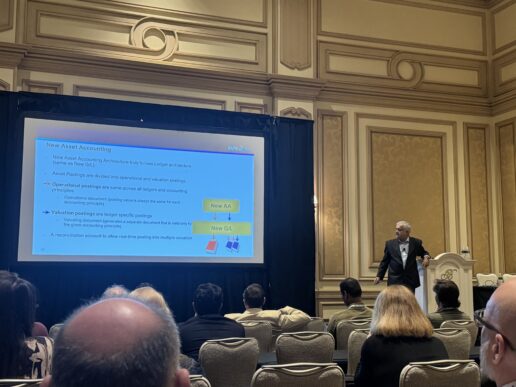
SAPinsider Pre-Con Session Urges Finance Teams to Treat SAP S/4HANA as an Architecture TransformationSAPinsider speaker Mitresh Kundalia emphasizes that successful SAP S/4HANA Finance transitions hinge on strategic architectural decisions made prior to migration, as automatic simplification is a misconception and legacy complexities may persist unless deliberately restructured.
4 minute read

Techwave Introduces SAP-Aligned Blueprint for Open Banking, Compliant Financial IntegrationTechwave is advocating for an API-first approach to open banking, enabling financial institutions to enhance compliance and create scalable, interconnected experiences, as open banking payments are set to exceed $116 billion by 2025.
3 minute read