

Mar 16-19, 2026Las Vegas, Nevada, NV
Metals and Mining
Featured Insiders
Upcoming Events
SAPinsider Las Vegas 2026
Related Vendors


Mining is a critical industry for the global economy, providing the raw materials needed for everything from construction to manufacturing. However, mining operations are often complex and opaque, making it challenging to ensure that they operate efficiently and responsibly. Intelligent mining is a new approach that uses automation and data analytics to improve operations and increase transparency.
SAP Metals and Mining helps companies automate production and collaborate with customers, suppliers, and communities, allowing mining companies to improve their agility and deliver resources responsibly. This will help create sustainable operations and drive profits while ensuring shared social outcomes. SAP Metals and Mining enables intelligent mining as a critical tool for the industry’s future.
Key capabilities of SAP Metals and Mining include:
- Commodity Supply Chain Management. Includes long-term business planning, customer engagement, sales, purchase, and shipment of commodities, and non-bulk transportation management.
- Mine Operations. Includes project and portfolio management, mining and processing, asset management, warehouse management
- Operational Risk and Compliance Management. Includes environment, health, and safety, and products compliance
Mining is a critical industry for the global economy, providing the raw materials needed for everything from construction to manufacturing. However, mining operations are often complex and opaque, making it challenging to ensure that they operate efficiently and responsibly. Intelligent mining is a new approach that uses automation and data analytics to improve operations and increase transparency.
SAP Metals and Mining helps companies automate production and collaborate with customers, suppliers, and communities, allowing mining companies to improve their agility and deliver resources responsibly. This will help create sustainable operations and drive profits while ensuring shared social outcomes. SAP Metals and Mining enables intelligent mining as a critical tool for the industry’s future.
Key capabilities of SAP Metals and Mining include:
- Commodity Supply Chain Management. Includes long-term business planning, customer engagement, sales, purchase, and shipment of commodities, and non-bulk transportation management.
- Mine Operations. Includes project and portfolio management, mining and processing, asset management, warehouse management
- Operational Risk and Compliance Management. Includes environment, health, and safety, and products compliance
SAP Road Map for Metals and Mining includes:
- Current release highlights: Commodity pricing and risk management, intelligent asset management, KPI dashboard and reporting for incidents, integrated HR/business partner information
- Upcoming innovations: Blockchain-based global trading and multiparty transactions, integrated operational planning, enhanced supplier collaboration tools, intelligent/predictive emissions forecasting
- Future Plans: Unified sales and operations planning, demand-driven business collaboration, cost-efficient asset management solutions, intelligent/predictive analytics for incident and compliance management
SAP software solutions to meet your needs include SAP S/4HANA Cloud and SAP Integrated Business Planning for Supply chain.
Key Considerations for SAP organizations:
- How SAP is Enabling Customers to Operate More Sustainably in a Zero-Waste Value Network. SAP is uniquely positioned to help its customers transition to a more sustainable way of doing business. One area where SAP has made a difference is waste management for industries, such as metals and mining. By helping metals and mining companies eliminate waste streams and adopt a circular economy approach, SAP has not only helped reduce its environmental impact but also created new business opportunities. With the right tools and support, businesses can unlock significant value by adopting more sustainable practices.
- Optimize integrated sustainability management and KPI tracking with SAP BusinessObjects Sustainability Performance Management (SuPM). Tracking and communicating sustainability performanceis essential for any organization wanting to reduce the time and costs spent compiling data and disclosures. However, tracking all the necessary information and activities can be challenging while reducing paper waste. This is where SAP BusinessObjects Sustainability Performance Management comes in, as it helps organizations save time and money by gathering data and creating disclosures automatically. In addition, the application provides an easy way for users to set goals and objectives, monitor progress, and track results.
- Learn how Sheet Metal Companies can Leverage SAP Product Costing for Joint Production. The concept of joint production is essential in managerial accounting and cost determination. In a joint production scenario, two or more finished products result from a single production process. The key characteristic of joint production is that the production cost is shared between the manufactured products. This requires an apportionment of the standard cost between the primary finished product and other co-products. The apportionment can be done on a physical or economic basis. A physical basis means that the quantity or value of each product is considered. An economic basis takes into account the demand for each product and the sales price. Once the apportionment has been made, a preliminary settlement transaction is recorded in SAP to remove the joint costs from the inventory of the primary finished product. This is important because it allows for the accurate calculation of variances for the primary product. Joint production is a complex topic with many nuances. However, understanding the basics is essential for anyone who wants a deeper understanding of managerial accounting and cost determination.
46 results

5 Ways Accrual Process Automation Helps Ensure Compliance within SAPNov 4, 2025 — Automating the accrual process transforms financial closing by enhancing accuracy, compliance, and transparency while reducing manual effort. Tools like accrual automation engines and integrations with ERP systems streamline approvals, enforce regulatory standards, and provide audit-ready reporting. By leveraging automation, organizations can improve financial reporting, mitigate compliance risks, and increase productivity across finance teams.
3 minute read

Is My Business AI Ready? Laying the Data Foundation for Successful AI ImplementationNov 4, 2025 — Successful AI adoption requires more than enthusiasm; it depends on the readiness of an organization’s data and infrastructure. Companies must focus on data quality, governance, accessibility, integration, and security while managing both structured and unstructured data to create a cohesive AI-ready environment. Coupled with strategic alignment to business goals, these practices lay the foundation for reliable, impactful, and compliant AI initiatives.
5 minute read

6 Best Practices for Setting Up Retention Policies in SAPNov 4, 2025 — Setting up effective SAP retention policies is essential for regulatory compliance, data security, and operational efficiency. Organizations should categorize data, apply automated retention rules via SAP ILM, and maintain audit-proof records while customizing policies to meet global and industry-specific regulations. Regular testing and monitoring ensure that retention policies function correctly, enabling organizations to manage data responsibly, minimize risk, and support ongoing business and compliance requirements.
2 minute read

Building a Budget for Your Journey to SAP RISENov 4, 2025 — A successful SAP RISE transformation starts long before cloud migration approval, with careful budgeting, data analysis, and requirement gathering. Reducing data volumes through cleaning and archiving helps lower migration costs, simplifies system integration, and ensures regulatory compliance. By planning early, defining clear requirements, and aligning timelines with the SAP ECC end-of-life, organizations can create a realistic, data-driven budget that maximizes ROI and enables a smooth, cost-efficient RISE journey.
5 minute read
Understanding Data Tiering vs. Data Archiving: Which is Better to Prepare for SAP RISE?Nov 4, 2025 — Effective data management is critical for a successful SAP RISE or S/4HANA migration. While data tiering helps optimize storage for frequently accessed data, it does not address migration speed, compliance, or long-term management. Data archiving, on the other hand, moves inactive data to cost-effective storage, reduces migration complexity, ensures regulatory compliance, and provides long-term cost savings, making it the preferred strategy for large-scale ERP migrations.
3 minute read

The Hybrid Approach for End-to-End Procure-to-Pay (P2P) AutomationNov 4, 2025 — Efficient P2P management is critical for operational success, yet manual processes create inefficiencies, errors, and compliance risks. By adopting a hybrid automation approach, integrating SAP Ariba for procurement, OpenText VIM for invoice management, and AI-powered accruals, organizations can streamline sourcing, invoicing, and financial close while maintaining compliance and visibility. This end-to-end automation delivers faster cycle times, improved supplier relationships, and measurable cost and productivity gains across the procure-to-pay lifecycle.
5 minute read

Managing HR Documents from Recruit to Retire — Extended ECM for SuccessFactorNov 4, 2025 — Managing HR documents across the employee lifecycle can be complex and compliance-intensive. SAP Extended ECM by OpenText for SuccessFactors simplifies this by centralizing all HR-related content, automating document workflows, and ensuring governance and data security. By integrating with SuccessFactors, organizations can streamline onboarding, enhance compliance, and deliver a more efficient and user-friendly HR experience.
4 minute read

Navigating M&A Compliance: Key Challenges and Solutions for Mergers, Acquisitions & DivestituresNov 4, 2025 — Mergers, acquisitions, and divestitures demand strategic management of IT systems and data to maintain compliance and operational stability. Companies face challenges such as integrating or separating complex infrastructures, managing data effectively, and retiring outdated systems. By adopting structured solutions, like improving data governance, optimizing business processes, and leveraging modern technologies, organizations can turn these transitions into opportunities for efficiency, compliance, and long-term growth.
4 minute read

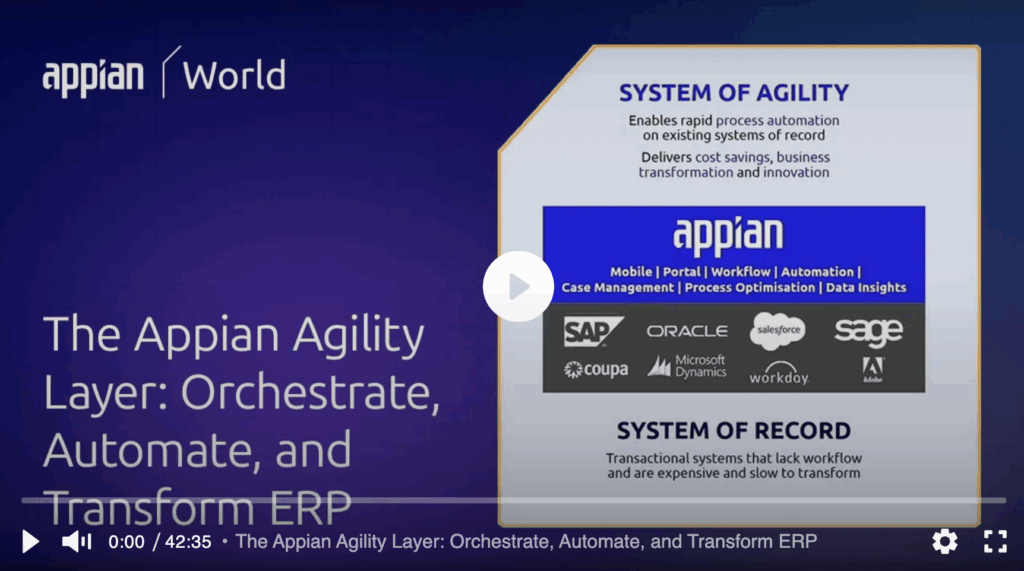
Introduction to AppianOct 31, 2025 — Appian brings orchestration, automation, and intelligence together in a secure, performant platform for managing your most complex processes. Consolidate your enterprise systems with data fabric, simplify your application architecture with low-code design for building apps and workflows, and unleash your process potential with AI-powered automation for a more adaptable and optimized business. Move your business forward with process orchestration from Appian.
1 minute read