Management
It is often difficult to decide how to train the SAP user base given your company’s requirements. Walk through an analysis technique that provides a decision matrix to help you make the right decision. The analysis is performed on three sample projects to illuminate how it can vary based on your needs.
Key Concept
Training needs analysis is an exercise that is conducted upon receiving a request for training and prior to engaging in any other training activity. In training needs analysis, you need to establish a training plan and present it for approval.
Selecting the right training method is very important for the success of any SAP training project. A wrong training method can be a recipe for training failure that leads to bad consequences for the organization, including lost money or time.
I will show you a simple technique on how to select the most suitable training method. The technique is based on using a simple formula that is a sum of four components: preference, time, cost, and resources. Stakeholders in training are anyone affected by the rollout of the new SAP functionality. For example, suppose the SAP project is related to SAP Customer Relationship Management (SAP CRM) functionality, such as automating a service request. The stakeholders in this case are the owners of the process and all employees that can be assigned to the roles of initiator, processor, reviewer, approver, and closure partner.
I’ll consider e-learning and classroom training as the possible methods and assign values to each component based on input data and decision matrix rules. In the model section, I’ll explain the technique in detail. This includes how to use the formula, the two training methods, the decision matrix, and the necessary steps. To demonstrate the model, I’ll show you three examples of projects in the results section. I’ll compare the three projects based on their calculations and show you the effect of changing the number of lessons on the training options. Then I’ll analyze the results and show you how to come to a decision about what recommendation to make.
The Model
The model is based on using the following formula:
Score = Preference + Time + Cost + Resources
Based on input data and decision matrix rules, the training professional assigns each component one numerical value (0, 5, or 10) that has the same weighting as the other three:
- Preference: This component represents the stakeholder’s preference regarding each training method. Accordingly, 0 represents no interest in the training method, 5 means being unsure, and 10 indicates that the method is preferred.
- Time: This component is the time it takes to implement the training method. For the training method to score high, the time must be less than the assigned period (D) for the training project.
- Cost: This component is the cost of implementing the training method. The cost must be less than the assigned budget (B) for the training project. The training budget is the amount assigned by the organization for the SAP project training. This amount is how much the organization plans to spend and how much it can afford for the training component.
- Resources: The available resources are restricted to the number of developers, trainers, and classrooms.
Table 1 shows the decision matrix for the two possible methods: e-learning and classroom training. In addition to B and D, it uses the following abbreviations:
- T1: Time required to create the e-learning course
- C1: Cost required to create the e-learning course
- T4: Time required to create and deliver the classroom course
- C2: Cost required to create and deliver the classroom course
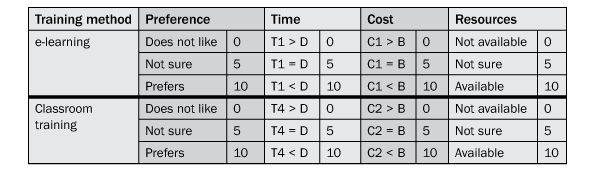
Table 1
The decision matrix
You can add up each training method to reach a score from 0 to 40. Then you can compare the scores and analyze the results to make a good recommendation. The steps in using this technique are as follows:
- Identify project-assigned duration, budget, resources, and any other data
- Finalize the formula
- Decide on training methods to consider
- Create a decision matrix
- Calculate scores for the training methods using the formula
- Analyze results
-
Select the training approach and make recommendations
Results
To demonstrate the model, I will show examples of three projects. Table 2 shows the assigned resources, input data, and requirements for the three projects based on two training methods. In project 1, you need to train 1,000 end users on how to create and process an SAP CRM service request. You have two options: creating an e-learning course of 10 lessons or delivering classroom training. Project 2 is the same as project 1, but for 100 end users. Project 3 is for 100 end users, but the number of lessons in the e-learning course is 40 instead of 10.

Table 2
Assigned resources and project requirements
With these scenarios, you can study the effect of changing the number of end users on the classroom training and the effect of changing the number of lessons on the e-learning training. Using the data from Table 2 and the decision matrix rules, you can calculate final scores. I’ve displayed these in Table 3. For the three projects, my example assumes that classroom training is preferred by the users over e-learning.

Table 3
Scores for three projects
For comparison, the final scores for the three projects are plotted in Figure 1. For project 1, the score for e-learning is much higher than that for classroom training. In project 2, the two training methods are almost equal with a slight edge for classroom training. As for project 3, the picture is reversed where the score for classroom training is much higher than that for e-learning.
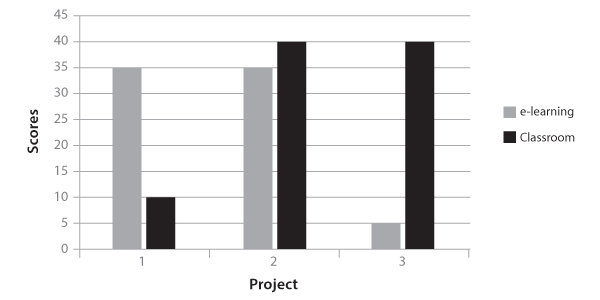
Figure 1
Scores for three projects
The effect of the number of end users on time and cost for the classroom training is shown in Figures 2 and 3. The number of end users has no effect on e-learning. As for the classroom training, the effect is proportional. As the number of end users increases, the time required for the classroom training increases linearly. The time required for classroom training is equal to the project duration at the point where the classroom line meets the duration line (the time is 160 hours; the number of end users is 175). The same can be said about the effect of the number of end users on cost. The cost required for classroom training is equal to the project budget at the point where the classroom line meets the budget line (the cost is $5,000; the number of end users is 230).

Figure 2
Effect of end users on time
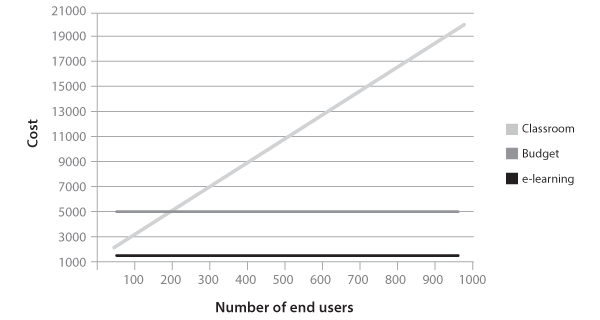
Figure 3
Effect of end users on cost
The effect of the number of lessons on time and cost for the e-learning is shown in Figures 4 and 5. The effect is clearly proportional. As the number of lessons increases, the time required for the e-learning increases linearly. The time required for creating the e-learning course is equal to the project duration at the point where the e-learning line meets the duration line (the time is 160 hours; the number of lessons is 20). The same can be said about the effect of the number of lessons on cost. The cost required for creating the e-learning course is equal to the project budget at the point where the e-learning line meets the budget line (the cost is $5,000; the number of lessons is 31).
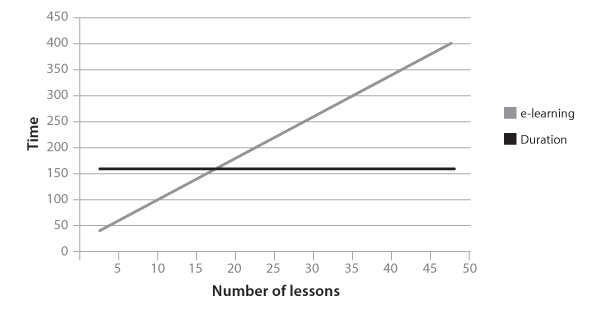
Figure 4
Effect of lessons on time

Figure 5
Effect of lessons on cost
Analysis
Now I’ll analyze the results for each of the three projects.
Project 1
The final scores show e-learning as a clear winner. The large number of end users makes it impossible in this case to use the classroom training method owing to the limited assigned project duration and budget. However, the time and cost of e-learning are less than the assigned project duration and budget.
The difference is as follows:
- Time difference = assigned project duration - e-learning time = 160 - 80 = 80 hours
- Cost difference = assigned project budget - e-learning cost = $5,000 - $1,600 = $3,400
The difference is sufficient to deliver training for approximately 100 employees in classroom settings without any extra time, cost, or resources (Figure 6).
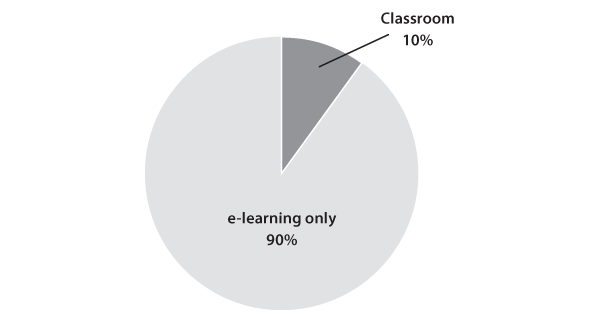
Figure 6
Recommendation for project 1
In conclusion, the recommendation for project 1 is to use a combination of e-learning and classroom training:
Project 2
For project 2, the number of end users is only 100. This lower number changes the outcome, and now there is no clear winner. The scores are e-learning = 35, classroom = 40. If you choose classroom training, you are still left with a balance of 60 hours and $2,600, which is not enough to cover the cost of creating a full e-learning course. On the other hand, if you choose the e-learning option first, the balance does not support classroom training for 100 end users. The recommendation for project 2 is to select one of these two options:
Project 3
For this case, the impact of increasing the number of lessons to 40 in the e-learning course is very obvious and so the recommendation is to not choose e-learning. The choice for classroom training is evident.
AbduNaser Shhub
AbduNaser Shhub has more than 15 years of experience in training, teaching, and academic research. He has spent seven years in managing training programs and developing training courses that are related to various SAP modules. He holds a Ph.D, MSc., and a BSc. in nuclear engineering and has four SAP consultant certificates in SAP ERP HCM, SAP CRM, SAP SRM, and SAP SCM.
You may contact the author at abdunaser.shhub.1@aramco.com.
If you have comments about this article or publication, or would like to submit an article idea, please contact the editor.