

3 minute read
Meet the Authors
Key Takeaways
-
The global agricultural enterprise implemented SAP Build Process Automation to streamline the processing of dealer consignment orders, significantly reducing manual effort and improving order handling during peak sales periods.
-
This automation is crucial for compliance, as it ensures that all dealer orders are processed and invoiced within the same calendar month, thus avoiding costly penalties and maintaining audit integrity.
-
The solution benefits customer service teams by increasing order processing capacity by 30% while minimizing errors, making it applicable to various industries facing similar operational challenges in document handling and ERP integration.
A global agricultural enterprise operating in a regulated regional export market faced recurring exposure during peak sales periods, when dealer consignment orders arrived faster than a competent human-staffed team could absorb them into the ERP system.
All dealer orders arrived by email, usually as attachments. Some were clean .PDFs while others were scans. More than a few were photos of handwritten order sheets. Every order had to be reviewed, interpreted and manually entered into SAP S/4HANA before the month-end close. During peak agricultural sales seasons, this became a choke point, proving an operational and structural bottleneck. A massive influx of dealers’ emails at the exact time when invoicing deadlines were most restrictive overwhelmed a 15-person customer service team.
Instead of adding additional staff, the company automated the front end of the process. Targeted intelligent automation was deployed on a cloud-based enterprise platform to extract consignment order data from incoming documents, including handwritten forms, and to validate it before creating SAP sales orders. The goal was automating the process and eliminate manual rekeying, which was slowing processes down.
Explore related questions
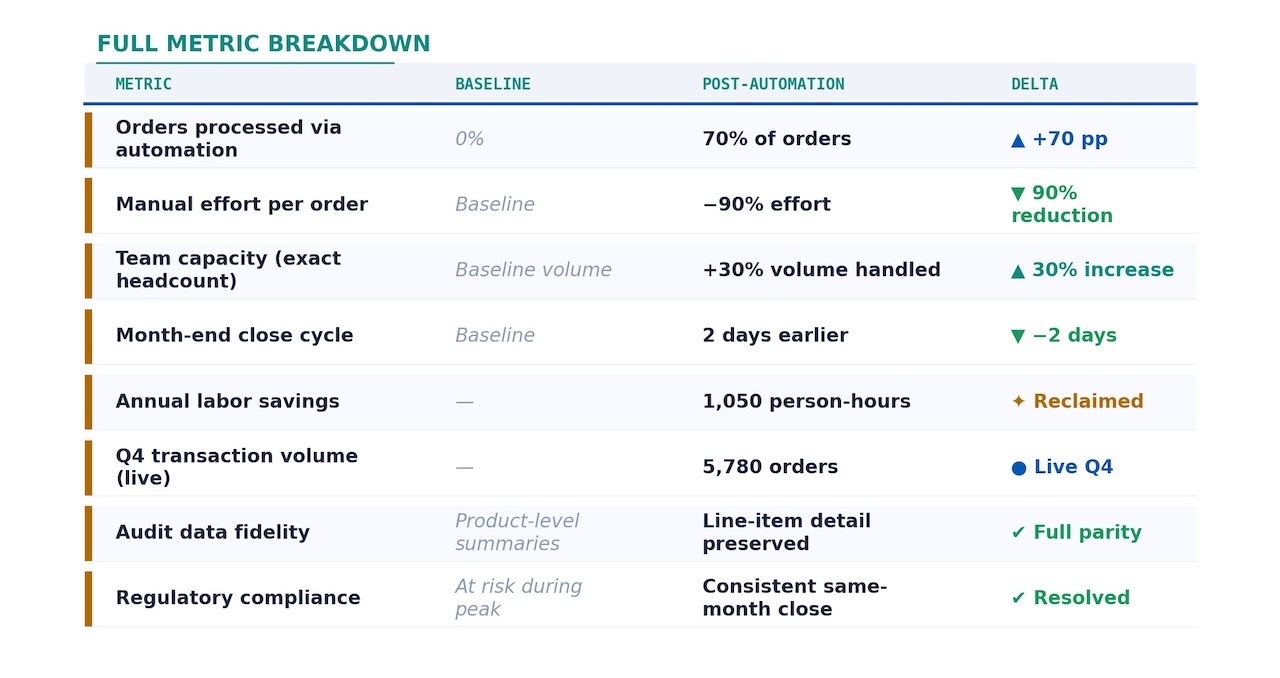
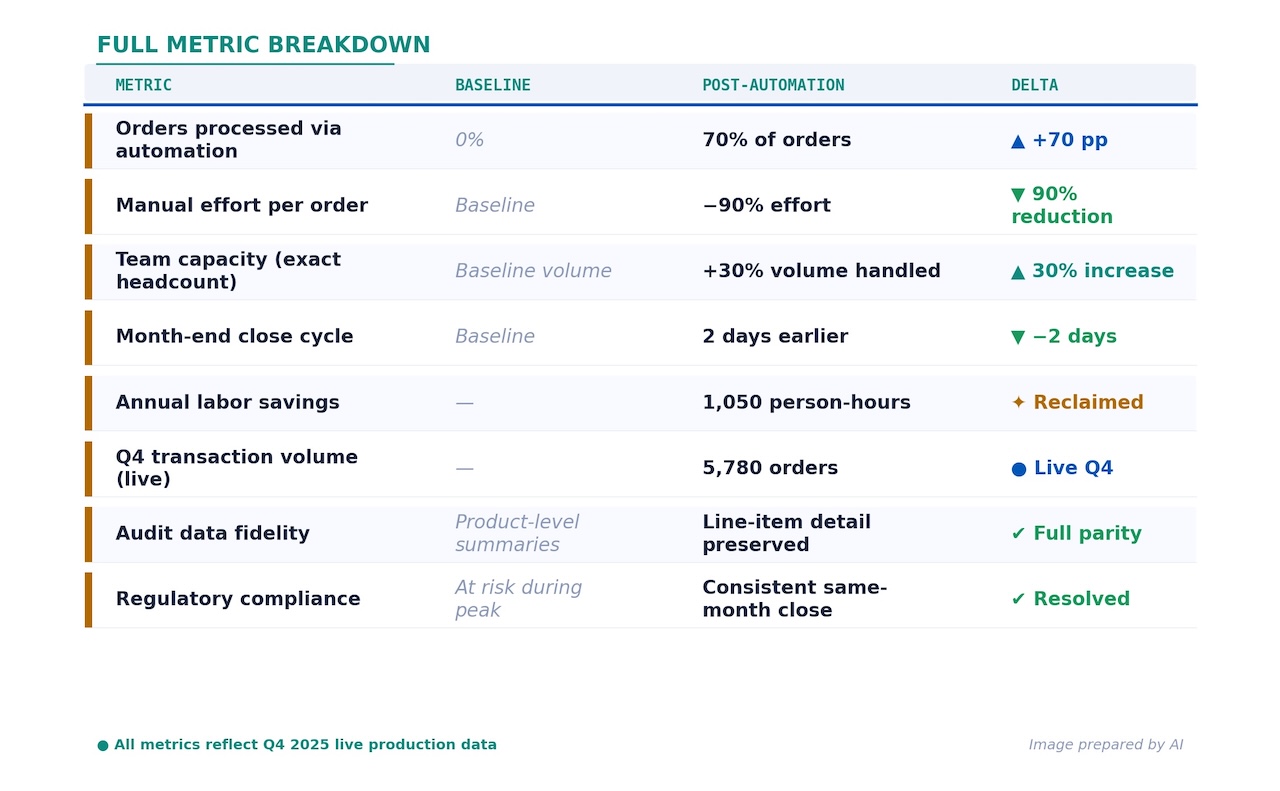
After rollout, the same customer service team processed about 30% more orders with 90% less manual effort per transaction. Month-end close consistently finished two days earlier, with fewer corrections and a cleaner audit trail.
Compliance Risk and Operational Constraints
Local regulations required consignment sales for agrochemical products to be entered and invoiced in the same calendar month they were delivered. There was no flexibility or carrying balances over to the next period and no retroactive adjustments.
During the off-season, order volume was manageable, and the customer service team could keep up. During peak season, however, conditions changed significantly. Order volume from dealers would exceed what the team could manually key in, and the pressure to get everything posted before month-end led to procedural shortcuts. To keep up with volume and regulatory compliance, customer service representatives began consolidating multi-line dealer orders into single product-level lines when keying them into S/4HANA. While the shortcut helped throughput, it stripped out detail.
Internal audit found consistent gaps between what the dealers submitted and what ended up in the S/4HANA system. The totals matched, but the line items didn’t tie back because the lack of traceability introduced material audit risk.
Benefits of SAP Build Process Automation
The organization took the time to assess several non-SAP automation platforms before settling on a long-term solution. Although these alternative platforms achieved acceptable extraction accuracy, they raised significant concerns about security, integration, and ongoing maintenance. Most required the development of custom connectors for SAP S/4HANA, as well as external credential management that operated outside the established enterprise identity and access management (IAM) framework.
As a result, these dependencies forced the IT team to run regression tests whenever SAP APIs or data models changed. From an operational standpoint, these requirements not only increased maintenance burdens, but they also introduced governance risks, which made the overall adoption model less feasible.
They chose SAP Build Process Automation (SAP BPA) after evaluating all options. This was because it works well with S/4HANA and follows SAP’s strong security rules. As a result, they didn’t need any middleware to connect things, which made it easier to manage and support everything. Two important features made this decision even stronger.
First, SAP BPA has a built-in mechanism for continuous learning. When a customer service representative fixes a mistake in extracting information, the system learns from it right away, so IT teams don’t have to retrain it manually.
Second, the generative AI feature in SAP Document AI can handle many types of dealer orders — from clean digital files to poor scans — in a single pipeline. This means the system doesn’t need special templates or complicated rules, which makes document processing much faster and more accurate and also improves how well the whole operation runs.
Understanding the Seven-Step Automation Process
The process is executed across seven discrete steps, with minimum user involvement. only one step requires user interaction, and even that is limited in scope:
- Order submission. The workflow begins when a customer service agent receives a dealer order by email. Instead of manually extracting data or logging into multiple systems, the agent places the email attachments into a dedicated inbox.
- Automatic monitoring. This mailbox is monitored by SAP Build Process Automation, which detects new inbound documents and initiates processing.
- Document extraction. The system’s intelligent extraction component (generative AI layer) sends the attachment to the document intelligence service, using a custom extraction schema tailored to dealer order documents. Rather than relying on dealer-specific templates, the solution identifies document structure. It extracts the required fields across a wide range of input types including structured .PDFs, low-quality scans and handwritten documents. This approach allows new document variations to be handled without ongoing template maintenance.
- Built-in validation and exception handling. Once the data is extracted, the workflow performs a series of automated validation checks. Line-item totals and derived values are recalculated to confirm mathematical accuracy and data consistency. Only documents that fail these validations are routed to a review screen. At this point, an agent can review and correct the data within the same workflow without switching applications or restarting the process.
- Real-time data enrichment in the S/4HANA system. After validation, the data is enriched through real-time integration with SAP S/4HANA using a secure cloud connector. Dealer identifiers are matched against customer master records, and free-text product descriptions are mapped to the correct material codes using live S/4HANA system data. This ensures that transactions are aligned with SAP master data before they are posted.
- Sales order posting. The enriched transaction is then posted to SAP S/4HANA as a standard sales order. All original line items are preserved as initially submitted, maintaining a clear audit trail from the incoming dealer document through to the final S/4 transaction.
- Final confirmation and delivery. To close the loop, the process generates an Excel confirmation file containing the fully enriched dataset and automatically returns it to the agent’s inbox for review. This approach enables agents to have a seamless experience, eliminating the need for any manual data re-entry, cross-system navigation, and follow-up processing.
Measured Business Outcomes
By automating the consignment sales order process, the organization reduced manual data entry, manual efforts and switching between systems for customer service teams.
Extending the Value Beyond a Single Use Case
This automation was designed to handle consignment orders, but its architecture can be applied to many other lines of business and industries. Many SAP-centric processes, such as processing purchase orders, matching invoices to deliveries and handling warranty claims, face the same structural challenge: converting large volumes of unstructured documents into valid transactions the company’s central ERP system can understand and process, while minimizing manual work. By using a solution like this, businesses can save time, reduce errors, stay compliant and achieve cost savings through increased productivity and greater efficiency.
For companies already using SAP, switching to this architecture requires less change than might be perceived. They already have core capabilities in place for identity, access control, integration and governance. This means they can start with one small project and then build on it as they see the benefits.
The SAP Business Technology Platform also enables this automation without requiring enterprises to build or operate their own AI infrastructure. Intelligence is delivered as a managed service, integration remains native, and governance is inherited rather than custom-built. As use cases evolve, document schemas, validation rules and master data mappings change. This preserves clean core principles while enabling repeatable, scalable automation across the enterprise.
Editor’s Note: What This Means for SAPinsiders
Automation solved compliance challenges without needing new hires. A global agricultural company faced significant difficulty processing a large number of invoices due for the same month. Rather than hiring more people, they deployed SAP’s native intelligent automation to auto-process about 70% of their consignment sales orders. Manual effort per order dropped by about 90%.
Staying on the native platform made all the difference. A big part of why it worked is by using SAP Build Process Automation and Document AI instead of bolting on third-party tools; they avoided the usual headaches such as custom connectors, parallel governance and upgrade conflicts while keeping the S/4HANA core clean.
The architecture works across industries. The architecture isn’t specific to agriculture or even to consignment orders. The same architecture — AI extraction from unstructured documents, real-time master data updates and automated ERP record creation — also applies to purchase order processing, invoice matching or warranty claim intake. The organizations don’t need to set up a separate AI infrastructure each time.
More Resources
See All Related Content
SAP, Uptycs Strategically Partner to Reduce AI Cyber ThreatsUptycs has partnered with SAP to deploy AI analysts that enhance enterprise security by enabling SOC teams to focus on advanced threat hunting and strategic risk assessments, producing rapid, verifiable insights to improve security resilience.
2 minute read

Artificial Intelligence enhances the role of agents at Bene Assicurazioni Artificial Intelligence enhances the role of agents at Bene AssicurazioniBene Assicurazioni has enhanced its operational efficiency and customer service by adopting a Virtual Assistant powered by AI, which streamlines agents' access to information and supports their ongoing learning, while fostering collaboration between technology and human expertise.
2 minute read

UiPath’s SAP S/4HANA Migration Brought Automation to Finance — And Built Confidence in the NumbersUiPath embedded automation and agentic AI directly into its SAP S/4HANA migration through a Customer Zero initiative. Chief accounting officer Hitesh Ramani explains how automation reshaped finance operations, governance frameworks, and the way teams interact with financial data.
4 minute read