



Mar 16-19, 2026Las Vegas, Nevada, NV
SAP Enterprise Architecture Framework
Featured Insiders
Upcoming Events
SAPinsider Las Vegas 2026
Related Vendors

What is SAP Enterprise Architecture Framework?
Based on The Open Group Architecture Framework (TOGAF), the SAP Enterprise Architect Framework (EAF) was developed to be an extension of TOGAF with the intention of supporting customers with an extensive SAP footprint. TOGAF and SAP EAF are intended to be complementary, with TOGAF 8.1 being the foundation for SAP EAF, and TOGAF 9.0 and higher being enhanced by contributions from the SAP EAF. The SAP EAF was initially developed by SAP to support the effective adoption of packaged software in a services-oriented enterprise.
What is SAP Enterprise Architecture Framework?
Based on The Open Group Architecture Framework (TOGAF), the SAP Enterprise Architect Framework (EAF) was developed to be an extension of TOGAF with the intention of supporting customers with an extensive SAP footprint. TOGAF and SAP EAF are intended to be complementary, with TOGAF 8.1 being the foundation for SAP EAF, and TOGAF 9.0 and higher being enhanced by contributions from the SAP EAF. The SAP EAF was initially developed by SAP to support the effective adoption of packaged software in a services-oriented enterprise.
While the TOGAF 8.1 Architecture Development Method (ADM) provides a narrative of each phase and describes the phase in terms of objectives, approach, inputs, steps, and outputs. What the SAP EAF adds is specific guidance around concepts, tasks, and terminology. In addition, narratives, worksheets describing outputs, and accelerators that can be leveraged for the ADM are included in the SAP EAF. The SAP EAF also provides a level of process flexibility that allows customers to focus on a target architecture rather than spending time defining a current architecture. Both extensions to the TOGAF 8.1 were included in TOGAF 9.0 content.
Key capabilities in the SAP Enterprise Architect Framework:
- SAP EAF Meta Model. The SAP EAF explicitly introduced a Meta Model concept as one did not exist in TOGAF 8.1, with the Meta Model enabling a comprehensive view of the entire enterprise architecture. The Meta Model classifies the enterprise into contextual and architectural elements and defines EA concepts into defined entities. These entity relationships provide the basis for a scheme for many enterprise architecture modeling tools.
- SAP EAF Artifacts. SAP EAF expanded on what was in TOGAF 8.1, which only provided a list of sample architectural views, to organize artifacts into Catalogs, Matrices, and Views (or Diagrams). The artifacts are integrated into the SAP EAF Process and Meta Model, and customers can leverage guidance and examples in SAP EAF to develop these artifacts.
- SAP Specific Mappings. The biggest area of distinct content for the SAP EAF is in providing content level guidance for organizations with a large SAP footprint. Mapping SAP content can help customers accelerate their efforts to develop their enterprise architecture as it includes references and mappings to SAP business, application, and technical content.
The SAP Enterprise Architecture Framework can offer specific advantages to SAP customers, and complements TOGAF to accelerate the development of an enterprise architecture for their business.
1274 results

Tips for Getting the Most Out of Transaction Code PPOMEJan 26, 2016 — Gain a detailed explanation of transaction code PPOME, its layout, and the functionalities behind buttons, icons, and menu items. All the information that can be accessed using this transaction is introduced, along with exact access points. Learn how to customize the look and feel of transaction code PPOME based on your company’s needs. Key Concept […]
11 minute read

Get Ready to Implement SAP Enhancement Packages for SAP ERP 6.0Dec 15, 2009 — SAP’s enhancement package strategy allows you to implement the functionality that you need when you need it without having to worry about overriding your customizations or any other unknown side effects. Gain a better understanding of SAP’s latest software delivery strategy as you learn how to implement and activate individual enhancements with minimal maintenance efforts. […]
34 minute read
Fully Integrate Your SAP HANA Database Procedures into ABAP with AMDPDec 21, 2015 — ABAP Managed Database Procedures (AMDP) is a new technology to embed native database source code into ABAP applications. With the current focus on SAP HANA, ABAP developers now can use database features beyond the scope of Open SQL. AMDPs are available with SAP NetWeaver 7.40 Support Package 5 though some features described here require subsequent […]
20 minute read

Introducing ABAP 7.51Oct 12, 2016 —
With all of the innovation included in SAP NetWeaver 7.5, including advanced support for core data services (CDS), why is SAP already delivering version 7.51 for the ABAP stack, and why should you upgrade? ABAP 7.51 delivers an enhanced ABAP programming model that extends CDS to include transactional as well as analytical application development and supports custom code management. This article provides an overview of the ABAP 7.51 features and, using an example, demonstrates how they work together to help you create sophisticated SAP Fiori-based transactional applications.
15 minute read

A Decision-Making Framework for Cloud AdoptionJun 18, 2024 — Adopting Cloud computing offers significant benefits in scalability, reliability, and cost-effectiveness, but it also introduces risks that need careful consideration. To ensure a successful Cloud migration, organizations should follow a structured decision-making framework. Start with a Technology Suitability Analysis to evaluate if Cloud services align with your IT needs. Next, employ Cost Modeling to accurately predict operational expenses. Conduct a Stakeholder Impact Analysis to understand how Cloud adoption affects your team and workflows. Finally, use Responsibility Modeling to identify and mitigate operational risks. This comprehensive approach addresses the challenges of cost calculations and organizational change, ensuring informed decisions. For those migrating SAP systems, partnering with an experienced service provider is crucial to enhance performance, agility, and flexibility. At Lemongrass, our experts can guide you through every step of your SAP Cloud migration journey, ensuring a seamless transition. Optimize your Cloud strategy with our proven expertise.
5 minute read

Becoming CMMC or NIST Compliant and How to Prove ItOct 12, 2022 — Over the next two years, many companies will face the challenge of compliance with the Cybersecurity Maturity Model Certification program, the U.S. Department of Defense’s supply chain cybersecurity requirements.
In part one of a three-article series, we will demonstrate how to first understand the NIST/CMMC frameworks, and how they relate to SOX and separation of duties.
CMMC was developed as a response to cyber threats and breaches of the military supply chain. Any company that has ties to a defense contract or supplies another company that holds a defense contract will be required to prove Level 1 foundational compliance. Level 1 is all about the basics of safeguarding networks and data, or basic cyber hygiene. What a lot of people don’t realize is they are already doing some of this with their existing SOX and NIST 800-53.x compliance programs.
4 minute read

Implement and Manage Competency Frameworks in SAP SuccessFactorsDec 21, 2021 — Managing talent in today’s volatile climate is both challenging and necessary. Companies need to remain engaged with their top performers while laying the groundwork for succession plans in key roles. To be successful, SAP SuccessFactors Platform provides two different systems to implement and manage Competency Framework. Understanding the differences between both can help with making the right choice.
Competencies are assigned to a Job Role to define what it requires from its incumbent, in terms of his/her abilities to perform the job, writes Faisal Iqbal, SAP Consultant, MSITEK LLC. “It helps companies in different processes, such as Career Development Planning and Succession Management. Anyone who is interested in, or a successor to, another role is first assessed for his/her readiness. “
Read this article and learn:
• How the Competency Framework, which is at the core of Talent Management processes, can be implemented and managed in the system.
• What the differences are between SAP SuccessFactors Platform’s two systems, JDM 1.0 (Job Description Manager) and JDM 2.0 (Job Profile Builder), and how they help companies manage Job Roles and Competencies.
• How to implement and manage your competency framework easily using either JDM 1.0 and JDM 2.0.
• When the Center of Capabilities is enabled and how this framework provides a repository of capabilities, including competencies, work values, etc., defined by an organization.
5 minute read

Master Barcode Labeling from SAP S/4HANA, SAP ECC and SAP EWMNov 1, 2018 — Thank you for registering for this live Q&A on how SAP customers use Enterprise Labeling Solutions. Please find the transcript below. Matthew Shea: Hello and welcome to today’s SAPinsider live Q&A. We will be discussing how SAP customers that use SAP ERP Central Component (SAP ECC), SAP S/4HANA, and SAP Extended Warehouse Management (SAP EWM) […]
27 minute read
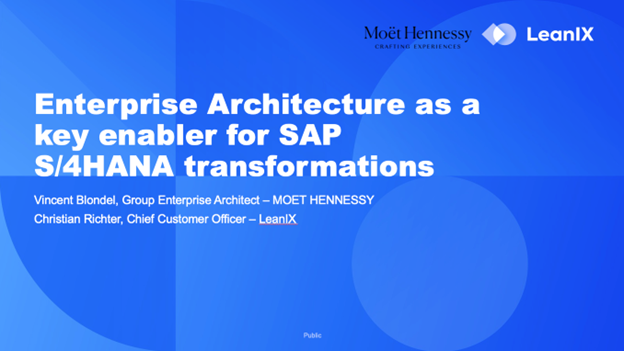
Case Study: How Moet Hennessy Leverages Enterprise Architecture as a Key Enabler for its SAP S/4HANA TransformationMay 23, 2023 — To stay ahead of the competition in an ever-changing environment, a modernized IT foundation is key. Go inside Moet Hennessy’s SAP S/4HANA Transformation Journey as they show you how they built a high-performing, secure, available IT backbone that supports all its core operations and serves as a foundation for their modernization journey. Learn from Moet Hennessy and LeanIX how Enterprise Architecture served as the linchpin to help secure the migration to SAP S/4HANA and was the key enabler for a successful large-scale rollout.
1 minute read
Share Data Access with SAP Crystal Reports for Enterprise 4.0 on Top of SAP NetWeaver BWApr 4, 2011 — Learn about some of the new capabilities of SAP Crystal Reports for Enterprise 4.0 and how you can connect the tool to your SAP NetWeaver BW data. Key Concept SAP Crystal Reports for Enterprise 4.0 provides end users with capabilities for formatted reporting. SAP Crystal Reports for Enterprise 4.0 is a fully redesigned report designer […]
11 minute read