Explore critical topics shaping today’s SAP landscape—from digital transformation and cloud migration to cybersecurity and business intelligence. Each topic is curated to provide in-depth insights, best practices, and the latest trends that help SAP professionals lead with confidence.
Discover how SAP strategies and implementations vary across global markets. Our regional content brings localized insights, regulations, and case studies to help you navigate the unique demands of your geography.
Get industry-specific insights into how SAP is transforming sectors like manufacturing, retail, energy, and healthcare. From supply chain optimization to real-time analytics, discover what’s working in your vertical.
Explore critical topics shaping today’s SAP landscape—from digital transformation and cloud migration to cybersecurity and business intelligence. Each topic is curated to provide in-depth insights, best practices, and the latest trends that help SAP professionals lead with confidence.
Discover how SAP strategies and implementations vary across global markets. Our regional content brings localized insights, regulations, and case studies to help you navigate the unique demands of your geography.
Get industry-specific insights into how SAP is transforming sectors like manufacturing, retail, energy, and healthcare. From supply chain optimization to real-time analytics, discover what’s working in your vertical.
SAP Process Integration (PI) and Process Orchestration (PO) will reach their end of support in December 2027. Organizations with PI/PO should consider transition to a newer solution.
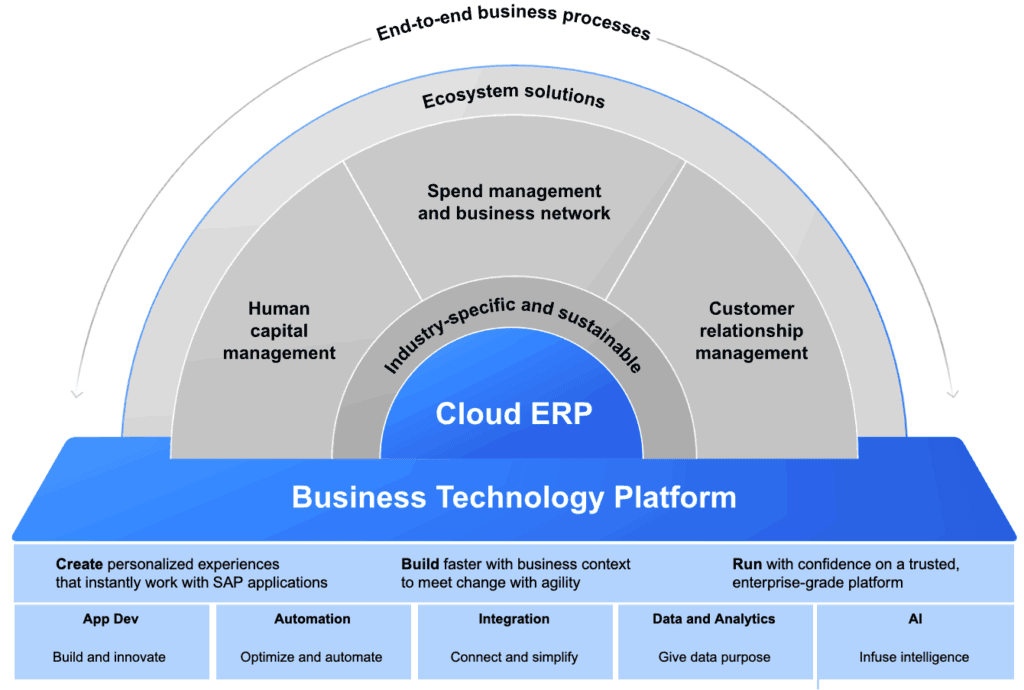
The SAP Integration Suite offers advanced capabilities such as cloud-native integration, API-led integration, and comprehensive connectivity options.
Preparing for the migration from PI/PO to SAP Integration Suite in BTP, requires system and landscape assessments and data preparation.
With SAP PI/PO support ending in December 2027, organizations must plan their next steps to preserve data and maintain business context. SAP Integration Suite emerges as the modern successor, offering advanced integration capabilities. Uncover what’s next and start preparing today.
In addition to the S/4HANA end of life coming in December 2027, one other key technological shift SAP customers are now facing is the planned phase-out of SAP Process Integration (PI) and SAP Process Orchestration (PO). With standard maintenance also ending in December 2027, organizations relying on PI/PO must begin charting their course forward.
SAP PI/PO
SAP PI/PO are middleware platforms used to integrate different SAP and non-SAP systems within an organization. Their core functionality is to enable seamless communication across disparate software applications via message processing, routing, and transformation.
SAP Integration Suite Auritas LLC" src="https://www.auritas.com/wp-content/uploads/2025/06/Creation-process-rafiki.svg" alt="sap activate, s/4hana migration, sap migration, sap rise, sap pi/po" />
SAP PI: Initially launched as SAP XI (Exchange Infrastructure), PI is designed to handle application-to-application (A2A) and business-to-business (B2B) integrations.
SAP PO: Built on top of PI, PO adds capabilities like Business Process Management (BPM) and Business Rules Management (BRM), allowing organizations to model, orchestrate, and automate complex workflows and decisions.
These tools have long been the backbone of integration for on-premise SAP environments. However, the rise of cloud solutions and hybrid IT landscapes means that traditional integration methods are no longer sufficient.
SAP has laid out a clear roadmap for PI/PO support with the Standard Maintenance ending December 31, 2027. Users will have the option to extend the support to 2030 at a heavy cost increase. After these dates, PI/PO will no longer receive updates, bug fixes, or security patches, leaving systems vulnerable and unsupported. Organizations delaying their migration risk running mission-critical integrations on obsolete technology.
For many organizations, PI/PO is deeply embedded in daily operations. As these integrations are mission-critical, the loss of official support could jeopardize business continuity. Additionally, maintaining legacy systems becomes increasingly expensive and resource-intensive over time.
Built with SAP’s newest applications and capabilities in mind, the SAP Integration Suite offer capabilities that allow for customer to be prepared for an intelligent, connected future.
While Integration Suite succeeds PI/PO in function, its capabilities and flexibility are far more advanced. SAP Integration Suite is cloud-native and built for the modern enterprise, which means it offers the scalability that on-premise PI/PO environments simply cannot match.
Additionally, Integration Suite supports a wide range of integration styles beyond A2A and B2B. It enables API-led integration, event-driven architectures, and low-code/no-code workflows, allowing businesses to integrate at their own pace using the most effective methodology for their scenario.
SAP Integration Suite provides seamless connectivity through over 170 prebuilt connectors to popular SaaS platforms like Salesforce and Workday. This greatly enhances the capability to build hybrid integration landscapes that include both on-premise and cloud-based applications.
Another major advantage is the use of AI/ML-based mapping tools within the Integration Advisor, which simplifies and accelerates the creation of integration scenarios. And, with advanced dashboards and analytics, it gives IT teams better visibility into integration performance and operational health.
Preparing for the Transition
To ensure a successful migration, organizations should begin by thoroughly assessing their current landscape, documenting all existing integrations, dependencies, and usage patterns. Understanding the scope and complexity of the current environment provides a foundation for effective planning.
Next, prioritize integrations based on business criticality. Determine which processes are essential to day-to-day operations and should be migrated first. This staged approach helps minimize disruption and allows teams to gain experience with the new platform before migrating less critical processes.
Finally, invest in training and change management. Transitioning to a new integration platform may require upskilling for development and operations teams. Leverage experienced implementation partners can ease the learning curve and accelerate the migration timeline.
In essence, migrating to SAP Integration Suite is not just a necessity due to PI/PO end-of-life, but a step forward in digital transformation. It equips businesses with future-ready tools that align with cloud strategies, improve integration agility, reduce risks associated with legacy, unsupported systems, and lower total cost of ownership.