






Mar 16-19, 2026Las Vegas, Nevada, NV
SAP Data and Data Management
Featured Insiders
Upcoming Events
SAPinsider Las Vegas 2026
Related Vendors


What is SAP Data Management?
Data management is the systematic collection, organization, and retrieval of data to enhance productivity, efficiency, and informed decision-making. A robust data management strategy and a modern data management system are crucial for organizations regardless of their scale or industry.
What is SAP Data Management?
Data management is the systematic collection, organization, and retrieval of data to enhance productivity, efficiency, and informed decision-making. A robust data management strategy and a modern data management system are crucial for organizations regardless of their scale or industry.
The data management process comprises a comprehensive array of tasks and procedures, encompassing:
Data collection, processing, validation, and storage: Data is acquired, undergoes processing procedures, undergoes verification to ensure accuracy and reliability, and is then stored securely.
Integration of diverse data types: Data from various origins, both structured and unstructured, are consolidated and harmonized to provide a comprehensive and unified view.
Optimal data availability and recovery: Measures are implemented to maintain a high level of data accessibility, minimize downtime, and establish contingency plans to mitigate potential data loss due to unforeseen events.
Data governance: Protocols are established to regulate data usage and access by individuals and applications, ensuring compliance with relevant regulations, policies, and standards.
Data protection, security, and privacy: Stringent measures are employed to safeguard data integrity, prevent unauthorized access or breaches, and uphold data privacy principles.
Why is SAP Data Management Important for Enterprises?
Data plays a fundamental role in the operations and functioning of a business. Given the multitude of systems and technologies that underpin the interconnected global economies of today, businesses face the challenge of extracting meaningful insights from the vast amounts of data available to them. Therefore, data assumes a pivotal position in this context. Nevertheless, data in isolation holds no value; it is imperative for companies to adopt a comprehensive approach encompassing strategic planning, governance, and a robust data management framework. Such measures enable the effective utilization of diverse data types, empowering businesses to optimize their supply chains, engage with employee networks, enhance customer experiences, nurture partner ecosystems, and achieve various other objectives in a practical and efficient manner.
Big data is an asset: Big Data management is a valuable business asset. When equipped with the right tools, Big Data becomes a powerful resource, enabling companies to gain profound insights and make precise predictions. It facilitates a deeper understanding of customer preferences, enabling the delivery of exceptional experiences based on data-driven knowledge. Moreover, it drives the emergence of innovative business models reliant on real-time Internet of Things (IoT) and sensor data, unveiling opportunities that would otherwise remain hidden without the ability to analyze and interpret large-scale data.
Data is crucial for digital transformation: The significance of data and data-driven technologies has surged amidst the COVID-19 pandemic. Businesses are facing heightened demands to leverage their data effectively, enabling them to anticipate future developments, swiftly adapt, and incorporate resilience into their strategies and operational frameworks. The core element uniting all digital transformation initiatives is data. To embark on process optimization, embrace emerging technologies, and achieve organizational intelligence, businesses must establish a robust data infrastructure, which entails adopting a contemporary data management system.
Adherence to data privacy laws: Effective data management is crucial for both domestic and global data privacy regulations compliance, such as the General Data Protection Regulation (GDPR) and the California Consumer Privacy Act in the United States. Additionally, it is vital for meeting industry-specific privacy and security obligations. Establishing robust data management policies and procedures becomes indispensable when substantiating or undergoing audits to demonstrate adherence to these protective measures.
SAP Data Management Benefits
With SAP’s data management solutions, organizations can take command of their data. These solutions not only facilitate and streamline data migration and management during the transition to SAP S/4HANA but also provide the opportunity to acquire a unified and reliable perspective of data, along with dependable AI, analytics, and valuable insights. SAP data management solutions provide the following benefits:
- Seamless transition to SAP S/4HANA with data readiness.
- Enhanced data visibility, eliminate redundancy
- Valuable business insights generation from data
- Strategic decision-making by leveraging advanced analytics tools
- Optimized business processes with innovative redesign.
What is SAP Master Data Management?
Master data management (MDM) is the process of developing and maintaining a unified record or a single source of truth for individuals, locations, and entities within a business. This enables organizations to have a reliable, up-to-date perspective of critical data, which can be shared throughout the enterprise for improved reporting, decision-making, and streamlined operations. Some examples of master data include customer, supplier, location, product, and asset master data. Master Data Management (MDM) offers various benefits that are beyond decision-making and addressing key inquiries. Some of these advantages include:
Enhanced data accuracy: MDM resolves inconsistencies resulting from different teams entering the same information in varying formats, minimizing errors and duplications.
Improved analytics and data-driven decision-making: Accurate data is essential for generating reliable insights. MDM ensures that the data being analyzed is of high quality, leading to more informed decisions.
Streamlined business processes: Consistent and reliable master data facilitates the automation and acceleration of end-to-end business operations, such as lead to cash, source to pay, and design to operate.
Enhanced transparency and compliance with data privacy regulations: MDM aids in complying with data privacy regulations like GDPR by preventing fragmented data across different departments, ensuring transparency and compliance.
Simplified mergers and acquisitions: MDM enables a streamlined process for integrating and reconciling multiple data assets, facilitating efficient mergers and acquisitions.
What is SAP Master Data Governance?
The SAP Master Data Governance application enables centralized management of master data by leveraging a master data management layer built on the SAP Business Technology Platform. SAP Master Data Governance application enables efficient management of master data within the enterprise system landscape and offers domain-specific governance capabilities for master data that can be locally managed, consolidated or centrally created, modified, and distributed. Through seamless integration with other SAP solutions, it promotes the reuse of data models, business logic, and validation frameworks. Additionally, the application facilitates seamless integration with third-party products and services in your diverse technology stack. It also provides a cloud edition suitable for hybrid and cloud systems. SAP Master Data Governance allows:
- Consistent enterprise-wide data by consolidating and managing master data across the business, regardless of the platform (SAP or third-party solutions).
- Enhances the speed and accuracy of business processes and analytics through automated maintenance and distribution of master data, tighter data integration, and improved data quality and consistency.
- Simplifies compliance and reduces risk by implementing a governed master data process with auditable data, tracking data changes, and providing audit trails to comply with regulations such as International Financial Reporting Standards and Generally Accepted Accounting Principles.
- Lowers the overall cost of data ownership by supporting master data domains within a single application and enabling implementation in on-premise, cloud, or hybrid environments.
Join SAPinsider Today
Join SAPinsider to access opportunities for networking and engagement in the dynamic SAP ecosystem. As a member, you will have access to a wealth of valuable resources and content tailored to SAP technologies and best practices like the latest research reports, articles, webinars, and events that will keep you informed and ahead of the curve.SAPinsider membership grants you exclusive access to in-depth analyses, expert insights, and practical guidance that will empower you to navigate the ever-evolving SAP landscape with ease. SAPinsider membership will enable you to remain one step ahead and harness the latest trends, innovations, and strategies to drive your own powerful digital transformations, optimize your SAP investments, and unlock business success.
Join SAPinsider to access opportunities for networking and engagement in the dynamic SAP ecosystem. As a member, you will have access to a wealth of valuable resources and content tailored to SAP technologies and best practices like the latest research reports, articles, webinars, and events that will keep you informed and ahead of the curve.SAPinsider membership grants you exclusive access to in-depth analyses, expert insights, and practical guidance that will empower you to navigate the ever-evolving SAP landscape with ease. SAPinsider membership will enable you to remain one step ahead and harness the latest trends, innovations, and strategies to drive your own powerful digital transformations, optimize your SAP investments, and unlock business success.
284 results

Top SAP Industry Events in the Nordics in Autumn 2023Jun 21, 2024 — As the SAP industry continues to evolve, attending industry events is a crucial way for the Adsotech team to stay updated on the latest trends, innovations, and best practices. These events offer a platform for networking with industry experts, gaining insights into emerging technologies, and expanding our knowledge base.
2 minute read

Impact20: Reduce Refresh Time, Storage, and Data Security Concerns in Your SAP Test SystemsMar 30, 2023 — For most companies, their SAP system is integral to their business, and any significant outage of a particular business process, or worse – the entire SAP production system – has a potential multi-million dollar impact. This is why effective testing in non-production environments is so important. Testing is only as effective as the quality of data the test executes on, and what better to test with than production data in a non-production environment?
Maintaining several full copies of production data in non-production environments is costly, and forces the business to focus its resources in a way that detracts from non-production environments. This creates a massive challenge around enabling functional analysts, testers, trainers, and consultants to access the data they need to support the production system.
During this session, you will learn how leading enterprise SAP companies are using EPI-USE Labs’ Data Sync Manager (DSM)™ to improve test data quality, reducing time, resources, and costs for major projects.
Data Sync Manager is certified by SAP for 'Integration with SAP S/4HANA®' and 'Integration with SAP S/4HANA Cloud®'. DSM5 also 'works with RISE with SAP’.
View this session deck to learn how DSM can help with the following:
Copying data on demand
Reducing data volume
Maintaining audit compliance for sensitive data in non-production systems
Speeding up testing processes by up to 90%
Reducing manual workload and reducing errors for compliance
Producing faster refreshes of non-production systems
Increasing scrambling coverage by up to 80% and masking sensitive data
1 minute read

SAP Analytics in a Cloud Native WorldMar 28, 2023 — Click Here to View the Session Deck Deploying SAP data solutions in a modern cloud environment provides a fast, scalable and repeatable process for implementing full SAP stacks with unparalleled capabilities. However, this topic can be confusing with many new terms that are foreign to a traditional SAP team. We will discuss some common terms […]
1 minute read

Integration of SAP ERP System with External Invoicing System Via SAP XIJul 20, 2023 — In this article, SAPinsider expert Dmitry Belan offers an inside look at how the Ascendo invoice accounts system works within the SAP landscape. It shows how users integrated the system to move data through to all necessary parts of the SAP ERP as well as SAP XI.
This article describes an example of a solution for integrating the SAP ERP system with an external invoice generation system. The article is presented from the point of view of SAP ERP implementation team in terms of logistics and will be useful for them. The solution architecture, composition and main function of the functional modules are described.
8 minute read
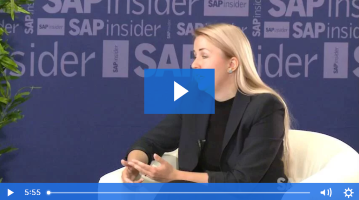
Live from SAPinsider Studio: Ella Brand on SAP Data HubMay 1, 2018 — Ella Brand of SAP, Product Marketing Lead for SAP Data Hub, joins SAPinsider Studio at the 2018 BI-HANA event to discuss SAP Data Hub, including the three pillars: data operations, data orchestration, and data governance. Brand shares use cases discusses the value of the data landscape management solution.
1 minute read

Centralized Processes for TelecommunicationsNov 7, 2024 — When a telecommunications giant, RTS implemented SAP BRIM after replacing legacy systems and Excel tools. This facilitated the B2C expansion through centralized processes despite budget limitations and tight timelines. RTS configured solutions like Java wizards and achieved one-click data migration. Organizational change management and advisory services further enabled user adoption and executive buy-in.
1 minute read



Real-Time SAP Data Is the Missing Link in Enterprise AI and Analytics InitiativesJan 29 — As organizations increasingly invest in AI and advanced analytics, the effectiveness of these initiatives hinges on timely access to reliable SAP data, which can be optimized through continuous data pipelines and Change Data Capture methods, ultimately enabling real-time insights and informed decision-making.
3 minute read