articles
Beyond the Perimeter: How Attackers Pivot Across SAP Cloud Migrations (and How to Stop Them)

The Expanded Attack Surface of Hybrid SAP Landscapes
SAP cloud migrations expand an organization’s attack surface by moving from isolated on-premises systems to more complex, interconnected hybrid environments. While migrating to RISE with SAP, SAP Business Technology Platform (BTP), and SaaS solutions drives business agility, it could also introduce potential lateral movement vectors that can bypass traditional perimeter defenses. Threat actors do not need to break through corporate firewalls when they can exploit misconfigured trust relationships, exposed trace logs, and shared cloud credentials to move freely between on-premises and cloud instances.
To demonstrate these cross-perimeter attacks, CTO JP Perez-Etchegoyen, Lead Offensive Security Researcher Pablo Artuso, and Senior Sales Engineer Hector Espinosa recently presented Beyond the Perimeter: Managing the Expanded Attack Surface of SAP Cloud Migrations, the fourth episode of our Hacking & Defending SAP Applications docuseries.
Key Takeaways
- Firewalls No Longer Protect SAP Data: While relying solely on firewalls left critical blind spots in the past, the risk has escalated significantly today. Hybrid architecture creates connective bridges (such as SAP Cloud Connector and RFC destinations) that threat actors traverse once an initial foothold is established.
- Insecure configurations can expose sensitive data: Enabling verbose diagnostic tracing (such as Cloud Connector Tunnel Traffic Trace) can write Base64-encoded administrative credentials directly to readable log files.
- Trust Relationships Can Be Weaponized: Compromising an on-premises S/4HANA or ERP system allows attackers to abuse established SM59 destinations and communication arrangements to provision backdoor accounts in SAP BTP.
- Subaccounts Are Not Hard Security Boundaries: Web application flaws (e.g., Command Injection in BTP apps) expose environment variables (VCAP_SERVICES), enabling attackers to harvest plaintext service credentials and pivot across subaccounts to internal databases.
The Hybrid SAP Reality: Why Traditional Perimeter Controls Fail
Traditional perimeter security fails in modern SAP environments because hybrid cloud connectivity turns external endpoints into internal gateways.
In legacy architectures, enterprise resource planning (ERP) systems resided behind corporate firewalls. Security teams relied on network segmentation to keep core business logic safe. Today, an enterprise SAP ecosystem spans multiple operational layers:
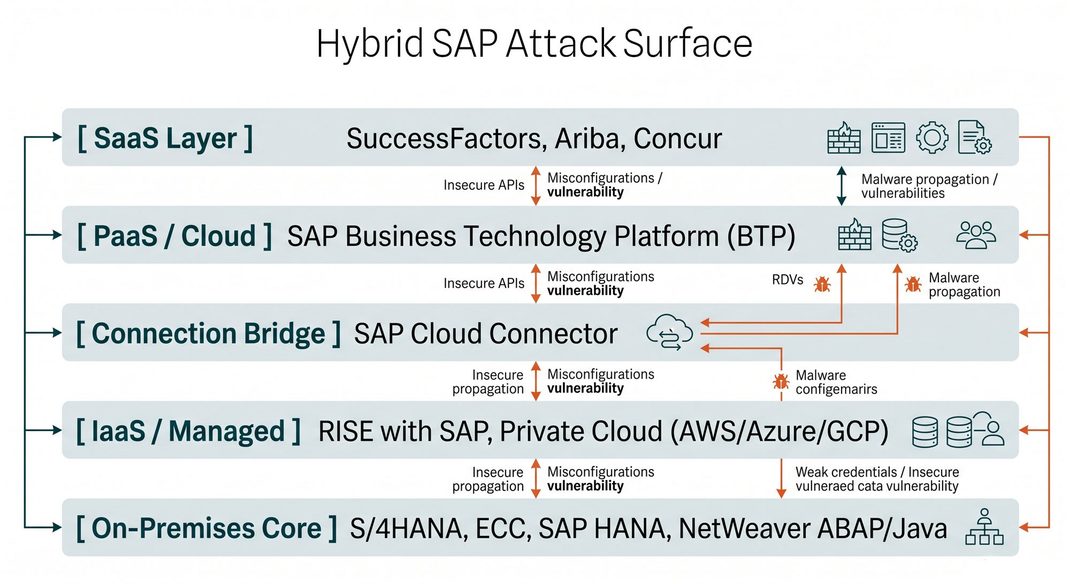
When organizations execute S/4HANA transformations or transition to RISE with SAP, they create tight integration flows between these layers. Threat actors target the integration protocols, authentication tokens, and diagnostic configurations connecting these environments rather than attacking hardened application cores directly.
Research from Onapsis Research Labs shows threat actors weaponize newly disclosed vulnerabilities in as little as 72 hours. To defend these hybrid environments, security teams must understand how attackers execute lateral movement across cloud and on-premises topologies.
Vendors mentioned
Fill in the form on this page to read the full article.