Enterprise ERP maintenance is a $100+ billion global industry, plagued by high costs, persistent inefficiencies, and frequent project failures- over 70% of SAP implementations fail to meet objectives. Manual interventions, ticket backlogs, and unmet service levels are widespread.
Dodge AI is a suite of autonomous AI agents specialized for ERP maintenance and operations, targeting legacy and S/4HANA SAP systems. It provides real-time process mapping, incident analysis, and ticket resolution, handling tasks that traditionally required large, costly consulting teams. The platform embeds directly within client ERP ecosystems, combining reasoning, browser automation, and system configuration tools.
The system’s architecture benefits from recent advances in agentic AI, graph-based reasoning, and process-first automation.
<div id=”wp-form-embed”> </div>
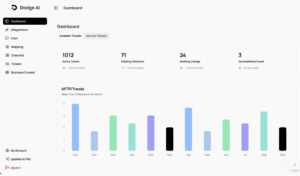
Seeing the system at a glance
The first thing you notice in Dodge AI is the dashboard.
Instead of digging through reports or ticket queues, you get a clear snapshot of your ERP operations. Active incidents. Tickets waiting on validation or change. Trends in MTTR over time.
This matters because trends tell a story that individual tickets never will. A rising MTTR or a growing validation queue usually points to deeper process or
configuration issues. The dashboard makes those patterns visible early, before they turn into fire drills.
Incident tickets: reducing noise and restoring flow
Instead of treating each incident as a standalone problem, the platform places it within the system context. An incident is tied back to the process it affects, the configurations involved, and similar past failures. Patterns emerge naturally.
This helps teams move faster, not because they rush, but because they don’t have to start from zero each time. Repeated issues become recognizable. Resolution paths become clearer. Over time, incident handling becomes steadier and more predictable rather than reactive.
Service tickets: handling change without friction
Dodge AI helps teams handle service tickets while accounting for downstream impact. Requests are evaluated in the context of existing processes and configurations rather than in isolation. Teams can see where a change fits, what it touches, and whether similar changes caused issues in the past.
This leads to fewer unintended consequences and a calmer change cadence. Service work becomes part of system evolution, not a source of future incidents.
Documentation: From scattered knowledge to a shared system view
Dodge AI approaches documentation differently. Instead of relying on manual write-ups, it builds understanding of how the system actually behaves. Processes, configurations, and dependencies are mapped as they exist today.
This creates living documentation that reflects reality. New team members ramp up faster. Decisions are made with confidence. The system becomes understandable again, even as it grows more complex.
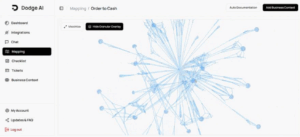
Root Cause Analysis through graph-based reasoning
A failed delivery, a blocked invoice, or a broken workflow often traces back through multiple steps, configurations, and decisions made long ago. Traditional RCA struggles here because it looks at problems linearly.
Dodge AI uses graph-based reasoning to connect the dots.
By mapping the ERP system as a network of processes, dependencies, and behaviors, the platform helps teams see where bottlenecks form and why issues repeat. Root cause analysis becomes faster and more reliable because it is grounded in relationships rather than assumptions.
This is where mapping, documentation, and RCA come together. The same system view that explains how processes run also explains where they fail.
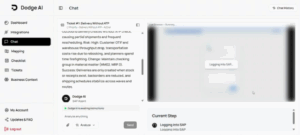
Executing tickets with context, not guesswork
In Dodge AI, tickets can move from understanding to execution in the same flow. The agent first gathers context from the system, the process, and similar past issues. Only once that picture is clear does it step into execution.
You can see what the agent is doing as it works through the steps, and you can chat with it along the way. Ask why a particular action is being taken, add clarifications, or adjust the approach if needed.
This turns ticket resolution into a guided workflow rather than a manual hunt across screens and transactions. Routine fixes become faster, and complex issues become easier to reason about because the context is always in view.
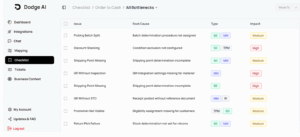
Bottlenecks become visible as hotspots in the system. Teams can see where work slows down, where validations pile up, and where failures tend to originate. Instead of debating opinions, the conversation shifts to evidence grounded in system behavior.
s
This is where improvement becomes possible. Fixing the root cause once often removes dozens of future tickets. Over time, the system becomes calmer, more predictable, and easier to operate.
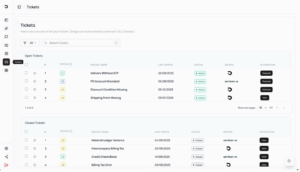
From ticket handling to meaningful progress
On the Tickets page, Dodge AI helps you analyze what is open, what is pending, and what has already been resolved. More importantly, it enables you to act.
For many common issues, the platform can guide or execute resolution steps directly. Work that used to take hours of investigation can often be handled far more efficiently.
The impact is simple. Less time spent chasing repetitive issues. More time available to improve processes, prevent future incidents, and support the business where it actually matters.
Rethinking how ERP systems are supported
Dodge AI is not about adding another AI tool to your stack.
Manual interventions, ticket backlogs, and unmet service levels are widespread. Dodge AI disrupts this by vertically integrating AI-powered process understanding, thus reducing reliance on expensive consultants and slashing incident backlogs while dramatically improving system reliability and user satisfaction.