
Integration strategy is ahead of architecture and many organizations are still relying on point-to-point connections or legacy middleware.
Real-time visibility leads modernization priorities, while AI and cloud growth create parallel pressure.
Modernization is delivering measurable benefits, but scaling those benefits requires investment in people and operating capabilities, not just new technology.
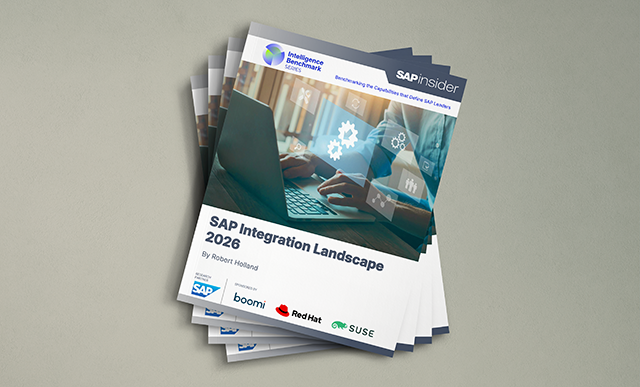
Enterprise integration has become a strategic platform capability for SAP organizations, but architecture hasn’t kept pace with strategy. SAPinsider’s latest benchmark research shows that half of organizations now have an enterprise-wide or platform-driven, AI-enabled integration strategy. Yet 43% still rely mainly on point-to-point connections or legacy middleware, and only 13% run an intelligent, adaptive architecture. Meanwhile, 72% say real-time operational visibility is driving modernization, but only 29% have achieved broadly or fully real-time integration.
Join SAPinsider’s Robert Holland as he walks through the key findings of the SAP Integration Landscape 2026 report and what they mean for your SAP integration modernization plans. He will look at how real-time demands, cloud growth, and AI are reshaping integration priorities. He will also cover why cost, skills gaps, and technical debt continue to slow progress, and where organizations are directing new investment, from event-driven connectivity to SAP Integration Suite and observability.
Register now to learn:
- Understand the integration strategies and architectures organizations are using today, and where the strategy-to-execution gap sits.
- Explore how organizations are moving to real-time and AI-ready integration, and why fit-for-purpose beats real-time everywhere.
- Learn about the two integration challenges AI is creating, and why governed, context-rich data comes first.
- See how SAPinsiders are building the skills, governance, and operating model needed to execute.
- Discover where integration investment is heading, including the 53% planning to adopt event-driven integration in the next one to two years.