articles
How tax leaders automate compliance in SAP S/4HANA

Senior tax and finance leaders share how clean data, complexity management, and early tax integration drive ERP transformation success.
Highlights
- Tax automation is crucial for successful SAP S/4HANA transitions, preventing errors and inefficiencies.
- Early integration of tax automation, strong data governance, and native SAP integration are key success factors.
- Thomson Reuters offers certified SAP-integrated tax solutions to automate compliance and provide real-time insights.
Corporate tax teams face increasing pressure to modernize their systems while maintaining compliance. As organizations transition to SAP S/4HANA, tax automation becomes a critical component of a successful ERP transformation. Without it, companies risk errors, inefficiencies, and audit exposure. To explore this challenge, Thomson Reuters hosted a roundtable with senior tax and finance leaders from multinational and Fortune 500 companies. The discussion revealed critical success factors for tax teams during ERP transformation, including clean data migration, managing system complexity, and embedding tax early in the process. We’ll explore key takeaways and actionable insights to help tax leaders automate compliance, strengthen data governance, and maximize ROI.
Why tax automation is essential during ERP transformation
Migrating to SAP S/4HANA is a complex process that touches every part of the business. Tax determination is often overlooked until late in the project. This leads to costly delays and manual workarounds. Automating tax compliance from the start ensures that tax is embedded into core business processes and avoids last-minute disruptions. 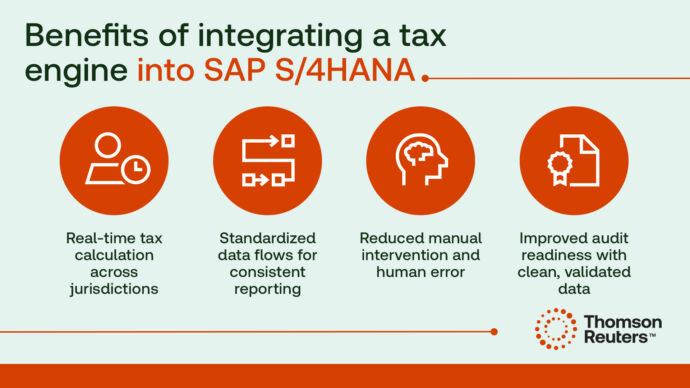 Many organizations underestimate the complexity of indirect tax until they are well into the migration process. One roundtable participant described the challenge of managing tax across 40 separate billing systems, each with its own logic and exemption rules, as a spiderweb of systems. This reinforces the importance of embedding automation early to avoid manual workarounds and reduce risk. Tax automation is not just a technical upgrade. It is a foundational element that supports ERP success and long-term scalability. Indirect tax automation is more than a compliance upgrade. It is a strategic enabler for transformation. New mandates like e-invoicing and digital filing add urgency, yet many organizations struggle with prolonged implementations and rising costs. A well-executed automation strategy offers stability, scalability, and reduced total cost of ownership. It streamlines vendor relationships, supports global compliance, and builds a foundation for future growth.
Fill in the form on this page to read the full article.