TL;DR — An AI chart of accounts is a learned mapping layer that sits beside your SAP GL and predicts, classifies and reconciles postings against your actual account structure — rather than relying on hard-coded rules that break every time the business changes. In practice it automates three of the slowest close tasks:transaction classification, reconciliation matching, and variance explanation. Published benchmarks put AI close automation at a 40–50% cycle-time reduction and up to 90% fewer reconciliation errors, against a baseline where only about 53% of businesses close in six days or less. Adoption is moving fast — agentic AI use in finance teams is projected at 44% in 2026, up from under 7% in early 2025. The architectural point that matters: this should be built as a side-by-side SAP BTP extension against a clean core, not as a modification. Modifications are exactly what block SAP’s own AI roadmap.
The close is slow for a boring reason
Ask a controller why the close takes eight days and you will not hear “we lack AI.” You will hear that someone is chasing an unmatched intercompany balance, someone else is reclassifying postings that landed in the wrong account because a rule was written in 2019, and a third person is writing variance commentary by reading last month’s commentary.
That is the real shape of the problem. McKinsey Global Institute has estimated that 42% of finance activities are fully automatable with technology that already exists — and the close is where the densest concentration of those activities sits. Yet only about 53% of businesses complete their monthly close in six days or less.
The gap between what is automatable and what is automated is not a technology gap. It is an architecture and data-structure gap.
Fig 1 — The Close Automation Gap
40–50%
cycle-time reduction
reported for AI close automation
up to 90%
fewer recon errors
on rule-bound matching
42%
of finance activities
automatable with existing tech
44%
of teams on agentic AI
in 2026, from under 7% in 2025
Yet the baseline has barely moved:
53% close in 6 days or less
47% take longer
The gap between what is automatable and what is automated is architectural, not technological.
What an “AI chart of accounts” actually is
Traditional close automation is rules-based: if vendor = X and cost centre = Y then post to account Z. It works until the business changes, and the business always changes. Every acquisition, new entity, restructured cost centre or new product line adds rules — and every rule added is a rule someone must maintain.
An AI chart of accounts inverts that. Instead of encoding the mapping, it learns it from your posting history, then applies it with a confidence score:
Fig 2 — How an AI Chart of Accounts Works
Posting History →
01 Classify
Propose the GL account, cost object and tax code — each with a confidence score
>
02 Match
Reconcile bank, intercompany and subledger on learned patterns, not exact strings
>
03 Explain
Draft the variance commentary by tracing it back to the transactions that caused it
Output: a short exception list — on day one, not day five.
The model learns the mapping from posting history instead of encoding it as rules that break when the business changes.
- Classification — incoming transactions are proposed against the correct GL account, cost object and tax code, with a confidence score. High-confidence items post straight through; low-confidence items route to a human with the model’s reasoning attached.
- Reconciliation matching — bank, intercompany and subledger items are matched on learned patterns rather than exact-string rules, which is where most manual matching effort actually goes.
- Variance explanation — the model drafts the first version of the commentary by tracing a variance back to the transactions that caused it, so the controller edits rather than investigates.
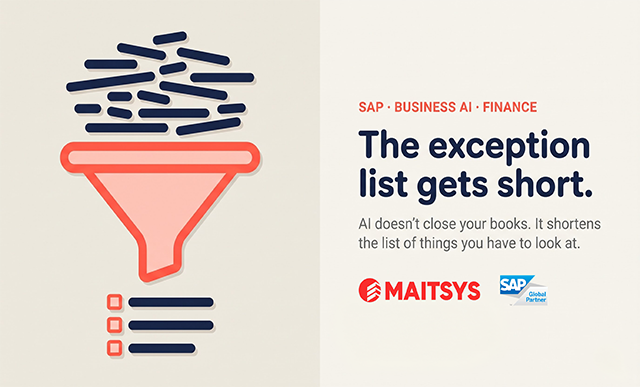
The output is not “AI closes the books.” The output is the exception list gets short, and it arrives on day one instead of day five.
What to expect in the first 90 days
Three things worth stating plainly, because they are the parts that get left out of the sales conversation:
- The first close is slower, not faster. The team reviews every auto-match by hand for the first cycle — that is how trust gets built and how the confidence threshold gets calibrated against a real false-positive rate rather than a guess. Budget a full extra cycle for it.
- The confidence threshold will move. A sensible starting point is deliberately high, and it settles lower once the team can see the actual error distribution. Starting it low to show early throughput is the fastest way to lose finance’s confidence permanently.
- Most of your exceptions will turn out to be data problems, not model problems — duplicate vendor records, inconsistent cost-centre usage, intercompany conventions that drifted between entities. The AI does not fix those. It makes them visible and countable for the first time, which is arguably the more valuable output and is almost never the one that gets sold.
Scope the first deployment to one reconciliation, and do not expect the published full-close benchmarks from it. Those describe end-to-end automation programmes; a single-process pilot delivers a fraction of that figure, and anyone quoting you the benchmark for a pilot is selling you the average of other people’s programmes.
The control question, answered up front
Any finance leader’s first reaction is the right one: how is this auditable?
Three design rules make it work:
- Nothing posts without a recorded rationale. Every automated posting carries the model’s confidence score and the features that drove it. That is a stronger audit trail than most manual reclassifications, which carry only a username.
- Confidence thresholds are a control, and they are owned by finance, not by IT. The threshold at which an item auto-posts is a policy decision, documented and approved like any other control.
- Segregation of duties is preserved. The model proposes; a human approves anything above the materiality line. The agent is a preparer, never an approver.
Fig 3 — The Control Model
proposal + confidence
score + drivers
No → auto-posts, rationale recorded
Yes → human approves. SoD preserved.
The threshold is a control owned by finance — documented and approved like any other.
The agent is a preparer, never an approver. That single rule is what makes the design auditable.
Framed that way, this passes an internal-audit conversation — because it is a control design conversation, not a technology one.
Why this only works on a clean core
Here is the part that connects back to the 2027 deadline.
SAP’s extensibility model now runs an A–D maturity framework pushing custom logic out of the core and into ABAP Cloud (in-app, tightly coupled) or side-by-side SAP BTP extensions. Clean core is not housekeeping — it is the admission requirement for SAP’s AI-powered stack. Every AI capability SAP is shipping, Joule and the autonomous agents included, is designed to run against a clean, standardized core.
So an AI chart of accounts built as a core modification is self-defeating: you would be adding the exact kind of customization that Blocks the platform capability you are buying it to reach. Build it side-by-side on BTP, read from standard objects, write back through released APIs. Then it survives your S/4HANA upgrade — and every one after it.
Fig 4 — Build it Beside the Core, Not Inside It
Modification ×
+ your custom logic welded in
Breaks on upgrade.
Blocks Joule and SAP AI agents.
Side-by-side on SAP BTP ✓
The clean core is the automation project.
A core modification adds exactly the customization that blocks the platform capability you are buying it to reach.
This is also why the sequencing question answers itself. Teams ask whether to migrate first or automate first. The clean core is the automation project. Do the migration with clean-core discipline and the AI layer becomes a deployment. Do it without, and you will pay twice.
Before you start, record four numbers. Without them you have a vendor claim instead of a business case:
| Days to close |
The headline. Benchmarks show 40–50% reduction is achievable. |
| Manual journal entries per close |
The best proxy for how much of the close is exception handling. |
| Reconciliation exception rate |
Where error reduction of up to 90% has been reported. |
| Hours of controller time in close week |
The number your CFO actually cares about. |
1. What is an AI chart of accounts?
An AI chart of accounts is a machine-learning layer that sits alongside the SAP general ledger and predicts the correct account, cost object and tax treatment for incoming transactions based on posting history, rather than on hard-coded rules. It returns a confidence score with each prediction so that high-confidence items post automatically and low-confidence items route to a human.
2. How much time does AI save on the month-end close?
Published benchmarks report AI close automation reducing cycle time by 40–50% and reconciliation errors by up to 90%. Some reported deployments cut the monthly close by around 7.5 days. Results depend heavily on the starting baseline — only about 53% of businesses currently close in six days or less.
3. Can AI agents actually close the books without a human?
No, and they should not. In a controlled design the AI acts as a preparer: it proposes classifications, matches and commentary, and a human approves anything above the materiality threshold. Segregation of duties is preserved by design.
4. Is AI-automated posting auditable?
Yes, if designed for it. Every automated posting should carry its confidence score and the drivers behind the prediction. That produces a richer audit trail than a manual reclassification, which typically records only a user ID and a timestamp.
5. Do I need to migrate to S/4HANA before using AI in finance?
Not strictly, but you need a clean core. SAP’s AI capabilities — including Joule and autonomous agents — are designed for a standardized core, so heavy modifications block them. Most organizations get better economics by treating clean core as part of the migration rather than as a separate later project.
6. Should this be built inside SAP or on SAP BTP?
Side-by-side on SAP BTP, reading from standard objects and writing back through released APIs. Building it as a core modification adds exactly the kind of customization that blocks SAP’s AI roadmap and breaks on upgrade.
7. How fast is AI adoption in finance teams?
Agentic AI use among finance teams is projected at 44% in 2026, up from under 7% in early 2025 — more than a sixfold increase in roughly a year.