articles
SAP MDG Approval processes in Teams
Learn More Here!

Accelerating SAP MDG Processes with Microsoft Teams
Master data governance is only effective when the right people participate at the right time.
SAP Master Data Governance provides the structure needed to manage critical master data in a controlled way. It manages change requests, validations, workflow steps, approvals, activation and distribution. Whether the process relates to a supplier, customer, material, cost centre, GL account or business partner, SAP MDG helps organisations protect the quality and consistency of the data on which their business depends.
But governance still depends on people.
A change request may need input from a data steward, finance approver, procurement lead, risk owner or business manager. Many of these people are not full-time MDG users. They do not spend their working day monitoring MDG worklists. They are busy in meetings, emails, Microsoft Teams conversations and other business systems.
That is where delays often begin.
The process may be perfectly controlled inside SAP MDG, but if the next participant misses an email, postpones logging into SAP, or needs to be chased manually, the change request stalls. The issue is not the governance model itself. The issue is how easily people can participate in that governance process.
This is where Looply can add value.
Where Looply fits
Looply does not replace SAP MDG. SAP MDG remains the system of governance and the controlled backend of record.
Looply adds an engagement layer by taking an actionable MDG workflow step and presenting it in Microsoft Teams as an Adaptive Card. That card can show the key master data context, highlight what has changed, provide a link back to SAP MDG where detailed review is needed, and allow the user to approve, reject, request clarification or add comments directly from Teams.
The core idea is simple:
SAP MDG controls the governance process. Looply brings the moment of action into Microsoft Teams.
This means organisations can keep the strength of SAP MDG while making the process easier for business users to engage with. MDG continues to control the change request, workflow state, validation, activation and replication. Looply helps the right person see the right task, with the right context, in the place where they are already working. 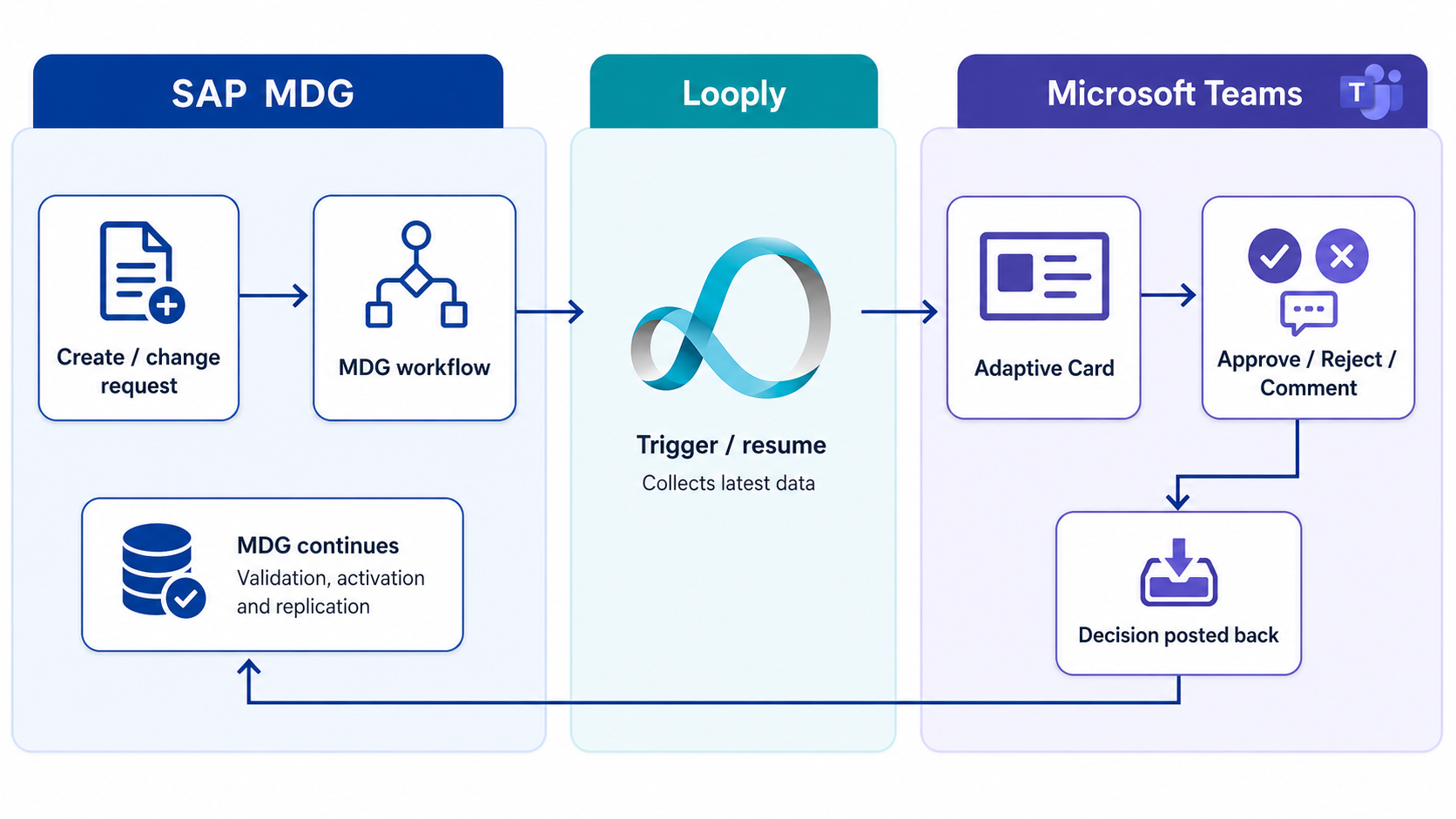
Why this matters for master data governance
Master data governance is not only a data management discipline. It is a cross-functional business process.
A supplier onboarding process may involve procurement, finance, compliance and tax. A material creation process may need input from purchasing, production, quality, logistics and finance. A cost centre or profit centre change may require approval from controlling or finance. A business partner change may need commercial, credit or risk review.
In each case, the process depends on timely participation from people who may not think of themselves as MDG users.
This is one of the practical challenges of enterprise governance. The more robust the process becomes, the more likely it is to involve people from across the business. Those people need enough context to make a good decision, but they should not need to become expert MDG users just to approve a familiar business change.
Vendors mentioned
Fill in the form on this page to read the full article.